answer.
Ask question
Login Signup
Ask question
All categories
  • English
  • Mathematics
  • Social Studies
  • Business
  • History
  • Health
  • Geography
  • Biology
  • Physics
  • Chemistry
  • Computers and Technology
  • Arts
  • World Languages
  • Spanish
  • French
  • German
  • Advanced Placement (AP)
  • SAT
  • Medicine
  • Law
  • Engineering
lisov135 [29]
2 years ago
3

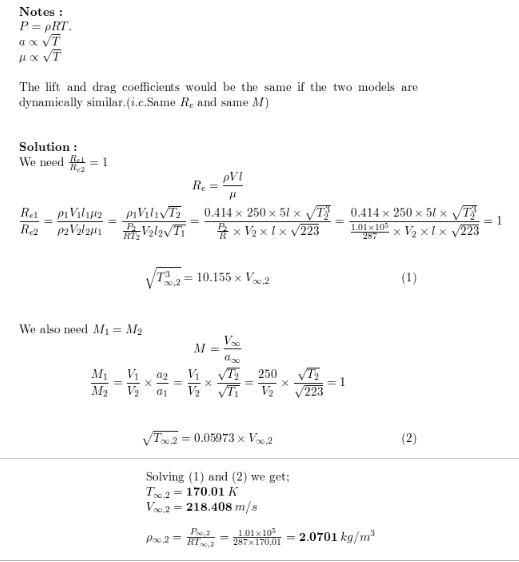
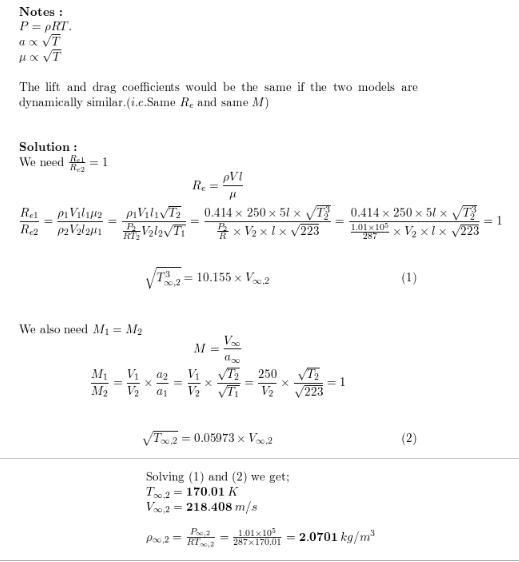
Consider a Lear jet flying at a velocity of 250 m/s at an altitude of 10 km, where the density and temperature are 0.414kg/m3 an

d 223 K, respectively. Consider also a one-fifth scale model of the Lear jet being tested in a wind tunnel in the laboratory. The pressure in the test section of the wind tunnel is 1atm=1.01imes105N/m2. Calculate the necessary velocity, temperature, and density of the airflow in the wind-tunnel test section such that the lift and drag coefficients are the same for the wind-tunnel model and the actual airplane in flight.

Physics
1 answer:
mezya [45]2 years ago
3 0

Answer:

Temperature = 170.01 K

Velocity = 218.408 m/s

Density = 2.0701 kg / m³

Explanation:

You might be interested in
The drawing shows an adiabatically isolated cylinder that is divided initially into two identical parts by an adiabatic partitio
Sveta_85 [38]

Answer:

temperature on left side is 1.48 times the temperature on right

Explanation:

GIVEN DATA:

\gamma = 5/3

T1 = 525 K

T2 = 275 K

We know that

P_1 = \frac{nRT_1}{v}

P_2 = \frac{nrT_2}{v}

n and v remain same at both side. so we have

\frac{P_1}{P_2} = \frac{T_1}{T_2} = \frac{525}{275} = \frac{21}{11}

P_1 = \frac{21}{11} P_2 ..............1

let final pressure is P and temp  T_1 {f} and T_2 {f}

P_1^{1-\gamma} T_1^{\gamma} = P^{1 - \gamma}T_1 {f}^{\gamma}

P_1^{-2/3} T_1^{5/3} = P^{-2/3} T_1 {f}^{5/3} ..................2

similarly

P_2^{-2/3} T_2^{5/3} = P^{-2/3} T_2 {f}^{5/3} .............3

divide 2 equation by 3rd equation

\frac{21}{11}^{-2/3} \frac{21}{11}^{5/3} = [\frac{T_1 {f}}{T_2 {f}}]^{5/3}

T_1 {f} = 1.48 T_2 {f}

thus, temperature on left side is 1.48 times the temperature on right

6 0
2 years ago
Ebo throws a ball into the air its velocity at the start is 18m/s at an angle of 37° to the ground. What is the range of the bal
NeTakaya
PLS help ASAP I DONT have time to answer this, it also detects if it’s right or wrong.
6 0
2 years ago
In the figures, the masses are hung from an elevator ceiling. Assume the velocity of the elevator is constant. Find the tensions
Keith_Richards [23]

The elevator may be moving, but if it is moving at a constant velocity, then the observer viewing the mass-rope system is in an inertial reference frame (non-accelerating) and Newton's laws of motion will apply in this reference frame.

A) Choose the point where the ropes intersect (the black dot above m₁) and set up equations of static equilibrium where the forces are acting on that point:

We'll assume that, because rope 3 is oriented vertically, T₃ also acts vertically.

Sum up the vertical components of the forces acting on the point. We will assign upward acting components as positive and downward acting components as negative.

∑Fy = 0

Eq 1: T₁sin(θ₁) + T₂sin(θ₂) - T₃ = 0

Sum up the horizontal components of the forces acting on the point. We will assign rightward acting components as positive and leftward acting components as negative.

∑Fx = 0

Eq 2: T₂cos(θ₂) - T₁cos(θ₁) = 0

T₃ is caused by the force of gravity acting on m₁ which is very easy to calculate:

T₃ = m₁g

m₁ = 3.00kg

g is the acceleration due to earth's gravity, 9.81m/s²

T₃ = 3.00×9.81

T₃ = 29.4N

Plug in known values into Eq. 1 and Eq. 2:

Eq. 1: T₁sin(38.0) + T₂sin(52.0) - 29.4 = 0

Eq. 2: T₂cos(52.0) - T₁cos(38.0) = 0

We can solve for T₁ and T₂ by use of substitution. First let us rearrange and simplify Eq. 2 like so:

T₂cos(52.0) = T₁cos(38.0)

T₂ = T₁cos(38.0)/cos(52.0)

T₂ = 1.28T₁

Now that we have T₂ isolated, we can substitute T₂ in Eq. 1 with 1.28T₁:

T₁sin(38.0) + 1.28T₁sin(52.0) - 29.4 = 0

Rearrange and simplify, and solve for T₁:

T₁(sin(38.0) + 1.28sin(52.0)) = 29.4

1.62T₁ = 29.4

T₁ = 18.1N

Recall from our previous work:

T₂ = 1.28T₁

Plug in T₁ = 18.1N and solve for T₂:

T₂ = 1.28×18.1

T₂ = 23.2N

B) We'll assume that, because rope 2 is horizontally oriented, T₂ also acts horizontally.

Again, choose the point where the ropes intersect and write equations of static equilibrium involving the forces acting at that point:

Sum up the vertical components of the forces

∑Fy = 0

Eq. 3: T₁sin(θ₃) - T₃ = 0

Sum up the horizontal components of the forces

∑Fx = 0

Eq. 4: T₂ - T₁cos(θ₃) = 0

Right away we can solve for T₃, which is the force of gravity acting on m₂:

T₃ = m₂g, m₂ = 6.00kg, g = 9.81m/s²

T₃ = 6.00×9.81

T₃ = 58.9N

Plug in known values into Eq. 3:

T₁sin(61.0) - 58.9 = 0

We can solve for T₁ now that is is the only unknown value in this equation

0.875T₁ = 58.9

T₁ = 67.3N

Plug in known values into Eq. 4:

T₂ - 67.3cos(61.0) = 0

We can solve for T₂ now that it is the only unknown value in this equation

T₂ = 67.3cos(61.0)

T₂ = 32.6N
6 0
2 years ago
Explain why is not advisable to use small values of I in performing an experiment on refraction through a glass prism?
Svetradugi [14.3K]
Explain<span> why it is </span>not advisable to use small values<span> of incident ray in </span>performing experiment<span> on the</span>refraction through a glass prism<span>.</span>
6 0
2 years ago
Read 2 more answers
A factory robot drops a 10 kg computer onto a conveyor belt running at 3.1 m/s. The materials are such that μs = 0.50 and μk = 0
frutty [35]

Answer:

x = 1.63 m

Explanation:

mass (m) = 10 kg

μk = 0.3

velocity (v) = 3.1 m/s

Assuming that most of the computers weight is applied on the belt instantaneously, we can apply the constant acceleration equation below

x = v^{2}/2a

where a = μk.g , therefore

x = v^{2}/2μk.g

x = (3.1 x 3.1)/(2 x 0.3 x 9.8)

x = 1.63 m

8 0
2 years ago
Other questions:
  • Daniel is 50.0 meters away from a building. He observes that his line-of-sight to the tip of the building makes an angle of 63.0
    14·1 answer
  • The sensory portion of the pns carries electrical signals ________ the cns; the motor portion carries electrical signals _______
    6·1 answer
  • Bob has a brother, jim, who has a daughter named bertha. Bertha's daughter, jennifer, has a sister named penny. which of the fol
    5·2 answers
  • A rock weighing 20 n (mass = 2 kg) is swung in a horizontal circle of radius 2 m at a constant speed of 6 m/s. what is the centr
    13·2 answers
  • Alyssa is carrying a water balloon while running down a field at a speed of 14 m/s. She tosses the water balloon forward toward
    9·2 answers
  • Which situation would create a field like the one shown here? A. an interaction between two magnetic south poles B. an interacti
    5·2 answers
  • Sea level is currently rising at 3.2 mm/yr, and scientists predict that global warming could cause a rise in sea level of 7 m if
    11·1 answer
  • g A coil formed by wrapping 50 turns of wire in the shape of a square is positioned in a magnetic field so that the normal to th
    5·1 answer
  • 11)A 1100 kg car travels on a straight highway with a speed of 30 m/s. The driver sees a red light ahead and applies her
    5·1 answer
  • Tyler drives 50km north. Tyler then drives back 30km south. What distance did he cover? What was his displacement?
    11·1 answer
Add answer
Login
Not registered? Fast signup
Signup
Login Signup
Ask question!