answer.
Ask question
Login Signup
Ask question
All categories
  • English
  • Mathematics
  • Social Studies
  • Business
  • History
  • Health
  • Geography
  • Biology
  • Physics
  • Chemistry
  • Computers and Technology
  • Arts
  • World Languages
  • Spanish
  • French
  • German
  • Advanced Placement (AP)
  • SAT
  • Medicine
  • Law
  • Engineering
enyata [817]
2 years ago
15

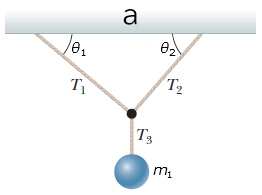
In the figures, the masses are hung from an elevator ceiling. Assume the velocity of the elevator is constant. Find the tensions

in the ropes (in N) for each case. Note that: θ1 = 38.0°, θ2 = 52.0°, θ3 = 61.0°, m1 = 3.00 kg, and m2 = 6.00 kg.
(a)
T1 = ___N
T2 = ___N
T3 = ___N

(b)
T1 = ___N
T2 = ___N
T3 = ___N

Physics
1 answer:
Keith_Richards [23]2 years ago
6 0

The elevator may be moving, but if it is moving at a constant velocity, then the observer viewing the mass-rope system is in an inertial reference frame (non-accelerating) and Newton's laws of motion will apply in this reference frame.

A) Choose the point where the ropes intersect (the black dot above m₁) and set up equations of static equilibrium where the forces are acting on that point:

We'll assume that, because rope 3 is oriented vertically, T₃ also acts vertically.

Sum up the vertical components of the forces acting on the point. We will assign upward acting components as positive and downward acting components as negative.

∑Fy = 0

Eq 1: T₁sin(θ₁) + T₂sin(θ₂) - T₃ = 0

Sum up the horizontal components of the forces acting on the point. We will assign rightward acting components as positive and leftward acting components as negative.

∑Fx = 0

Eq 2: T₂cos(θ₂) - T₁cos(θ₁) = 0

T₃ is caused by the force of gravity acting on m₁ which is very easy to calculate:

T₃ = m₁g

m₁ = 3.00kg

g is the acceleration due to earth's gravity, 9.81m/s²

T₃ = 3.00×9.81

T₃ = 29.4N

Plug in known values into Eq. 1 and Eq. 2:

Eq. 1: T₁sin(38.0) + T₂sin(52.0) - 29.4 = 0

Eq. 2: T₂cos(52.0) - T₁cos(38.0) = 0

We can solve for T₁ and T₂ by use of substitution. First let us rearrange and simplify Eq. 2 like so:

T₂cos(52.0) = T₁cos(38.0)

T₂ = T₁cos(38.0)/cos(52.0)

T₂ = 1.28T₁

Now that we have T₂ isolated, we can substitute T₂ in Eq. 1 with 1.28T₁:

T₁sin(38.0) + 1.28T₁sin(52.0) - 29.4 = 0

Rearrange and simplify, and solve for T₁:

T₁(sin(38.0) + 1.28sin(52.0)) = 29.4

1.62T₁ = 29.4

T₁ = 18.1N

Recall from our previous work:

T₂ = 1.28T₁

Plug in T₁ = 18.1N and solve for T₂:

T₂ = 1.28×18.1

T₂ = 23.2N

B) We'll assume that, because rope 2 is horizontally oriented, T₂ also acts horizontally.

Again, choose the point where the ropes intersect and write equations of static equilibrium involving the forces acting at that point:

Sum up the vertical components of the forces

∑Fy = 0

Eq. 3: T₁sin(θ₃) - T₃ = 0

Sum up the horizontal components of the forces

∑Fx = 0

Eq. 4: T₂ - T₁cos(θ₃) = 0

Right away we can solve for T₃, which is the force of gravity acting on m₂:

T₃ = m₂g, m₂ = 6.00kg, g = 9.81m/s²

T₃ = 6.00×9.81

T₃ = 58.9N

Plug in known values into Eq. 3:

T₁sin(61.0) - 58.9 = 0

We can solve for T₁ now that is is the only unknown value in this equation

0.875T₁ = 58.9

T₁ = 67.3N

Plug in known values into Eq. 4:

T₂ - 67.3cos(61.0) = 0

We can solve for T₂ now that it is the only unknown value in this equation

T₂ = 67.3cos(61.0)

T₂ = 32.6N
You might be interested in
Inna Hurry is traveling at 6.8 m/s, when she realizes she is late for an appointment. She accelerates at 4.5 m/s^2 for 3.2 s. Wh
Alborosie

Answer:

1) v = 21.2 m/s

2) S = 63.33 m

3) s = 61.257 m

4) Deceleration, a = -4.32 m/s²

Explanation:

1) Given,

The initial velocity of Inna, u = 6.8 m/s

The acceleration of Inna, a = 4.5 m/s²

The time of travel, t = 3.2 s

Using the first equation of motion, the final velocity is

                v = u + at

                   = 6.8 + 4.5 x 3.2

                   = 21.2 m/s

The final velocity of Inna is, v = 21.2 m/s

2) Given,

The initial velocity of Lisa, u = 12 m/s

The final velocity of Lisa, v = 26 m/s

The acceleration of Lisa, a = 4.2 m/s²

Using the III equations of motion, the displacement is

                          v² = u² +2aS

                         S = (v² - u²) / 2a

                            = (26² -12²) / 2 x 4.2

                            = 63.33 m

The distance Lisa traveled, S = 63.33 m

3) Given,

The initial velocity of Ed, u = 38.2 m/s

The deceleration of Ed, d = - 8.6 m/s²

The time of travel, t = 2.1 s

Using the II equations of motion, the displacement is

                        s = ut + 1/2 at²

                           =38.2 x 2.1 + 0.5 x(-8.6) x 2.1²

                           = 61.257 m

Therefore, the distance traveled by Ed, s = 61.257 m

4) Given,

The initial velocity of the car, u = 24.2 m/s

The final velocity of the car, v = 11.9 m/s

The time taken by the car is, t = 2.85 s

Using the first equations of motion,

                         v = u + at

∴                        a = (v - u) / t

                            = (11.9 - 24.2) / 2.85

                            = -4.32 m/s²

Hence, the deceleration of the car, a = = -4.32 m/s²

5 0
2 years ago
Read 2 more answers
A solenoid that is 35 cm long and contains 450 circular coils 2.0 cm in diameter carries a 1.75-A current. (a) What is the magne
Taya2010 [7]

Answer:

Explanation:

a )  No of turns per metre

n = 450 / .35

= 1285.71

Magnetic field inside the solenoid

B = μ₀ n I

Where I is current

B = 4π x 10⁻⁷ x 1285.71 x 1.75

= 28.26 x 10⁻⁴ T

This is the uniform magnetic field inside the solenoid.

b )

Magnetic field around a very long wire at a distance d is given by the expression

B = ( μ₀ /4π ) X 2I / d

= 10⁻⁷ x 2 x ( 1.75 / .01 )

= .35 x 10⁻⁴ T

In the second case magnetic field is much less. It is due to the fact that in the solenoid magnetic field gets multiplied due to increase in the number of turns. In straight coil this does not happen .

6 0
2 years ago
Read 2 more answers
Nora tied a string around a tennis ball, and then she swung it in a circle in front of her to demonstrate a planet orbiting the
777dan777 [17]

<em>Choice-A </em>is a true statement. The string holding the ball in orbit is a contact force, whereas gravity is a non-contact force.

Choice-C is half-true.  The string keeps the distance between the bodies constant, but gravity doesn't "MAKE" the distance vary.

8 0
2 years ago
Read 2 more answers
The sound level at 1.0 m from a certain talking person talking is 60 dB. You are surrounded by five such people, all 1.0 m from
Hunter-Best [27]

Answer:

66.98 db

Explanation:

We know that

L_T=L_S+10log(n)

L_T= Total signal level in db

n= number of sources

L_S= signal level from signal source.

L_T=60+10 log(5)

= 66.98 db

7 0
2 years ago
A 75.0 kg sailor climbs a 28.3 m rope ladder at and angle of 45.0degrees with the mast. how much work did he do?
sladkih [1.3K]
W = m · g · h
h = 28.3 m · sin 45° = 28.3 m · 0.707 = 20 m
g = 9.8 m/s²
W = 75 kg · 9.8 m/s² · 20 m
Answer:
W = 14,700 J = 14.7 kJ 

8 0
2 years ago
Read 2 more answers
Other questions:
  • Calculate the volume of a liquid with a density of 5.45 g/ml and a mass of 65g
    6·1 answer
  • A boat takes off from the dock at 2.5 m/s and speeds up at 4.2 m/s2 for 6.0 s. How far has the boat traveled? Round your answer
    10·2 answers
  • A soccer player kicks a ball down the field. It rolls to a stop just before the goal. Which statement accurately describes the m
    15·1 answer
  • If the voltage amplitude across an 8.50-nF capacitor is equal to 12.0 V when the current amplitude through it is 3.33 mA, the fr
    5·1 answer
  • In a particular application involving airflow over a surface, the boundary layer temperature distribution may be approximated as
    15·1 answer
  • How much energy must be transferred out of the system as heat q to lower its temperature to 0∘c? express your answer numerically
    15·1 answer
  • The natural tendency is for entropy to___ over time.
    6·2 answers
  • The inductor in a radio receiver carries a current of amplitude 200 mA when a voltage of amplitude 2.40 V is across it at a freq
    13·1 answer
  • If you wanted to find the area of the hot filament in a light bulb, you would have to know the temperature (determinable from th
    5·1 answer
  • Brian and Jack decided to investigate which water fountain at school has the coldest water. The two boys take measurements using
    5·1 answer
Add answer
Login
Not registered? Fast signup
Signup
Login Signup
Ask question!
