answer.
Ask question
Login Signup
Ask question
All categories
  • English
  • Mathematics
  • Social Studies
  • Business
  • History
  • Health
  • Geography
  • Biology
  • Physics
  • Chemistry
  • Computers and Technology
  • Arts
  • World Languages
  • Spanish
  • French
  • German
  • Advanced Placement (AP)
  • SAT
  • Medicine
  • Law
  • Engineering
Damm [24]
2 years ago
4

A compound A (C6H6) undergoes catalytic hydrogenation over Lindlar catalyst to give a compound B, which in turn undergoes ozonol

ysis followed by workup with aqueous H2O2 to yield succinic acid and two equivalents of formic acid. In the absence of a catalyst poison, hydrogenation of A gives hexane. Propose a structure for compound A.

Chemistry
1 answer:
katovenus [111]2 years ago
7 0

Answer:

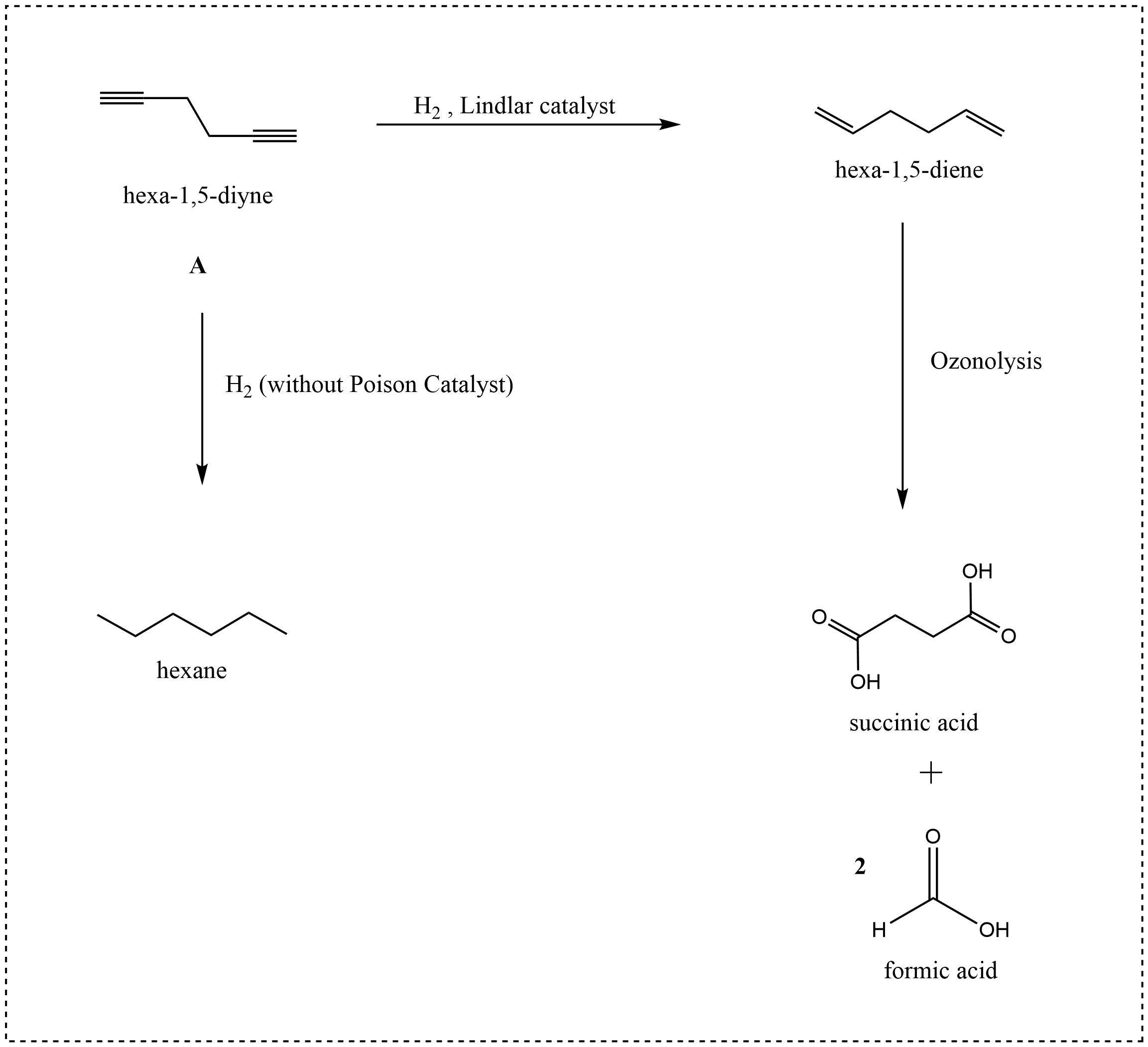
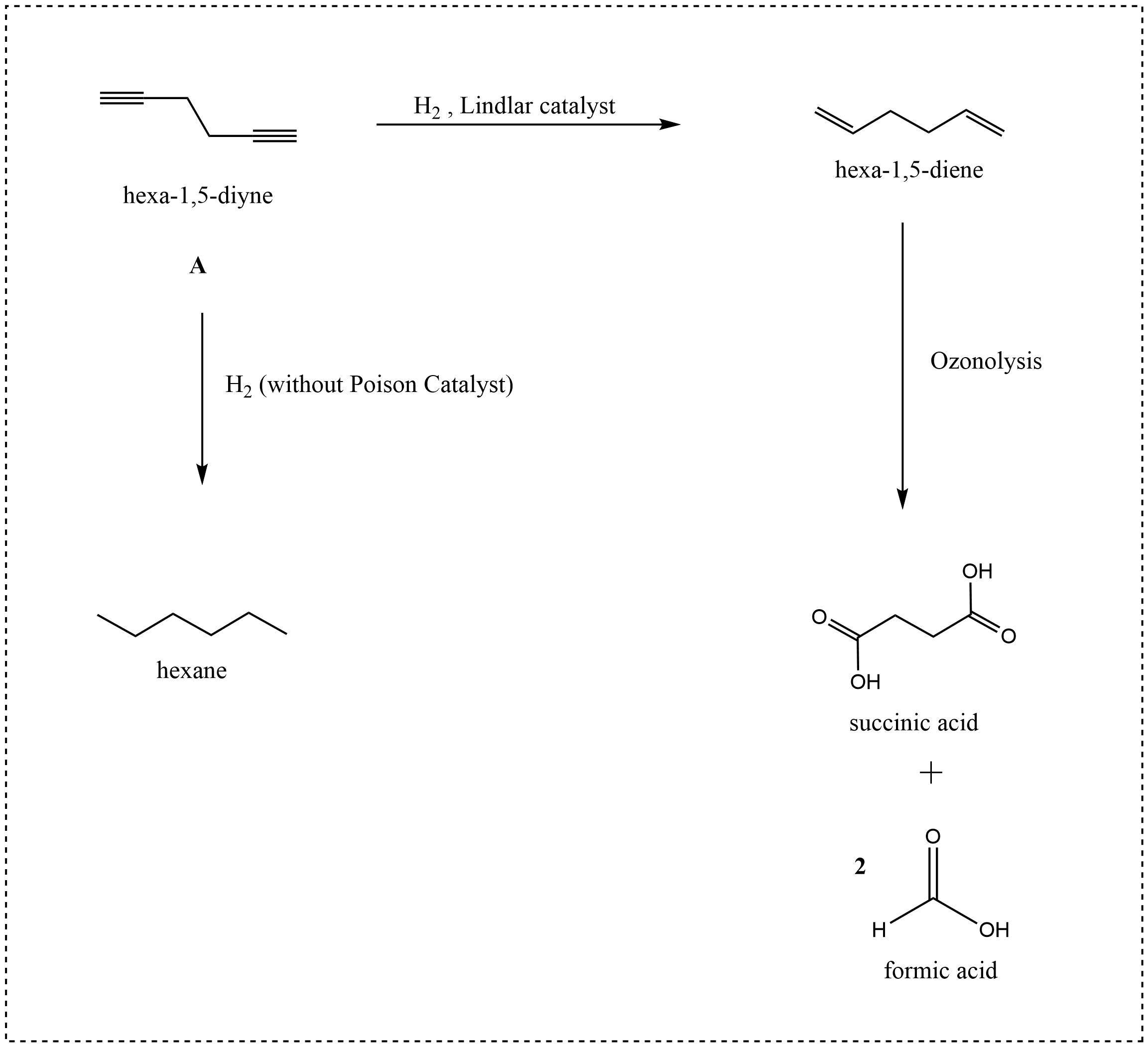
                   Hexa-1,5-diyne is the correct name for Compound-A.

Explanation:

                    This problem was solved using following concepts;

(1) Partial Hydrogenation:

                                          One should always keep in mind that Lindlar Catalyst is used for the partial hydrogenation of Alkyne in order to convert alkynes into alkenes. If the poisoned catalyst is not used then the full hydrogenation will result in the formation of corresponding alkanes like in this case the hexa-1,5-diyne when hydrogenated without converts into hexane as shown in scheme attached.

(2) Ozonolysis:

                        Ozonolysis process was used to characterize alkenes. Upon ozonolysis the alkene were broken down at double bonds and the corresponding acids were obtained depending upon there carbon length. Hence, in this case the succinic acid shows that the starting material (i.e. hexa-1,5-diene) has two double bond with 4 carbon atoms in middle and two carbon atoms at terminals as two moles of formic acids are formed.

You might be interested in
Two beach balls collide, deforming during a collision. They bounce off in opposite directions. What type of collision was this?
Flura [38]

Answer: Elastic

Explanation: Both Objects  had there momentum and kinetic energy conserved.

4 0
2 years ago
Read 2 more answers
1. Which class of compounds contains at least one element from Group 17 of the Periodic Table ? A) aldehyde B ) amine C) ester D
blondinia [14]

Halide

hope it helps

4 0
2 years ago
An air sample consists of oxygen and nitrogen gas as major components. It also contains carbon dioxide and traces of some rare g
jekas [21]

Explanation:

A mixture is defined as the substance that contains two or more different number of substances that are physically mixed together.

For example, a mixture of air which contains oxygen, nitrogen and other gases.

A mixture in which solute particles are unevenly distributed into the solvent then it is known as a heterogeneous mixture.

For example, sand in water is a heterogeneous mixture.

A homogeneous mixture is defined as the mixture in which solute particles are evenly distributed in a solvent.

A homogeneous mixture is a clear solution.

For example, salt dissolved in water is a homogeneous mixture.

A solution is defined as the substance in which two or more substances are mixed together.

A compound is defined as the substance that contains two or more different elements that chemically combined together in a fixed ratio by mass.

A element is defined as the substance that contains only one type of atoms.

For example, a piece of sodium element will contain only atoms of sodium.

Whereas a pure substance is defined as the substance which contains only one type of molecule or one type of atom.

For example, O_{2}, N_{2} etc are pure substances.

Thus, we can conclude that the terms which could be used to describe the given sample of air is as follows.
  • pure chemical substance.
  • heterogenous mixture.
  • mixture.
4 0
2 years ago
mixture or pure substance: 1.blood 2.dyes 3.self-raising flour 4.muesli 5.copper wire 6.distilled water 7.table salt 8.milk 9.br
jenyasd209 [6]

Answer: Mixture: Blood , Self raising flour,muesli ,dyes, milk, tea, air, bronze

Pure substance: Copper wire, distilled water, table salt, oxygen.

Explanation:

Mixture is a substance which is made up two or more number of compounds which chemically inactive and retain their distinct chemical properties.

Blood , Self raising flour,muesli ,dyes, milk, tea, air, bronze

Pure substance is defined as anything with uniform and unchanging composition is known s pure substance.

Copper wire, distilled water, table salt, oxygen.

5 0
2 years ago
A toy car is placed at 0 on a number line. It moves 9 cm to the left, then 4 cm to the right, and then 6 cm to the left. What is
snow_lady [41]

Answer:

19

Explanation:

The total distance traveled by the toy cay would be 19 cm.

The total distance traveled should not be mistaken for total displacement. While displacement measures the distance and direction from the starting position of the toy car relative to its final position, the total distance traveled is calculated by adding all the movements of the toy car together. Hence;

Total distance traveled = 9 + 4 + 6 = 19 cm

7 0
2 years ago
Read 2 more answers
Other questions:
  • A 36 gram sample of water has an initial temperature of 22 degrees Celsius after the sample absorbs 1200joules of heat energy th
    9·2 answers
  • One atom of silicon can properly combined in a compound with
    5·1 answer
  • To begin the experiment, 1.11g of methane CH4 is burned in a bomb calorimeter containing 1000 grams of water. The initial temper
    7·1 answer
  • Convert 7.68cal/sec to Kcal/min
    12·2 answers
  • A steam turbine is a device in which high-pressure steam enters the turbine and causes blades to spin. The spinning blades have
    15·2 answers
  • The ________ orbital is degenerate with 5py in a many-electron atom.
    14·1 answer
  • USATEST PREP QUESTION HELP ! Really appreciate it !
    14·2 answers
  • A sample of krypton has a volume of 6.00 L, and the pressure is 0.960 atm. If the final temperature is 55.0°C, the final volume
    11·1 answer
  • For each case below, identify the most likely value for x: a. BHx b. CHx c. NHx d. CH2Clx
    7·1 answer
  • A chemist forms 16.6 g of potassium iodide by combining 3.9 g of potassium with 12.7 g of iodine. Show that these results are co
    10·1 answer
Add answer
Login
Not registered? Fast signup
Signup
Login Signup
Ask question!
