answer.
Ask question
Login Signup
Ask question
All categories
  • English
  • Mathematics
  • Social Studies
  • Business
  • History
  • Health
  • Geography
  • Biology
  • Physics
  • Chemistry
  • Computers and Technology
  • Arts
  • World Languages
  • Spanish
  • French
  • German
  • Advanced Placement (AP)
  • SAT
  • Medicine
  • Law
  • Engineering
amm1812
2 years ago
6

The compound AX2 decomposes according to the equation, 2 AX2(g) => 2 AX(g) + X2(g). In one experiment, AX2 was measured at va

rious times, and these data recorded: Time (s) AX2 mol/L 0 0.0500 2.0 0.0448 6.0 0.0300 8.0 0.0249 10.0 0.0209 20.0 0.0088 What is the average rate from 6.0 to 10.0 seconds in mol / L s? Use 4 decimal places.
Chemistry
1 answer:
Karolina [17]2 years ago
8 0

Answer:

0.0011 mol/L.s

Explanation:

The average rate of disappearing of the reagent is the variation of the concentration of it divided by the time that this variation is being measured. The reaction rate, is proportional to the coefficient of the substance, so, for a generic reaction:

aA + bB --> cC + dD

rate = -(1/a)Δ[A]/Δt = -(1/b)Δ[B]/Δt = (1/c)Δ[C]/Δdt = (1/d)Δ[D]/dt

The minus sign is because of the reagent is desapering, so:

rate = -(1/2)*(0.0209 - 0.0300)/(10 - 6)

rate = 0.0011 mol/L.s

You might be interested in
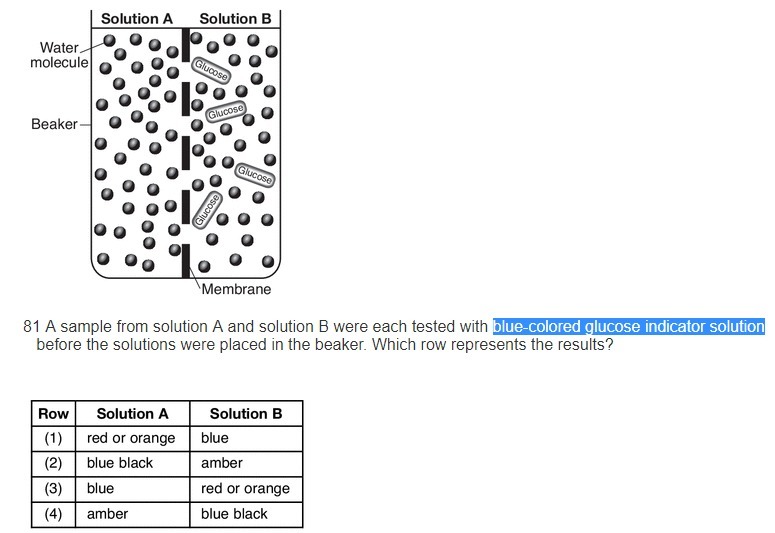
A sample from solution a and solution b were each tested with blue colored glucose indicator solution before the solutions were
vova2212 [387]
With the given problem you gave here, I can't answer the question because I need more details. Luckily, I found a similar problem that's provided with a diagram and a table shown in the attached picture.

This test is called the Benedict's test which is used as test for presence of sugars. If the solution contains sugar, like glucose, the solution would turn from blue to red. If not, it would stay blue. <em>Therefore, the correct results would be that in row 3.</em>

3 0
2 years ago
Н
nevsk [136]

Answer:

C4H90H

Explanation:

nskwjxnxnxnslq

6 0
2 years ago
Insoluble sulfide compounds are generally black in color. Which of the following combinations could yield a black precipitate? C
Lubov Fominskaja [6]

Answer:

Li₂S(aq) + Pb(NO₃)₂(aq)

2 K₂S(aq) + Sn(NO₃)₄(aq)

Explanation:

For these reactions, the products are:

1. Na₂S(aq) + 2 KCl(aq) → K₂S + 2 NaCl

2. Li₂S(aq) + Pb(NO₃)₂(aq) →  PbS + 2 Li(NO₃)

3. Pb(ClO₃)₂(aq) + 2 NaNO₃(aq) → Pb(NO₃)₂ + 2 Na(ClO₃)

4. AgNO₃(aq) + KCl(aq) → AgCl + KNO₃

5. 2 K₂S(aq) + Sn(NO₃)₄(aq) → SnS₂ + 4 KNO₃

K₂S is a soluble sulfide that, in solid state, is white. As K has a low electronegativity, the relative polar bond K-S allows its dissolution in water.

PbS is a black and insoluble compound. As Pb electronegativity is higher than K electronegativity, The bond is less-polar and its dissolution will not be allowed.

For the third reaction, all nitrates are soluble and Na(ClO₃) is also a very soluble compound.

AgCl is an insoluble white compound.

As Sn electronegativity is high, the solubility of this compound is very low. Also, this compound is black!

Thus, combinations could yield a black precipitate are:

Li₂S(aq) + Pb(NO₃)₂(aq)

2 K₂S(aq) + Sn(NO₃)₄(aq)

I hope it helps!

6 0
2 years ago
A slender uniform rod 100.00 cm long is used as a meter stick. two parallel axes that are perpendicular to the rod are considere
kvv77 [185]
Refer to the diagram shown below.

The second axis is at the centroid of the rod.
The length of the rod is L = 100 cm = 1 m

The first axis is located at 20 cm = 0.2 m from the centroid.
Let m =  the mass of the rod.

The moment of inertia about the centroid (the 2nd axis) is
I_{g} =  \frac{mL^{2}}{12} = (m \, kg) \frac{(1 \, m)^{2}}{12} =  \frac{m}{12} \, kg-m^{2}

According to the parallel axis theorem, the moment of inertia about the first axis is
I_{1} = I_{g} + (m \, kg)(0.2 m)^{2} \\ I_{1} =  \frac{m}{12}+ 0.04m = 0.1233m \, kg-m^{2}

The ratio of the moment of inertia through the 2nd axis (centroid) to that through the 1st axis is
\frac{I_{g}}{I_{1}} =  \frac{0.0833m}{0.1233m} =0.6756

Answer:  0.676

6 0
2 years ago
Read 2 more answers
An unknown substance was put in a container. The substance filled up the container from the bottom up, taking half of the space
ale4655 [162]

Answer: The state of the substance is most likely to be is liquid state.

Explanation:

States of matter of three types:

1) Solids: In this state of matter particles are strongly associated due to high inter molecular forces acting between them. They have a fixed shape that is they doesn't take the shape of the container in which they are kept.

2) Liquids: In this state of matter particles are associated due to weak inter molecular forces acting between them. They don't have a fixed shape that is they take the shape of the container in which they are kept. They do not occupy the whole volume of the container.

3) Gases: In this state of matter particles are very weakly associated . They don't have a fixed shape that is they take the shape of the container in which they are kept. They occupy the whole volume of the container.

The state of the matter most likely is liquid state.

6 0
2 years ago
Other questions:
  • Solar energy travels to the Earth in many forms, such as ultraviolet radiation, infrared radiation, and visible rays. These vari
    9·1 answer
  • The mass of a solid copper penny is 3.46 g. how many copper atoms are in the penny?
    9·2 answers
  • A man pours some hot coffee into a small cup from a large jug that contains enough coffee for several cups. Which statement corr
    14·2 answers
  • Write the equations that represent the first and second ionization steps for hydroselenic acid (H2Se) in water. (Use H3O+ instea
    5·1 answer
  • Compound A, C6H12 reacts with HBr/ROOR to give compound B, C6H13Br. Compound C, C6H14, reacts with bromine and light to produce
    5·1 answer
  • What is the reaction energy Q of this reaction? Use c2=931.5MeV/u. Express your answer in millions of electron volts to three si
    7·1 answer
  • Wet steam at 1100 kPa expands at constant enthalpy (as in a throttling process) to 101.33 kPa, where its temperature is 105°C. W
    8·2 answers
  • Nickel-63 has a half life of 92 hours. If a
    14·1 answer
  • A 50.0 mL Volumetric flask filled with aqueous solution of hydrogen peroxide has a total mass of 88.5 g. The mass of the volumet
    12·1 answer
  • Why is the atomic mass of iron, 55.845 amu, most similar to the mass of iron-56, yet less than 56 amu? The atomic mass is the si
    5·1 answer
Add answer
Login
Not registered? Fast signup
Signup
Login Signup
Ask question!