answer.
Ask question
Login Signup
Ask question
All categories
  • English
  • Mathematics
  • Social Studies
  • Business
  • History
  • Health
  • Geography
  • Biology
  • Physics
  • Chemistry
  • Computers and Technology
  • Arts
  • World Languages
  • Spanish
  • French
  • German
  • Advanced Placement (AP)
  • SAT
  • Medicine
  • Law
  • Engineering
Mariulka [41]
2 years ago
14

A mixture of CO2 and Kr weighs 35.0 g and exerts a pressure of 0.708 atm in its container. Since Kr is expensive, you wish to re

cover it from the mixture. After the CO2 is completely removed by absorption with NaOH(s), the pressure in the container is 0.250 atm. How many grams of CO2 were originally present? How many grams of Kr can you recover?
Chemistry
1 answer:
ollegr [7]2 years ago
6 0

Explanation:

Since, it is given that carbon dioxide is completely removed by absorption with NaOH. And, pressure inside the container is 0.250 atm.

For Kr = 0.250 atm and pressure CO_{2} will be calculated as follows.

           CO_{2} = (0.708 - 0.250) atm

                       = 0.458 atm

Now, we will calculate the mole fraction as follows.

            CO_{2} = \frac{0.458}{0.708}

                       = 0.646

               Kr = \frac{0.250}{0.708}

                    = 0.353

Now, we will convert into gram fraction as follows.

              CO_{2} = 0.646 \times 44

                          = 28.424

                   Kr = 0.353 \times 83.78

                        = 29.57

Therefore, total mass is calculated as follows.

           Total mass = (28.424 + 29.57)

                              = 57.994

Hence, the percentage of CO_{2} and Kr are calculated as follows.

          CO_{2} = \frac{28.424}{57.99} \times 100

                     = 49%

               Kr = \frac{29.57}{57.99} \times 100

                    = 51%

Hence, amount of CO_{2} and Kr present i mixture is as follows.  

         CO_{2} in mixture = 35 \times 0.49

                             = 17.15 g

                  Kr = 35 \times 0.51

                       = 17.85 g

Thus, we can conclude that 17.15 g of CO_{2} is originally present and 17.85 g of Kr is recovered.

You might be interested in
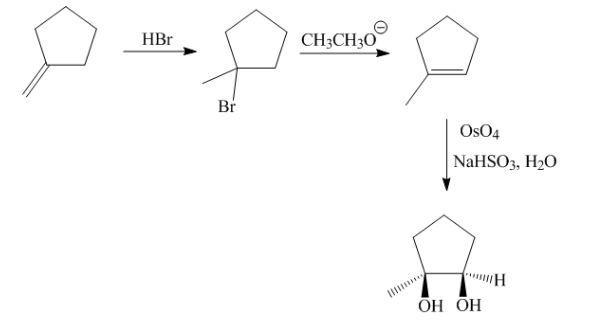
The target diol is synthesized in one step from 1-methylcyclopentene, but your lab partner exhausted the supply of that alkene.
andrezito [222]

Answer:

The reagents are CH_{3}CH_{3}O^{-},OsO_{4},NaHSO_{3}and H_{2}O.

Explanation:

1-Methylenecyclopentene is treated with HBr form 1-bromo-1-methylcyclopentane, which is treated with strong base ethoxide ion and forms 1-methylcyclopent-1-ene.

This alkene is treated with osmium tetraoxide in the presence of sodium bisulfite to form target product.

The chemical reaction is as follows.

4 0
2 years ago
Eddie is going to do an experiment to find out which freezes more easily—distilled water or salt water. In what order should he
mel-nik [20]

1. Make a Prediction

2. Fill both beakers with water

3. Dissolve salt in one of the beakers

4. Place both in the freezer and observe

5. Write a report

(Always make the prediction first! That's a hypothesis!)

4 0
2 years ago
Read 2 more answers
A 17.0-g sample of hf is dissolved in water to give 2.0 x 10 2 ml of solution. the concentration of the solution is:
fredd [130]
 The  concentration  of the solution  is   4.25 M

 Explanation

molarity=moles/volume in liters

moles  = mass/molar mass
molar mass  of HF = 19 + 1 =  20 g/mol
moles is therefore = 17.0 g/ 20 g/mol  = 0.85  moles

volume in  liters = 2  x10^2ml/1000 = 0.2  liters

therefore  molarity =  0.85/0.2 = 4.25  M
8 0
2 years ago
Read 2 more answers
The density of o2 gas at 16 degrees Celsius and 1.27atm is?
velikii [3]

Answer:

The density of O₂ gas is 1.71 \frac{g}{L}

Explanation:

Density is a quantity that allows you to measure the amount of mass in a given volume of a substance. So density is defined as the quotient between the mass of a body and the volume it occupies:

density=\frac{mass}{volume}

An ideal gas is characterized by three state variables: absolute pressure (P), volume (V), and absolute temperature (T). The relationship between them constitutes the ideal gas law, an equation that relates the three variables if the amount of substance, number of moles n, remains constant and where R is the molar constant of the gases:

P * V = n * R * T

So, you can get:

\frac{n}{V} =\frac{P}{R*T}

The relationship between number of moles and mass is:

n=\frac{mass}{molar mass}

Replacing:

\frac{\frac{mass}{molar mass} }{V} =\frac{P}{R*T}

\frac{mass}{V*Molar mass} =\frac{P}{R*T}

So:

\frac{mass}{V} =\frac{P*molar mass}{R*T}

Knowing that 1 mol of O has 16 g, the molar mass of O₂ gas is 32 \frac{g}{mol}.

Then:

\frac{mass}{V} =\frac{P*molar mass of O_{2} }{R*T}

In this case you know:

  • P=1.27 atm
  • molar mass of O₂= 32 \frac{g}{mol}.
  • R= 0.0821 \frac{atm*L}{mol*K}
  • T= 16 °C=  289 °K (0°C= 273°K)

Replacing:

density=\frac{mass}{V} =\frac{1.27atm*32\frac{g}{mol}  }{0.0821\frac{atm*L}{mol*K} *289 K}

Solving:

density= 1.71 \frac{g}{L}

<u><em>The density of O₂ gas is 1.71 </em></u>\frac{g}{L}<u><em></em></u>

3 0
2 years ago
A vessel contains 18.06*10^23 molecules of ammonia gas at 25°c. Calculate the number of hydrogen atoms present in the ammonia ga
velikii [3]

Answer:

Explanation:

<h2>Before you use log you have to multiply the answer of 8.66 mol by 6.02⋅1023 by 3 because the answer of 8.66 mol by 6.02⋅1023 gives you the number of ammonia molecules and in each molecules there are 3 hydrogen atoms present. </h2><h2> </h2><h2>So it is: </h2><h2> </h2><h2>8.66⋅6.02⋅1023=5.21332⋅1024 </h2><h2>5.21332⋅1024⋅3=1.563996⋅1025 </h2><h2>log(1.563996⋅1025)=25.19 </h2>

8 0
2 years ago
Read 2 more answers
Other questions:
  • __________ is one of many factors that can determine the rate of alcohol absorption.
    12·1 answer
  • The molecular weight of table salt, NaCl, is 58.5 g/mol. A tablespoon of salt weighs 6.37 grams. Calculate the number of moles o
    5·2 answers
  • What is the name of a compound with the structure: ch3ch2ch2ch2ch2co2ch2ch2ch3?
    13·1 answer
  • 40pionts
    9·1 answer
  • Copper(II) sulfide, CuS, is used in the development of aniline black dye in textile printing. What is the maximum mass of CuS wh
    14·1 answer
  • A solution that contains 55.0 g of ascorbic acid (vitamin C) in 250.0 g of water freezes at –2.34°C.
    7·1 answer
  • At 80 ∘C, Kc=1.87×10^−3 for the reaction PH3BCl3(s)⇌PH3(g)+BCl3(g)
    11·1 answer
  • Determine whether the statement is true or false, and why? “Climate change could cause many habitats to be destroyed, leading to
    7·1 answer
  • the image above shows a chamber with a fixed volume filled with gas at a pressure of 1560 mmHg and a temperature of 445.0 K. If
    11·1 answer
  • If this decay has a half life of 2.60 years, what mass of 72.5 g of sodium 22 will remain after 15.6 years
    7·1 answer
Add answer
Login
Not registered? Fast signup
Signup
Login Signup
Ask question!