answer.
Ask question
Login Signup
Ask question
All categories
  • English
  • Mathematics
  • Social Studies
  • Business
  • History
  • Health
  • Geography
  • Biology
  • Physics
  • Chemistry
  • Computers and Technology
  • Arts
  • World Languages
  • Spanish
  • French
  • German
  • Advanced Placement (AP)
  • SAT
  • Medicine
  • Law
  • Engineering
Tcecarenko [31]
2 years ago
9

A ball is held at a height H above a floor. It is then released and falls to the floor. If air resistance can be ignored, which

of the five graphs below correctly gives the mechanical energy E of the Earth-ball system as a function of the altitude y of the ball?

Physics
1 answer:
Vaselesa [24]2 years ago
5 0

Answer:

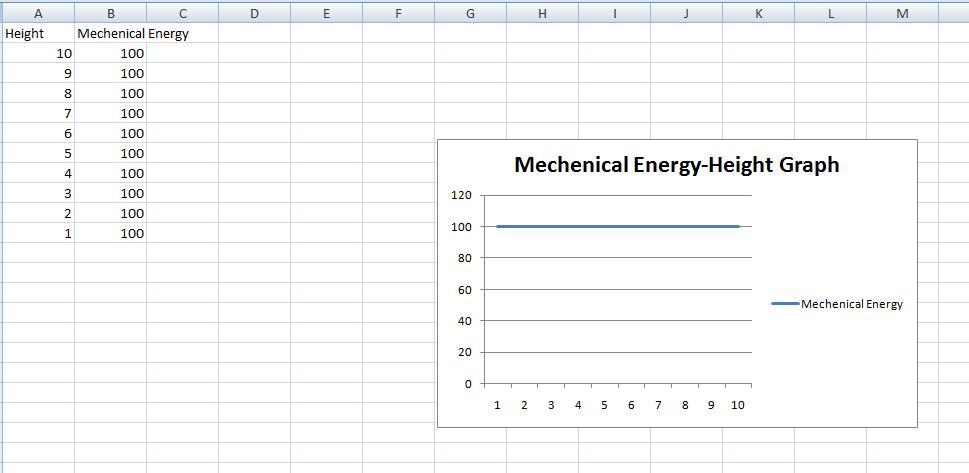
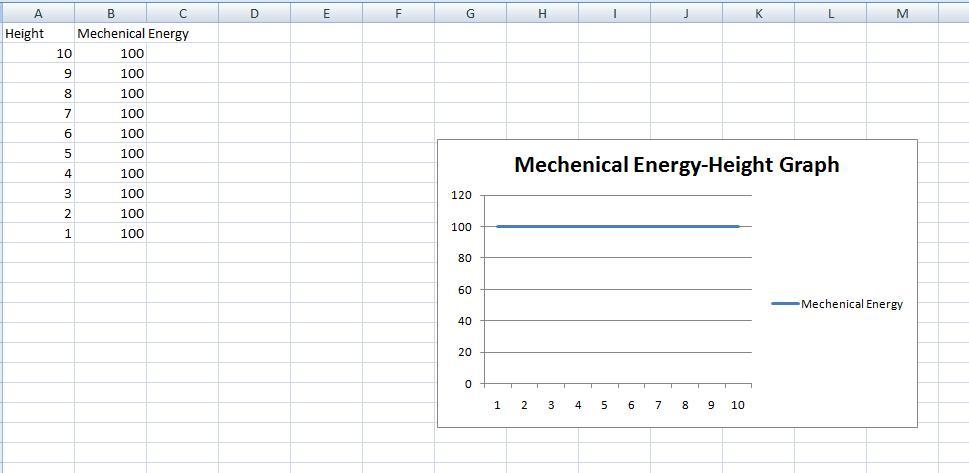
Straight line graph attached showing mechanical energy on x-axis and altitude y on y-axis

Explanation:

As mechanical energy is the sum of kinetic energy and potential energy, the ball at a height H possesses potential energy= m.g.H

and Kinetic energy= 0.

But the sum of both energies is equal to m.g.H.

When the ball starts moving, the height starts to decrease and potential energy also decreases with decreasing y. On the other hand kinetic energy starts increasing with decreasing Y. But their sum remains constant i.e equal to mechanical energy. It remains same until the ball touches the ground. The graph attached shows height H or altitude y on x-axis and Mechanical Energy on y-axis. It shows a straight horizental line showing that mechanical energy remains same as y decreases.  

You might be interested in
Springfield's "classic rock" radio station broadcasts at a frequency of 102.1 mhz. what is the length of the radio wave in meter
Mila [183]
The frequency of the radio wave is:
f=102.1 MHz = 102.1 \cdot 10^6 Hz

The wavelength of an electromagnetic wave is related to its frequency by the relationship
\lambda= \frac{c}{f}
where c is the speed of light and f the frequency. Plugging numbers into the equation, we find
\lambda= \frac{3 \cdot 10^8 m/s}{102.1 \cdot 10^6 Hz}= 2.94 m
and this is the wavelength of the radio waves in the problem.
7 0
2 years ago
A coat rack weighs 65.0 lbs when it is filled with winter coats and 40.0 lbs when it is empty. The base of the coat rack has an
Whitepunk [10]

Answer:

0.056 psi more pressure is exerted by filled coat rack than an empty coat rack.

Explanation:

First we find the pressure exerted by the rack without coat. So, for that purpose, we use formula:

P₁ = F/A

where,

P₁ = Pressure exerted by empty rack = ?

F = Force exerted by empty rack = Weight of Empty Rack = 40 lb

A = Base Area = 452.4 in²

Therefore,

P₁ = 40 lb/452.4 in²

P₁ = 0.088 psi

Now, we calculate the pressure exerted by the rack along with the coat.

P₂ = F/A

where,

P₂ = Pressure exerted by rack filled with coats= ?

F = Force exerted by filled rack = Weight of Filled Rack = 65 lb

A = Base Area = 452.4 in²

Therefore,

P₂ = 65 lb/452.4 in²

P₂ = 0.144 psi

Now, the difference between both pressures is:

ΔP = P₂ - P₁

ΔP = 0.144 psi - 0.088 psi

<u>ΔP = 0.056 psi</u>

8 0
2 years ago
A block of mass m is pushed up against a spring with spring constant k until the spring has been compressed a distance x from eq
Snowcat [4.5K]

Answer:d

Explanation:

Spring is compressed to a distance of x from its equilibrium position

Work done by block on the spring is equal to change in elastic potential energy

i.e. Work done by block W=\frac{1}{2}kx^2

therefore spring will also done an equal opposite amount of work on the block in the absence of external force

Thus work done by spring on the block W=-\frac{1}{2}kx^2

Thus option d is correct

6 0
2 years ago
Which of the following are inertial reference frames? A. A car driving at steady speed on a straight and level road. B. A car dr
Aloiza [94]

Answers:

A. A car driving at steady speed on a straight and level road.

B. A car driving at steady speed up a 10∘ incline.

Explanation:

An object is said to be in an inertial reference frame if the net force acting on the object is zero. According to Newton's second law, this also means that the acceleration of the object is also zero:

F=ma

Since F=0, a=0 as well.

Let's now analyze each case.

A. A car driving at steady speed on a straight and level road. --> YES: this is an inertial reference frame, because the car is keeping a constant speed and a constant direction, so its velocity is not changing, and its acceleration is zero.

B. A car driving at steady speed up a 10∘ incline. --> YES: this is an inertial reference frame, because the car is keeping a constant speed and a constant direction, so its velocity is not changing, and its acceleration is zero.

C. A car speeding up after leaving a stop sign. --> NO: this is not an intertial reference frame, because the car is speeding up, so it is accelerating.

D. A car driving at steady speed around a curve. --> NO: this is not an inertial reference frame, because the car is changing direction, therefore its velocity is changing and so the car is accelerating.

So the only two choices which are correct are A and B.
8 0
2 years ago
Read 2 more answers
The moon’s orbital speed around Earth is 3.680 × 10^3 km/h. Suppose the moon suffers a perfectly elastic collision with a comet
Naily [24]

Answer:

Speed of comet before collision is

v_{2_{i}}=-2.5\times10^{3}\quad km/h

Explanation:

Correction: (As stated after collision comet moves away from moon so velocity of moon and moon and comet must be opposite in direction. as spped of moon after collision is −4.40 × 10^2km/h so that comet's must be 5.740 × 10^3km/h instead of -5.740 × 10^3km/h)

Solution:

mass \quad of\quad moon = m_{1}\\\\mass\quad of \quad comet = m_{2} = 0.5 m_{1}\\\\speed\quad of\quad moon\quad before\quad collision = v_{1_{i}}=3.680\times 10^3 km/h\\\\speed \quad of\quad moon\quad after\quad collision=v_{1_{f}} = -4.40 \times 10^2 km/h\\\\speed\quad of\quad comet\quad after\quad collision =v_{2_{f}} =5.740 \times 10^3 km/h

Case is considered as partially inelastic collision, by conservation of momentum

m_{1}v_{1_{i}}+m_{2}v_{2_{i}}=m_{1}v_{1_{f}}+m_{2}v_{2_{f}}\\\\m_{1}v_{1_{i}}+0.5m_{1}v_{2_{i}}=m_{1}v_{1_{f}}+0.5m_{1}v_{2_{f}}\\\\v_{1_{i}}+0.5v_{2_{i}}=v_{1_{f}}+0.5v_{2_{f}}\\\\v_{2_{i}}=2(v_{1_{f}}+0.5v_{2_{f}}-v_{1_{i}})\\\\v_{2_{i}}=2(-4.40 \times 10^2+0.5(5.740 \times 10^3)-3.680 \times 10^3 )\\\\v_{2_{i}}=-2.5\times10^{3}\quad km/h

8 0
2 years ago
Other questions:
  • Write a hypothesis about how the height of the cylinder affects the temperature of the water. Use the "if . . . then . . . becau
    14·2 answers
  • A car with an initial velocity of 16.0 meters per second east slows uniformly to 6.0 meters per second east in 4.0 seconds. What
    8·1 answer
  • A 0.500 kg aluminum pan on a stove is used to heat 0.250 liters of water from 20.0ºC to 80.0ºC. (a) How much heatis required? Wh
    15·1 answer
  • What is the direction of the current in the loop as the loop rotates clockwise through the magnetic field from as viewed from th
    14·2 answers
  • The blood plays an important role in removing heat from th ebody by bringing the heat directly to the surface where it can radia
    13·1 answer
  • The potential energy for a certain mass moving in one dimension is given by U(x)=(2.0J/m3)x3−(15J/m2)x2+(36J/m)x−23JU(x)=(2.0J/m
    11·1 answer
  • A cleaver physics professor wants to create a situation where a block starts from rest at the top of a 31.0° inclined plane and
    13·1 answer
  • The Type K thermocouple has a sensitivity of about 41 micro-Volts/℃, i.e. for each degree difference in the junction temperature
    6·1 answer
  • Three sticks are arranged in such a way that they form a right triangle. The
    8·1 answer
  • A child of mass m is at the edge of a merry-go-round of diameter d. When the merry-go-round is rotating with angular acceleratio
    15·1 answer
Add answer
Login
Not registered? Fast signup
Signup
Login Signup
Ask question!