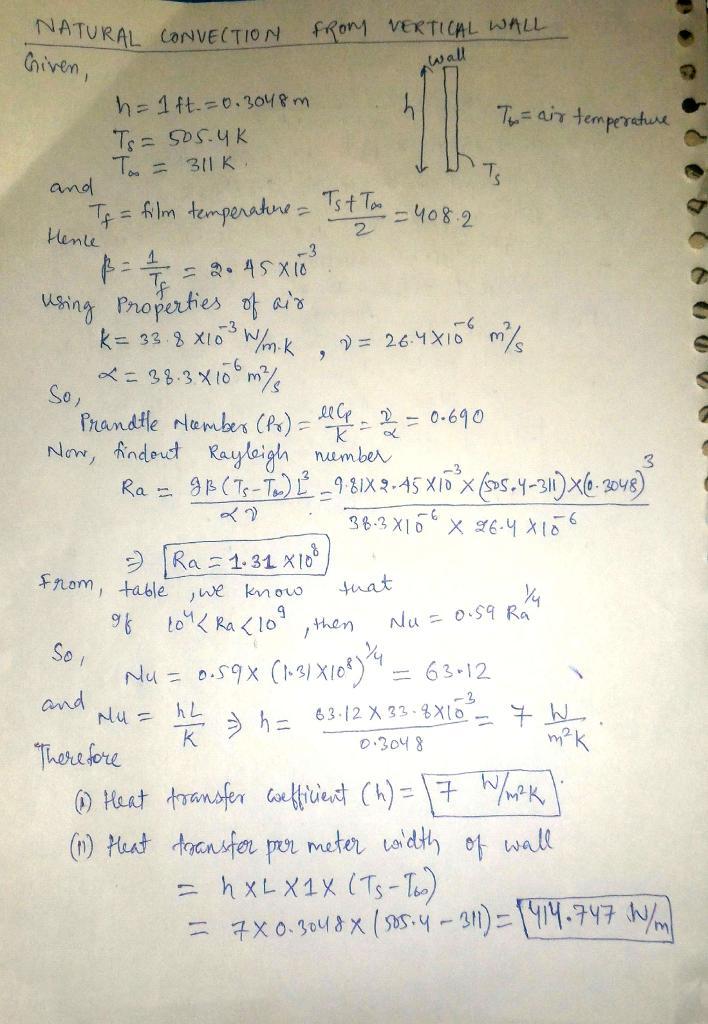
Answer:
i) Heat transfer coefficient (h) = 7 w/m²k
ii) Heat transfer per meter width of wall
= h x L x 1 x (Ts - T₆₀)
= 7 x 0.3048 x (505.4 - 322) = 414.747 w/m
Explanation:
see attached image
Answer:
Inventor claim is not valid.
Explanation:
Given that
Source temperature = 510 K
Sink temperature = 270 K
Power produce = 4.1 KW
Heat reject = 15,000 KJ/h
Heat reject =4.16 KW
As we know that
Heat addition = Heat rejection + Power produce
Heat addition = 4.16 + 4.1 KW
Heat addition = 8.16 KW
So efficiency of engine


Now check the maximum efficiency can be possible by using Carnot heat engine
As we know that efficiency of Carnot heat engine given as

By putting the value


So the efficiency of Carnot cycle is less than the efficiency of above given engine.So this engine is not possible.It means that inventor claim is not valid.
Answer:
Explanation:
FromTable A - 20; the values of yield strength and tensile strength are derived by using the "Deterministic ASTM Minimum Tensile and yield strength for some Hot-Rolled (HR) and Cold - Drawn (CD) steels for cold drawn AISI 1020 sheet steel:


We calculate the ratio of the radius in relation to the thickness of the spherical vessel by using the formula:

Since the fraction from the ration is higher than 1°, then the shell can be regarded to be a thin spherical shell.
From here; we estimate the tensile stress induced by using the formula:


Therefore; the tensile stress is equal to the stress-induced in the transverse direction; i.e.

Thus, since 
Then the radial stress 
By the application of Von Mises Stress; the resultant stress can be estimated as follows:


Then: by relating the Von Mises stress at yield condition:


P = 0.934 kpsi
P = 934 psi
Hence, the pressure at the yield condition is 934 psi
Similarly, relating Von Mises stress at the rupture condition

68 = 61 P

P = 1.11 kpsi
Hence, the pressure at rupture condition is 1.11 kpsi
Answer:
Q=0.95 W/m
Explanation:
Given that
Outer diameter = 0.3 m
Thermal conductivity of material

So the mean conductivity


So heat conduction through cylinder


Q=0.95 W/m