answer.
Ask question
Login Signup
Ask question
All categories
  • English
  • Mathematics
  • Social Studies
  • Business
  • History
  • Health
  • Geography
  • Biology
  • Physics
  • Chemistry
  • Computers and Technology
  • Arts
  • World Languages
  • Spanish
  • French
  • German
  • Advanced Placement (AP)
  • SAT
  • Medicine
  • Law
  • Engineering
nalin [4]
2 years ago
7

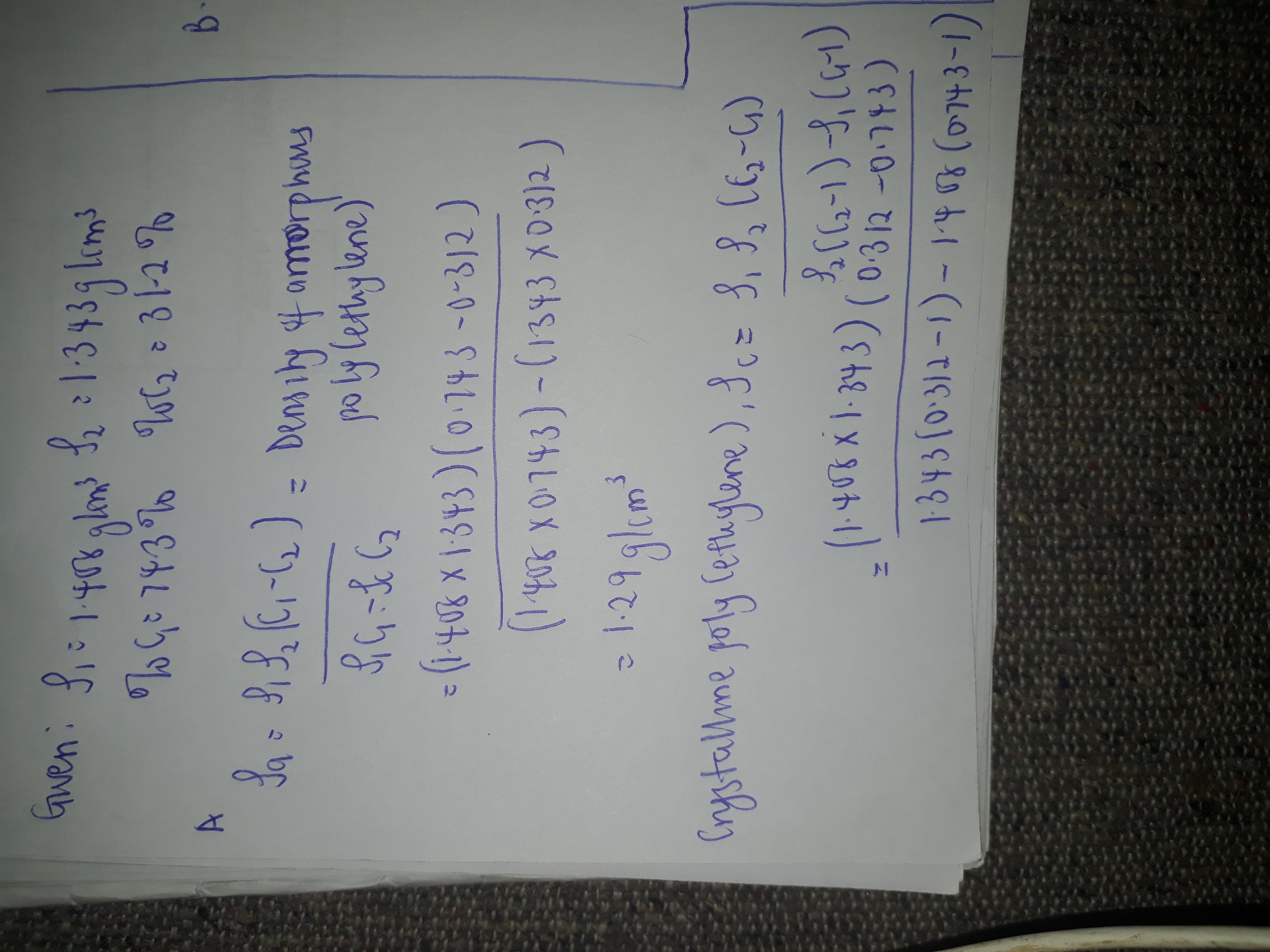
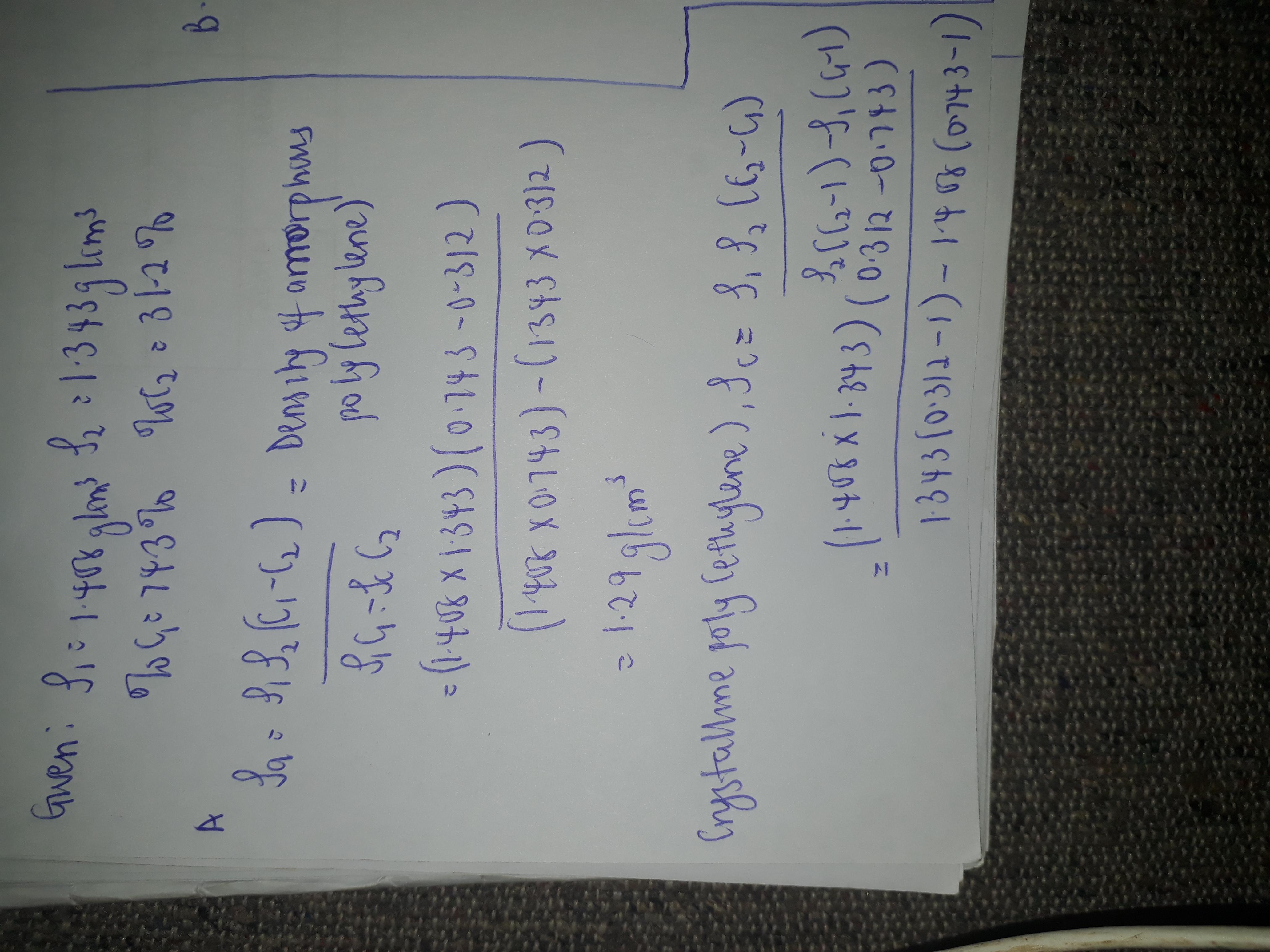
5 The density and associated percent crystallinity for two poly(ethylene terephthalate) materials are as follows: (a) Compute th

e densities of totally crystalline and totally amorphous poly(ethylene terephthalate). (b) Determine the percent crystallinity of a specimen having a density of 1.382 g/cm3.

Chemistry
1 answer:
m_a_m_a [10]2 years ago
7 0

Explanation:

Below is an attachment containing the solution.

You might be interested in
1) How many aluminum atoms are there in 3.50 grams of Al2O3?
drek231 [11]

Answer:

Aluminium atoms =  4.13 *10^22 aluminium atoms

The correct answer is E

Explanation:

Step 1: Data given

Mass of Al2O3 = 3.50 grams

Molar mass of Al2O3 = 101.96 g/mol

Number of Avogadro = 6.022 * 10^23 /mol

Step 2: Calculate moles Al2O3

Moles Al2O3 = mass Al2O3 / molar mass Al2O3

Moles Al2O3 = 3.50 grams / 101.96 g/mol

Moles Al2O3 = 0.0343 moles

Step 3: Calculate moles Aluminium

In 1 mol Al2O3 we have 2 moles Al

in 0.0343 moles Al2O3 we have 2*0.0343 = 0.0686 moles Al

Step 4: Calculate aluminium atoms

Aluminium atoms =  moles aluminium * Number of Avogadro

Aluminium atoms =  0.0686 * 6.022 * 10^23

Aluminium atoms =  4.13 *10^22 aluminium atoms

The correct answer is E

3 0
2 years ago
When you apply heat energy to a substance, where does the energy go? Think about the law of conservation of energy.
MAVERICK [17]

The energy is transformed into kinetic energy which makes the substance to move. The law of conservation of energy which is the first law of thermodynamics states that in a closed system energy can neither be created nor destroyed but can change from one form to another

7 0
2 years ago
PLEASE HELP!!! The image represents the reaction between a certain number of molecules of N2 and H2.
77julia77 [94]

Answer:

  • <u><em>The leftover reactant is the nitrogen gas, N₂.</em></u>

Explanation:

As per your description:

<u>1. Square on the left: N₂(g)</u>

  • 3 units of two joint circles: this represents 3 molecules of nitrogen gas, N₂(g).

<u>2. Square on the right: H₂(g)</u>

  • 3 units of two joint circles: this represents 3 molecules of hydrogen gas, H₂(g).

<u>3. Reaction</u>

If the maximum possible amount of NH₃ is formed during the reaction, you assume that the reaction goes to completion.

The chemical equation that represents the reaction is:

  • N₂(g) +  H₂(g) → NH₃(g)

Which must be balanced:

  • N₂(g) +  3H₂(g) → 2NH₃(g)

That means that 1 molecule (or 1 mol) of N₂(g) reacts with 3 molecules (or 3 moles ) of  H₂(g) to produce 2 molecules (or 2 moles) of NH₃(g).

Since, the squares show that there are 3 molecules of each reactant, the 3 molecules of hydrogen gas will be able to react with 1 molecule of nitrogen gas. When that happens, all the hydrogen gas is consumend and yet two molecules of nitrogen gas will remain unreacted. Hence, the nitrogen gas is the leftover reactant.

4 0
2 years ago
Read 2 more answers
Website
vredina [299]

Answer:

volume in L = 0.25 L

Explanation:

Given data:

Mass of Cu(NO₃)₂ = 2.43 g

Volume of KI = ?

Solution:

Balanced chemical equation:

2Cu(NO₃)₂  + 4KI    →    2CuI + I₂ + 4KNO₃

Moles of Cu(NO₃)₂:

Number of moles = mass/ molar mass

Number of moles = 2.43 g/ 187.56 g/mol

Number of moles = 0.013 mol

Now we will compare the moles of Cu(NO₃)₂ with KI.

                        Cu(NO₃)₂       :              KI    

                              2              :               4

                            0.013          :            4 × 0.013=0.052 mol

Volume of KI:

<em>Molarity = moles of solute / volume in L</em>

volume in L = moles of solute /Molarity

volume in L =  0.052 mol / 0.209 mol/L

volume in L = 0.25 L

6 0
2 years ago
Is utensils a substance homogeneous mixture or heterogeneous mixture
Phoenix [80]

A pure substance or a homogeneous mixture consists of a single phase. A heterogeneous mixture consists of two or more phases. When oil and water are combined, they do not mix evenly, but instead form two separate layers.

7 0
2 years ago
Other questions:
  • How many ml of a 0.155 m kcl solution contain 2.55 g kcl?
    6·2 answers
  • a student adds 15 g of baking soda to 10 g of acetic acid in a beaker. a chemical reaction occurs and a gas is given off. after
    10·1 answer
  • Be sure to answer all parts. one of the most important industrial sources of ethanol is the reaction of steam with ethene derive
    8·1 answer
  • When 21.45 g of KNO3 was dissolved in water in a calorimeter, the temperature fell from 25.00°C to 14.14 °C. If the heat capacit
    7·1 answer
  • In parallel flow heat exchangers...
    10·1 answer
  • If you add a chunk of zinc to a beaker of acid and zinc shavings to another beaker of acid, the sample with the zinc shavings wi
    13·1 answer
  • When 70. milliliter of 3.0-molar Na2CO3 is added to 30. milliliters of 1.0-molar NaHCO3 the result­ing concentration of Na+ is 2
    9·1 answer
  • In hypothetical element, two energy levels are separated by an energy of 282 kj/mol. what wavelength of light (in nm) is involve
    7·1 answer
  • A blacksmith making a tool heats 525 grams of steel to 1230°C. After hammering the steel, she places it into a bucket of water t
    5·1 answer
  • How many moles of NaOH are present in 65.00 g of NaOH(s)? *
    12·1 answer
Add answer
Login
Not registered? Fast signup
Signup
Login Signup
Ask question!