answer.
Ask question
Login Signup
Ask question
All categories
  • English
  • Mathematics
  • Social Studies
  • Business
  • History
  • Health
  • Geography
  • Biology
  • Physics
  • Chemistry
  • Computers and Technology
  • Arts
  • World Languages
  • Spanish
  • French
  • German
  • Advanced Placement (AP)
  • SAT
  • Medicine
  • Law
  • Engineering
Sholpan [36]
2 years ago
11

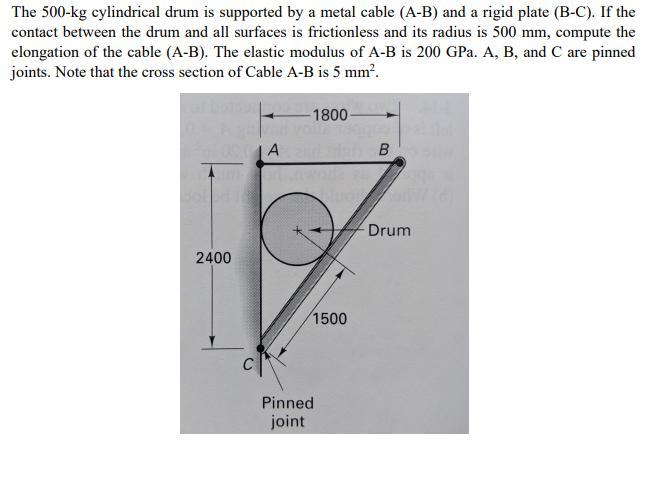
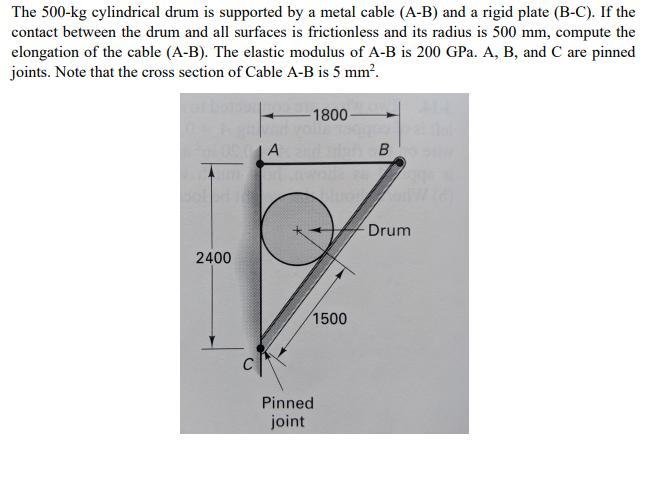
The 500-kg cylindrical drum is supported by a metal cable (A-B) and a rigid plate (B-C). If the contact between the drum and all

surfaces is frictionless and its radius is 500 mm, compute the elongation of the cable (A-B). The elastic modulus of A-B is 200 GPa. A, B, and C are pinned joints. Note that the cross section of Cable A-B is 5 mm2 .

Physics
1 answer:
kotykmax [81]2 years ago
8 0

Explanation:

Beloware attachments containing the complete question and solution.

You might be interested in
on the surface of planet x a body with a mass of 10 kilograms weighs 40 newtons. The magnitude of the acceleration due to gravit
tamaranim1 [39]
Based on the Newton's second law of motion, the value of the net force acting on the object is equal to the product of the mass and the acceleration due to gravity. If we let a be the acceleration due to gravity, the equation that would allow us to calculate it's value is,
      W = m x a
where W is weight, m is mass, and a is acceleration. Substituting the known values,
    40 kg m/s² = (10 kg) x a
Calculating for the value of a from the equation will give us an answer equal to 4. 
ANSWER: 4 m/s². 

6 0
2 years ago
Read 2 more answers
A golfer hits a golf ball at an angle of 25.0° to the ground. if the golf ball covers a horizontal distance of 301.5 m, what is
kvasek [131]

<u>Answer:</u>

 Maximum height reached = 35.15 meter.

<u>Explanation:</u>

Projectile motion has two types of motion Horizontal and Vertical motion.

Vertical motion:

         We have equation of motion, v = u + at, where v is the final velocity, u is the initial velocity, a is the acceleration and t is the time taken.

         Considering upward vertical motion of projectile.

         In this case, Initial velocity = vertical component of velocity = u sin θ, acceleration = acceleration due to gravity = -g m/s^2 and final velocity = 0 m/s.

        0 = u sin θ - gt

         t = u sin θ/g

    Total time for vertical motion is two times time taken for upward vertical motion of projectile.

    So total travel time of projectile = 2u sin θ/g

Horizontal motion:

  We have equation of motion , s= ut+\frac{1}{2} at^2, s is the displacement, u is the initial velocity, a is the acceleration and t is the time.

  In this case Initial velocity = horizontal component of velocity = u cos θ, acceleration = 0 m/s^2 and time taken = 2u sin θ /g

 So range of projectile,  R=ucos\theta*\frac{2u sin\theta}{g} = \frac{u^2sin2\theta}{g}

 Vertical motion (Maximum height reached, H) :

     We have equation of motion, v^2=u^2+2as, where u is the initial velocity, v is the final velocity, s is the displacement and a is the acceleration.

   Initial velocity = vertical component of velocity = u sin θ, acceleration = -g, final velocity = 0 m/s at maximum height H

   0^2=(usin\theta) ^2-2gH\\ \\ H=\frac{u^2sin^2\theta}{2g}

In the give problem we have R = 301.5 m,  θ = 25° we need to find H.

So  \frac{u^2sin2\theta}{g}=301.5\\ \\ \frac{u^2sin(2*25)}{g}=301.5\\ \\ u^2=393.58g

Now we have H=\frac{u^2sin^2\theta}{2g}=\frac{393.58*g*sin^2 25}{2g}=35.15m

 So maximum height reached = 35.15 meter.
7 0
2 years ago
Heat engines were first envisioned and built during the industrial revolution. Explain the thermodynamics of a heat engine comme
Artyom0805 [142]

Heat engines were developed during industrial revolution.

Generally a heat engine contains three parts i.e source, sink and working substance.

The source of a heat engine is present at a higher temperature as compared to the sink. Due to the temperature difference, the heat will flow from source to sink through working substance.

Let us consider  T_{1}\ and\ T_{2} are the temperature of source and sink.

As the source is at higher temperature as compared to sink, heat will flow from source to sink.

Let\ Q_{1}\ and\ Q_{2} are the heat provided by source and heat rejected to sink.

Hence, the work done by the working substance will be -

                                                W\ =\ Q_{1}-Q_{2}

The efficiency of a heat engine is defined as the ratio of output to the input energy.

Here output = workdone [W]

Hence, the efficiency of a heat engine is calculated as -

                     Efficiency\ [\eta]=\frac{W}{Q_{1}}

                                        \eta\ =\frac{Q_{1}- Q_{2}} {Q_{1}}

                                               =\ 1-\frac{Q_{2}} {Q_{1}}

This is the expression for the efficiency of heat engine.

Here, all the heat absorbed by the working substance can not be converted to desired output. The efficiency of a heat engine can not be 100 percent. Some amount of heat is lost in the form of sound and heat due to the friction which is produced due to the relative motion between various parts of the machine.

6 0
2 years ago
Read 2 more answers
In Part 6.2.2, you will determine the wavelength of the laser by shining the laser beam on a "diffraction grating", a set of reg
harkovskaia [24]

Answer:

λ = 2042 nm

Explanation:

given data

screen distance d = 11 m

spot s = 4.5 cm = 4.5 ×10^{-2} m

separation L = 0.5 mm = 0.5 ×10^{-3} m

to find out

what is λ

solution

we will find first angle between first max and central bright

that is tan θ = s/d

tan θ = 4.5 ×10^{-2}  / 11

θ = 0.234

and we know diffraction grating for max

L sinθ  = mλ

here we know m = 1  so put all value and find λ

L sinθ  = mλ

0.5 ×10^{-3}  sin(0.234)  = 1 λ

λ = 2042.02 ×10^{-9}  m

λ = 2042 nm

3 0
2 years ago
A string is wrapped around a pulley with a radius of 2.0 cm and no appreciable friction in its axle. The pulley is initially not
stiks02 [169]

Answer:

2

Explanation:

2

5 0
2 years ago
Read 2 more answers
Other questions:
  • A 1200-kilogram space vehicle travels at 4.8 meters per second along the level surface of Mars. If the magnitude of the gravitat
    8·2 answers
  • An atom of neon has a radius rNe = 38. pm and an average speed in the gas phase at 25°C of 350.⁢/ms. Suppose the speed of a neon
    10·1 answer
  • Monica pulls her daughter Jessie in a bike trailer. The trailer and Jessie together have a mass of 25 kg. Monica starts up a 100
    12·1 answer
  • The frequency of a wave increases. If the speed of the wave remains constant, what happens to the distance between successive cr
    6·1 answer
  • a)A concentration C(mol/L) varies with time (min) according to the equation C=3.00exp(−2.00t) a) What are the implicit units of
    7·1 answer
  • A large solar panel on a spacecraft in Earth orbit produces 1.0 kW of power when the panel is turned toward the sun. What power
    9·1 answer
  • A vertical spring of constant k = 400 N/m hangs at rest. When a 2 kg mass is attached to it, and it is released, the spring exte
    6·1 answer
  • A hydroelectric dam holds back a lake of surface area 3.0×10⁶m2 that has vertical sides below the water level. The water level i
    6·1 answer
  • A rigid, uniform bar with mass mmm and length bbb rotates about the axis passing through the midpoint of the bar perpendicular t
    10·1 answer
  • 100 POINTS! I will mark brainliest! Record your hypothesis as an “if, then” statement for the rate of dissolving the compounds:
    6·1 answer
Add answer
Login
Not registered? Fast signup
Signup
Login Signup
Ask question!