answer.
Ask question
Login Signup
Ask question
All categories
  • English
  • Mathematics
  • Social Studies
  • Business
  • History
  • Health
  • Geography
  • Biology
  • Physics
  • Chemistry
  • Computers and Technology
  • Arts
  • World Languages
  • Spanish
  • French
  • German
  • Advanced Placement (AP)
  • SAT
  • Medicine
  • Law
  • Engineering
Rudiy27
2 years ago
3

For a cantilever beam subjected to a triangular distributed load, what is the order of the internal moment expression of the bea

m as a function of the location

Physics
1 answer:
bearhunter [10]2 years ago
6 0

Answer:

The Order is 4th order

Explanation:

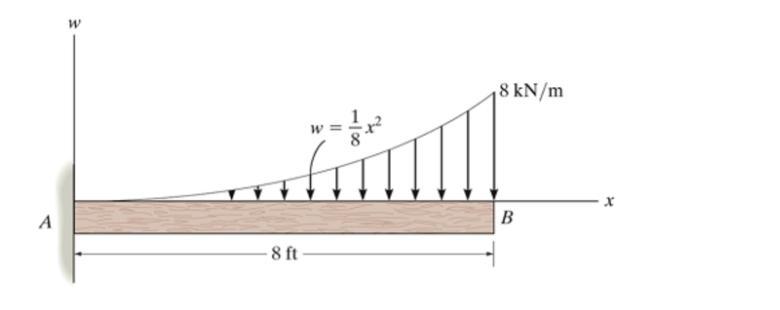
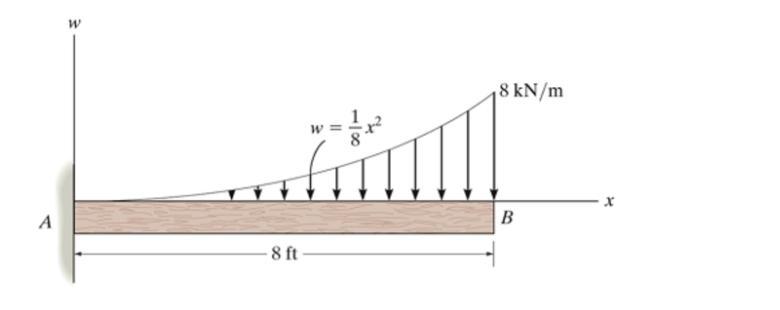
Let take the diagram on the first uploaded image as an example of triangular distributed load  

Let x denote the location

To obtain the vertical force acting at point a we integrate the function  

          \frac{dA_y}{dx} = w

    where A_y is the vertical force

    dx is the change in location

     w is a single component of force acting downwards

             A_y = \int\limits^L_0 {w} \, dx

           A_y = \int\limits^8_0 {\frac{x^2}{8} } \, dx

                 =  \frac{1}{8}  [\frac{8^3}{3} ]

                  = 21.33N

To obtain the moment of of inertia \

              M_A = \int\limits^L_0 {wx} \, dx

                     =\int\limits^8_0 {[\frac{x^2}{8} ]x} \, dx

                     = \frac{8^4}{32}

                   = 128 Nm

To obtain the shear force acting at a distance x from A

             V = A_y -\int\limits^x_0 {[\frac{x^2}{8} ]} \, dx

                  = 21.33 - \frac{x^3}{24}

   To obtain the moment about the triangular distributed load section that is at a distance x from A as shown on the diagram

       = >    dM = \int\limits^x_0 {V} \, dx

          =>        M_x -M_A = \int\limits^x_0 {[21.33- \frac{x^3}{24}]} \, dx

      =>           M_x = 128 + 21.33x -\frac{x^4}{96}

Looking at this equation as a polynomial we see that the order is 4 i.e x^4


You might be interested in
At a given point on a horizontal streamline in flowing air, the static pressure is â2.0 psi (i.e., a vacuum) and the velocity is
Nastasia [14]
At a point on the streamline, Bernoulli's equation is
p/ρ + v²/(2g) = constant
where
p = pressure
v = velocity
ρ = density of air, 0.075 lb/ft³ (standard conditions)
g = 32 ft/s²

Point 1:
p₁ = 2.0 lb/in² = 2*144 = 288 lb/ft²
v₁ = 150 ft/s

Point 2 (stagnation):
At the stagnation point, the velocity is zero.

The density remains constant.
Let p₂ = pressure at the stagnation point.
Then,
p₂ = ρ(p₁/ρ + v₁²/(2g))
p₂ = (288 lb/ft²) + [(0.075 lb/ft³)*(150 ft/s)²]/[2*(32 ft/s²)
     = 314.37 lb/ft²
     = 314.37/144 = 2.18 lb/in²

Answer: 2.2 psi

5 0
2 years ago
If you add 700 kJ of heat to 700 g of water at 70 degrees C, how much water is left in the container? The latent heat of vaporiz
makkiz [27]

Answer:A

Explanation:Find attached picture file for details

3 0
2 years ago
A black, totally absorbing piece of cardboard of area A = 1.7 cm2 intercepts light with an intensity of 8.1 W/m2 from a camera s
Furkat [3]

Answer:

2.7x10⁻⁸ N/m²

Explanation:

Since the piece of cardboard absorbs totally the light, the radiation pressure can be found using the following equation:

p_{rad} = \frac{I}{c}

<u>Where:</u>

p_{rad}: is the radiation pressure

I: is the intensity of the light = 8.1 W/m²

c: is the speed of light = 3.00x10⁸ m/s

Hence, the radiation pressure is:

p_{rad} = \frac{I}{c} = \frac{8.1 W/m^{2}}{3.00 \cdot 10^{8} m/s} = 2.7 \cdot 10^{-8} N/m^{2}

Therefore, the radiation pressure that is produced on the cardboard by the light is 2.7x10⁻⁸ N/m².

I hope it helps you!

3 0
2 years ago
Read 2 more answers
You are flying a hang glider at 14 mph in the northeast direction (45°). The wind is blowing at 4 mph from due north.
Afina-wow [57]

Answer:

<em>a) 17.05 mph</em>

<em>b) 54.7°  northeast direction</em>

<em>c) 10.71 mph</em>

<em>The direction is -22.58° relative to the east.</em>

<em></em>

<em>To head northeast, you must either increase your gliding speed or increase your angle relative to the x-axis greater than 45°.</em>

Explanation:

The question is a little confusing but, I guess the correct question should be;

You are flying a hang glider at 14 mph in the northeast direction (45°). The wind is blowing at 4 mph due north.

a) What is your airspeed?

b) What angle (direction) are you flying?

c) The wind increases to 14 mph from north. Now what is your airspeed and what direction are you flying? If your destination is to the northeast, how would you change your speed or direction so you might make it there?

NB: The difference in the question and my suggestion is highlighted boldly.

Your speed = 14 mph

direction is 45° northeast

Th wind speed = 4 mph

direction is north

We resolve the your speed and the wind speed into the horizontal and vertical components

For vertical the component component

V_{y} = 14(sin 45) + 4 = 9.89 + 4 = 13.89 mph

For the horizontal speed component

V_{x} = 14(cos 45) + 0 = 9.89 + 0 = 9.89 mph

Resultant speed = \sqrt{V^{2} _{y}+V^{2} _{x}  }

==> \sqrt{13.89^{2} +9.89^{2}   } = <em>17.05 mph  This is your airspeed</em>

b) To get your direction, we use

tan ∅ = V_{y} /V_{x}

tan ∅ = 13.89/9.89 = 1.413

∅ = tan^{-1}(1.413) = <em>54.7°  northeast direction</em>

c) If the wind increases to 14 mph from the north, then it means the wind blows due south. As before, only the vertical component is affected .

In this case,

V_{y} = 14(sin 45) - 14 = 9.89 - 14 = -4.11 mph

Resultant speed = \sqrt{V^{2} _{y}+V^{2} _{x}  }

==> \sqrt{4.11^{2} +9.89^{2}   } = <em>10.71 mph  This is your airspeed</em>

Your direction will be,

tan ∅ = V_{y} /V_{x}

tan ∅ = -4.11/9.89 = -0.416

∅ = tan^{-1}(-0.416) =<em> -22.58°  this is the angle you'll travel relative to the east.</em>

<em>To head northeast, you must either increase your gliding speed or increase your angle relative to the x-axis greater than 45°.</em>
5 0
2 years ago
A crane uses a block and tackle to lift a 2200N flagstone to a height of 25m
Cloud [144]

Remember the headline:  ENERGY IS NEVER CREATED OR DESTROYED

The amount of energy before and after are always equal.  All we ever do with energy is move it around from one place to another.

a). A crane can't create energy.  Lifting the same rock in 20 different ways always takes the <u><em>same amount of work</em></u>.  It doesn't matter whether one person picks the rock straight up, or 50 people get around it and lift it, or roll it up a ramp, or lift it with 16 pulleys and a mile of rope, or use a giant steam crane.

You want to lift a 2200N weight up 25m, you're going to have to supply

(2200N) x (25m) = <em>55,000 Joules</em> of work.

c). YOU put out 55,000 Joules of energy.  It had to GO someplace. Where is it now ? ===>  It's the potential energy the rock has now, from being 25m higher than it was before.  That <em>55,000 Joules</em> is NOW the potential energy  of the rock.

No energy was created or destroyed.  It just got moved around.  

55,000 Joules of energy began as nuclear energy in the core of the sun. Solar radiation carried it to the Earth. Plants absorbed it, and stored it as chemical energy.  You ... or a cow that you ate later ... ate the plants and took the chemical energy.  One way or the other, the chemical energy got stored in your blood and fat.  When you needed to put it out somewhere, you moved it into your muscles, and they converted it into mechanical energy.  Then you used the mechanical energy to exert forces.  Today, you used the original 55,000 joules to lift the flagstone, and NOW that energy is in the flagstone, 25 meters up off the ground !

6 0
2 years ago
Other questions:
  • What is the mass of a large dog that weighs 441 newtons
    10·1 answer
  • Can a small child play with fat child on the seesaw?Explain how?
    14·2 answers
  • The drag force, fd, imposed by the surrounding air on a vehicle moving with velocity v is given by fd = cdaρv 2/2 where cd is a
    7·1 answer
  • 40-turn circular coil (radius = 4.0 cm, total resistance = 0.20 ) is placed in a uniform magnetic field directed perpendicular
    5·1 answer
  • The suspension cable of a 1,000 kg elevator snaps, sending the elevator moving downward through its shaft. The emergency brakes
    14·1 answer
  • A girl at an airport rolls a ball north on a moving walking that moves east. If the ball’s speed with respect to the walkway is
    5·1 answer
  • Carry's car has a mass of 1000 kg and its brakes can apply 8000 N of force. If she is driving at 24 m/s and sees something in th
    5·1 answer
  • An uncharged 30.0-µF capacitor is connected in series with a 25.0-Ω resistor, a DC battery, and an open switch. The battery has
    7·2 answers
  • An automobile is traveling at a constant 15 m/s, then it undergoes acceleration from that moment forward. Which statement best d
    7·1 answer
  • A balky cow is leaving the barn as you try harder and harder to push her back in. In coordinates with the origin at the barn doo
    10·1 answer
Add answer
Login
Not registered? Fast signup
Signup
Login Signup
Ask question!
