answer.
Ask question
Login Signup
Ask question
All categories
  • English
  • Mathematics
  • Social Studies
  • Business
  • History
  • Health
  • Geography
  • Biology
  • Physics
  • Chemistry
  • Computers and Technology
  • Arts
  • World Languages
  • Spanish
  • French
  • German
  • Advanced Placement (AP)
  • SAT
  • Medicine
  • Law
  • Engineering
il63 [147K]
2 years ago
13

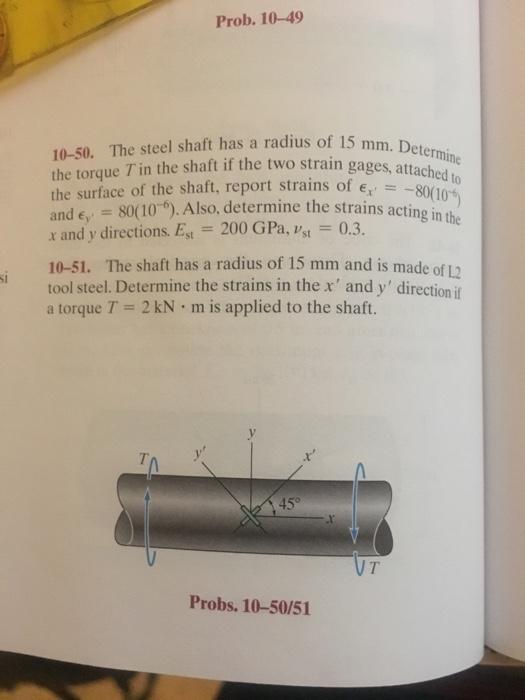
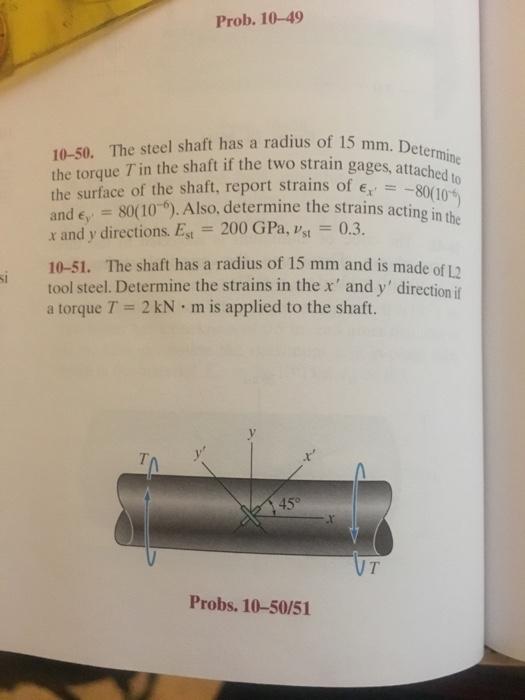
The steel shaft has a radius of 15 mm. Determine the torque Tin the shaft if the two strain gages, attached to the surface of th

e shaft, report strains of elementof_x = -80(10^-6) and elementof_y = 80(10^-6). Also, determine the strains acting in the x and y directions. E_st = 200 GPa. v_st = 0.3. The shaft has a radius of 15 mm and is made of L2 tool steel. Determine the strains in the x' and y direction a torque T = 2 kN middot m is applied to the shaft.

Engineering
1 answer:
GalinKa [24]2 years ago
7 0

Answer:

Part A.

T = 65.248  N-m

Part B.

εx' = 0.00245

εy' = - 0.00245

Explanation:

Part A.

Given

R = 15 mm = 0.015 m

εx' = - 80*10⁻⁶

εy' = 80*10⁻⁶

Est = E = 200 GPa

υst = υ = 0.3

T = ?

In order to understand the question we can see the pic shown.

Pure shear.

εx = εy = 0

We apply the formula

εx' = εx*Cos²θ + εy*Sin²θ + γxy*Sin θ*Cos θ

If

θ = 45° we have

- 80*10⁻⁶ = 0 + 0 + γxy*Sin 45*Cos 45°

⇒   γxy = - 160*10⁻⁶

Also,

θ = 135° we have

80*10⁻⁶ = 0 + 0 + γxy*Sin 135*Cos 135°

⇒   γxy = - 160*10⁻⁶

Then we get G as follows:

G = E/(2*(1 + υ))

⇒    G = 200 GPa/(2*(1 + 0.3)) = 76.923 GPa = 76.923*10⁹Pa

we can use the equation

τ = G*γxy   ⇒       τ = (76.923*10⁹Pa)(160*10⁻⁶) = 12.308*10⁶Pa

Finally, we can obtain T as follows

T = τ*Jz/R

where

Jz = π*R⁴/2     ⇒   Jz = π*(0.015 m)⁴/2  = 7.95*10⁻⁸m⁴

⇒    T = 12.308*10⁶Pa*7.95*10⁻⁸m⁴/0.015 m

⇒    T = 65.248  N-m

Part B.

The shaft has a radius of 15 mm and is made of L2 tool steel. Determine the strains in the x' and y' direction if a torque T = 2 kN-m is applied to the shaft.

Given:

R = 15 mm = 0.015 m

Jz = 7.95*10⁻⁸m⁴

E = 200 GPa

υ = 0.3

G = 76.923*10⁹Pa

T = 2 kN-m = 2000 N-m

We can apply the equation

T = τ*Jz/R  ⇒   τ = T*R/Jz

⇒   τ = 2000 N-m*(0.015 m)/(7.95*10⁻⁸m⁴)

⇒   τ = 3.77*10⁸ Pa

We use the formula

τ = G*γxy   ⇒   γxy = τ/G

⇒   γxy = 3.77*10⁸ Pa/76.923*10⁹Pa

⇒   γxy = 0.0049

Now, we apply the equations

εx' = εx*Cos²θ + εy*Sin²θ + γxy*Sin θ*Cos θ

If

θ = 45° we have

εx' = 0 + 0 + 0.0049*Sin 45°*Cos 45°

⇒   εx' = 0.00245

If

θ = 135° we have

εy' = 0 + 0 + 0.0049*Sin 135°*Cos 135°

⇒   εy' = - 0.00245

You might be interested in
Why is it that dislocations play an important role in controlling the mechanical properties of metallic materials, however, they
klio [65]

Answer:

dislocations play an important role in controlling as

Explanation:

As dislocations plays an important role in the ductility, elasticity and plurality of materials

  • The elastic and elastic deflections play a large role in their properties as the metallic materials, because the dislocation of a glass material does not play a major role in their properties.

5 0
2 years ago
A surface grinding operation is used to finish a flat plate that is 5.50 in wide and 12.500 in long. The starting thickness is 1
valina [46]

Answer:

77.40

Explanation:

Initial width = 5.5 Inches

Initial length = 12.5 inches

Initial thickness = 1.085 inches

After grinding

Thickness of flat plate  = 1 inch

Grinding wheel

starting diameter( di )= 6.013 inches

width of grinding wheel = 0.5 inch

After operation

Diameter of grinding wheel ( df ) = 5.997

<u>Calculate the grinding ratio in this operation</u>

First step : determine the volume of material removed from flat plate

= Length of flat plate * width of flat plate * change in thickness

= 12.5 * 5.5 * ( 1.085 - 1 )

= 5.8437 in^3

Volume of material from grinding wheel

= π / 4 * ( di^2 - df^2 ) * width  

= π / 4  * ( 6.013^2 - 5.997^2 ) * 0.5

= 0.0755 in^3

<u>Finally the Grinding ratio</u>

= 5.8437  / 0.0755

= 77.4

5 0
2 years ago
Test if a number grade is an A (greater than or equal to 90). If so, print "Great!". Hint: Grades may be decimals. Sample Run En
Sphinxa [80]

Answer:

In Python:

grade = float(input("Enter a Number: "))

if grade >= 90:

   print("Great!")

Explanation:

This prompts the user for grade

grade = float(input("Enter a Number: "))

This checks for input greater than or equal to 90

if grade >= 90:

If yes, this prints "Great"

   print("Great!")

3 0
2 years ago
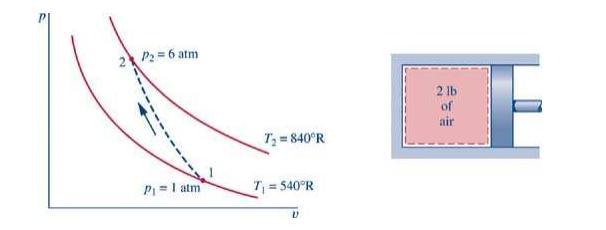
A piston-cylinder assembly contains 2 lb of air at a temperature of 540 °R and a pressure of 1 atm. The air compressed to a stat
dalvyx [7]

Answer:

123.9 Btu

Explanation:

The energy balance on the air is:

∆E = E2 − E1 = ∆KE + ∆PE + ∆U = Q + W

ignore  ∆KE and ∆PE,

W = ∆U − Q = m(u2 − u1) − Q;                               (u2 − u1 = 51.94 Btu/lb)

ideal gas properties is attached

W = (2 lb)(143.98 − 92.04) Btu/lb − (− 20 Btu) = 123.9 Btu

u2 − u1 ≈ cv(T2 − T1) = (0.173 Btu/lb°R)(840 − 540) °R = 51.9 Btu/lb

6 0
2 years ago
A spring-loaded toy gun is used to shoot a ball of mass m = 1.50 kg straight up in the air. The spring has spring constant k = 6
adell [148]

Answer:

1) a) Mechanical energy is conserved because no dissipative forces perform work on the ball.

2) The muzzle velocity of the ball is approximately 5.272 meters per second.

3) The maximum height of the ball is 1.417 meters.

Explanation:

1) Which of the following statements are true?

a) Mechanical energy is conserved because no dissipative forces perform work on the ball.

True, statement indicates that there is no air resistence and no friction between ball and the inside of the gun because the first never touches the latter one.

b) The forces of gravity and the spring have potential energies associated with them.

False, force of gravity do work on the ball and spring receives a potential energy at being deformated by the ball.

c) No conservative forces act in this problem after the ball is released from the spring gun.

False, the absence of no conservative forces is guaranteed for the entire system according to the statement of the problem.

2) According to the statement, we understand that spring is deformed and once released and just after reaching its equilibrium position, the muzzle velocity is reached. As spring deformation is too small in comparison with height, we can neglect changes in gravitational potential energy. By Principle of Energy Conservation, we describe the motion of the ball by the following expression:

U_{k, 1}+K_{1}=U_{k,2}+K_{2} (Eq. 1)

Where:

U_{k,1}, U_{k,2} - Initial and final elastic potential energies of spring, measured in joules.

K_{1}, K_{2} - Initial and final translational kinetic energies of the ball, measured in joules.

After using definitions of elastic potential and translational kinetic energies, we expand the equation above as:

\frac{1}{2}\cdot m\cdot (v_{2}^{2}-v_{1}^{2}) = \frac{1}{2}\cdot k\cdot (x_{1}^{2}-x_{2}^{2})

And the final velocity is cleared:

m\cdot (v_{2}^{2}-v_{1}^{2}) = k\cdot (x_{1}^{2}-x_{2}^{2})

v_{2}^{2}-v_{1}^{2} =\frac{k}{m}\cdot (x_{1}^{2}-x_{2}^{2})

v_{2}^{2} =v_{1}^{2}+\frac{k}{m}\cdot (x_{1}^{2}-x_{2}^{2})

v_{2} = \sqrt{v_{1}^{2}+\frac{k}{m}\cdot (x_{1}^{2}-x_{2}^{2}) } (Eq. 2)

Where:

v_{1}, v_{2} - Initial and final velocities of the ball, measured in meters per second.

k - Spring constant, measured in newtons per meter.

m - Mass of the ball, measured in kilograms.

x_{1}, x_{2} - Initial and final position of spring, measured in meters.

If we know that v_{1} = 0\,\frac{m}{s}, k = 667\,\frac{N}{m}, m = 1.50\,kg, x_{1} = -0.25\,m and x_{2} = 0\,cm, the muzzle velocity of the ball is:

v_{2} =\sqrt{\left(0\,\frac{m}{s} \right)^{2}+\left(\frac{667\,\frac{N}{m} }{1.50\,kg} \right)\cdot [(-0.25\,m)^{2}-(0\,m)^{2}]}

v_{2}\approx 5.272\,\frac{m}{s}

The muzzle velocity of the ball is approximately 5.272 meters per second.

3) After leaving the toy gun, the ball is solely decelerated by gravity. We construct this model by Principle of Energy Conservation:

U_{g,2}+K_{2} = U_{g,3}+K_{3} (Eq. 3)

Where:

U_{g,2}, U_{g,3} - Initial and gravitational potential energies of the ball, measured in joules.

K_{2}, K_{3} - Initial and final translational kinetic energies of the ball, measured in joules.

After applying definitions of gravitational potential and translational kinetic energies, we expand the equation above and solve the resulting for the final height:

m\cdot g \cdot (h_{3}-h_{2}) = \frac{1}{2}\cdot m \cdot (v_{2}^{2}-v_{3}^{2})

h_{3}-h_{2}=\frac{v_{2}^{2}-v_{3}^{2}}{2\cdot g}

h_{3} = h_{2} +\frac{v_{2}^{2}-v_{3}^{2}}{2\cdot g} (Eq. 4)

h_{2}, h_{3} - Initial and final heights of the ball, measured in meters.

v_{2}, v_{3} - Initial and final velocities of the ball, measured in meters per second.

g - Gravitational acceleration, measured in meters per square second.

If we get that v_{2} = 5.272\,\frac{m}{s}, v_{3} = 0\,\frac{m}{s}, h_{2} = 0\,m and g = 9.807\,\frac{m}{s^{2}}, the maximum height of the ball is:

h_{3} = 0\,m+\frac{\left(5.272\,\frac{m}{s} \right)^{2}-\left(0\,\frac{m}{s} \right)^{2}}{2\cdot \left(9.807\,\frac{m}{s^{2}} \right)}

h_{3} = 1.417\,m

The maximum height of the ball is 1.417 meters.
5 0
2 years ago
Other questions:
  • A hydrogen-filled balloon to be used in high altitude atmosphere studies will eventually be 100 ft in diameter. At 150,000 ft, t
    7·1 answer
  • Pam Jones worked for 41 years at the same company and had positive performance ratings and personnel records. She needed a calcu
    9·1 answer
  • The basic barometer can be used to measure the height of a building. If the barometric readings at the top and the bottom of a b
    15·1 answer
  • One mole of iron (6 1023 atoms) has a mass of 56 grams, and its density is 7.87 grams per cubic centimeter, so thecenter-to-cent
    15·1 answer
  • An ideal Stirling cycle filled with air uses a 75 F energy reservoir as a sink. The engine is designed to so that the maximum ai
    8·1 answer
  • What ratio between differential gain and common-mode gain is called​
    9·1 answer
  • Who can work on a fixed ladder that extends more than 24 feet?
    11·1 answer
  • The BARO sensor informs the PCM about changes in weather and ____________________.
    14·1 answer
  • Mr. Ray deposited $200,000 in the Old and Third National Bank. If the bank pays 8% interest, how much will he have in the accoun
    10·2 answers
  • What term describes a guardrail system
    13·2 answers
Add answer
Login
Not registered? Fast signup
Signup
Login Signup
Ask question!