answer.
Ask question
Login Signup
Ask question
All categories
  • English
  • Mathematics
  • Social Studies
  • Business
  • History
  • Health
  • Geography
  • Biology
  • Physics
  • Chemistry
  • Computers and Technology
  • Arts
  • World Languages
  • Spanish
  • French
  • German
  • Advanced Placement (AP)
  • SAT
  • Medicine
  • Law
  • Engineering
Anna007 [38]
2 years ago
4

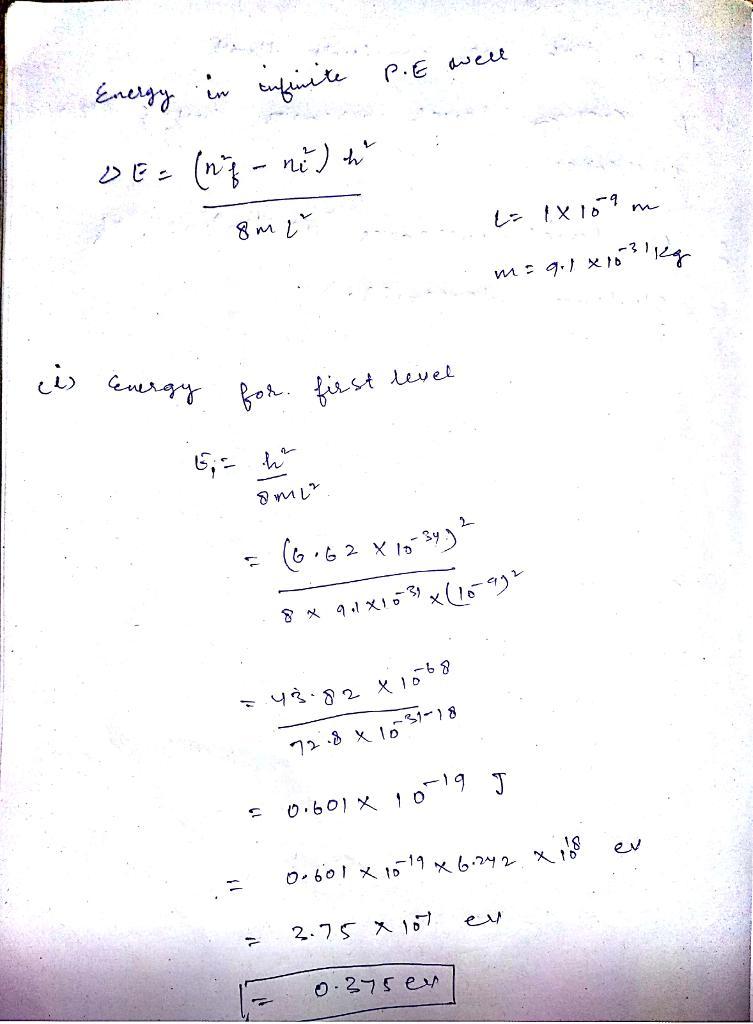
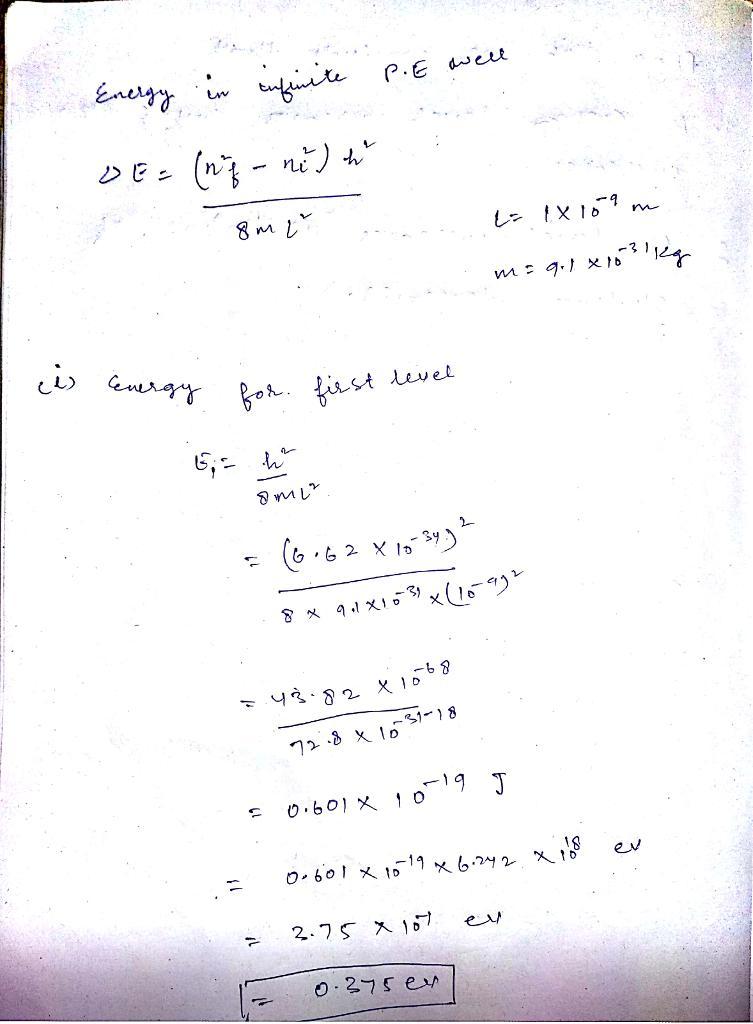
Infinite and finite potential energy well First consider an infinite one dimensional PE well of width 1 nm. Calculate the energi

es of the first three levels. Consider a finite PE well with the same width (1 nm). The height of the barrier is 2.0 eV. There are only three energy levels E1 0.23 eV. E2- 0.89 eV, and Es 1.81 eV. Are the finite PE well levels higher or lower than the corresponding infinite well levels? Find the electron penetration depth into the barrier for each of the three energy levels. What is your conclusions?

Engineering
1 answer:
Free_Kalibri [48]2 years ago
6 0

Answer:

See attached pictures.

Explanation:

See attached pictures for detailed explanation.

You might be interested in
(3) Calculate the heat flux through a sheet of brass 7.5 mm (0.30 in.) thick if the temperatures at the two faces are 150°Cand 5
bezimeni [28]

Answer:

a.) 1.453MW/m2,  b.)  2,477,933.33 BTU/hr  c.) 22,733.33 BTU/hr  d.) 1,238,966.67 BTU/hr

Explanation:

Heat flux is the rate at which thermal (heat) energy is transferred per unit surface area. It is measured in W/m2

Heat transfer(loss or gain) is unit of energy per unit time. It is measured in W or BTU/hr

1W = 3.41 BTU/hr

Given parameters:

thickness, t = 7.5mm = 7.5/1000 = 0.0075m

Temperatures 150 C = 150 + 273 = 423 K

                        50 C = 50 + 273 = 323 K

Temperature difference, T = 423 - 323 = 100 K

We are assuming steady heat flow;

a.) Heat flux, Q" = kT/t

K= thermal conductivity of the material

The thermal conductivity of brass, k = 109.0 W/m.K

Heat flux, Q" = \frac{109 * 100}{0.0075} = 1,453,333.33 W/m^{2} \\ Heat flux, Q" = 1.453MW/m^{2} \\

b.) Area of sheet, A = 0.5m2

Heat loss, Q = kAT/t

Heat loss, Q = \frac{109*0.5*100}{0.0075} = 726,666.667W

Heat loss, Q = 726,666.667 * 3.41 = 2,477,933.33 BTU/hr

c.) Material is now given as soda lime glass.

Thermal conductivity of soda lime glass, k is approximately 1W/m.K

Heat loss, Q=\frac{1*0.5*100}{0.0075} = 6,666.67W

Heat loss, Q = 6,666.67 * 3.41 = 22,733.33 BTU/hr

d.) Thickness, t is given as 15mm = 15/1000 = 0.015m

Heat loss, Q=\frac{109*0.5*100}{0.015} =363,333.33W

Heat loss, Q = 363,333.33 * 3.41 = 1,238,966.67 BTU/hr
5 0
2 years ago
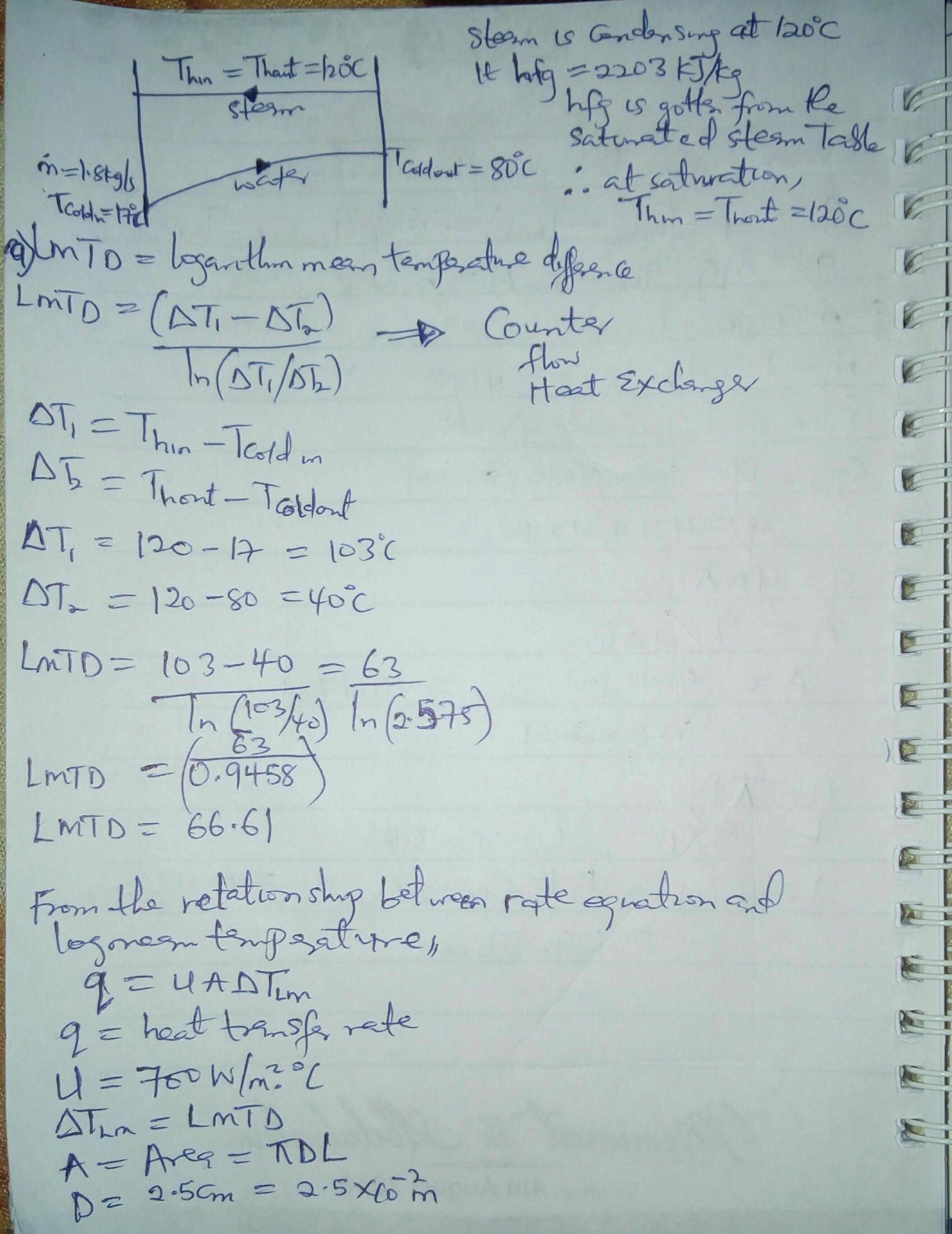
Water (cp = 4180 J/kg·°C) enters the 2.5 cm internal diameter tube of a double-pipe counter-flow heat exchanger at 17°C at a rat
aksik [14]

Answer:

Length = 129.55m, 129.55m

Explanation:

Given:

cp of water = 4180 J/kg·°C

Diameter, D = 2.5 cm

Temperature of water in =  17°C

Temperature of water out = 80°C

mass rate of water =1.8 kg/s.

Steam condensing at 120°C

Temperature at saturation = 120°C

hfg of steam at 120°C = 2203 kJ/kg

overall heat transfer coefficient of the heat exchanger = 700 W/m2 ·°C

U = 700 W/m2 ·°C

Since Temperature of steam is at saturation,

temperature of steam going in = temperature of steam out = 120°C

Energy balance:

Heat gained by water = Heat loss by steam

Let specific capacity of steam = 2010kJ/Kg .°C

Find attached the full solution to the question.

3 0
2 years ago
A shipment of rebar that weighs 745 kg would weigh roughly how much in pounds​
Andre45 [30]

Answer:

Dont no but will check

Explanation:

6 0
2 years ago
A six- lane freeway ( three lanes in each direction) in a scenic area has a measured free- flow speed of 55 mi/ h. The peak- hou
Novosadov [1.4K]

Answer:

0.867

Explanation:

The driver population factor (f_{p})can be estimated using the equation below:

f_{p} = \frac{V}{PHF*N*f_{HV}*v_{p}}

The value of the heavy vehicle factor (f_{HV}) is determined below:

The values of the E_{T} = 2 and E_{R} = 3 are gotten from the tables for the RVs, trucks and buses upgrades for passenger-car equivalents. Therefore:

f_{HV} = 1/[1+0.08(2-1)+0.06(3-1)] = 1/[1+0.08+0.12] = 1/1.2 = 0.833

Furthermore, the vp is taken as 2250 pc/(h*In) from the table of LOS criteria for lane freeway using the 15 minutes flow rate. Therefore:

f_{p} = 3900/[0.8*3*0.833*2250] = 3900/4498.2 = 0.867

6 0
2 years ago
Consider air entering a heated duct at P1 = 1 atm and T1 = 288 K. Ignore the effect of friction. Calculate the amount of heat pe
Ne4ueva [31]

Answer:

The solution for the given problem is done below.

Explanation:

M1 = 2.0

\frac{p1}{p*} = 0.3636

\frac{T1}{T*} = 0.5289

\frac{T01}{T0*} = 0.7934

Isentropic Flow Chart:  M1 = 2.0 , \frac{T01}{T1} = 1.8

T1 = \frac{1}{0.7934} (1.8)(288K) = 653.4 K.

In order to choke the flow at the exit (M2=1), the above T0* must be stagnation temperature at the exit.

At the inlet,

T02= \frac{T02}{T1}T1 = (1.8)(288K) = 518.4 K.

Q= Cp(T02-T01) = \frac{1.4(287 J / (Kg.K)}{1.4-1}(653.4-518.4)K = 135.7*10^{3} J/Kg.

5 0
2 years ago
Read 2 more answers
Other questions:
  • Theorems of Pappus and Guldinus are used to find: a. The surface area and volume of a body of rotation b. The surface area and v
    14·1 answer
  • A joining process in which a filler metal is melted and distributed by capillary action between faying surfaces, the base metals
    12·1 answer
  • Your roommate wants to learn about organizational chart. You can tell her that these charts can tell you all of these about an o
    10·1 answer
  • A particle has an initial velocity of v0 = 14 ft/s to the right, at s0 = 0, and a = 2 ft/s2 to the left. determine its position
    5·1 answer
  • A platinum resistance temperature sensor has a resistance of 120 Ω at 0℃ and forms one arm of a Wheatstone bridge. At this tempe
    12·1 answer
  • The atomic radii of a divalent cation and a monovalent anion are 0.77 nm and 0.136 nm, respectively.1- Calculate the force of at
    11·1 answer
  • The mass fractions of a mixture of gases are 15 percent nitrogen, 5 percent helium, 60 percent methane, and 20 percent ethane. T
    9·1 answer
  • Thermal energy generated by the electrical resistance of a 5-mm-diameter and 4-m-long bare cable is dissipated to the surroundin
    12·1 answer
  • The rectangular frame is composed of four perimeter two-force members and two cables AC and BD which are incapable of supporting
    9·1 answer
  • The typical Canadian worker is able to produce 100 board feet (a unit of measure) of lumber or 1000 light bulbs per year. The wo
    12·1 answer
Add answer
Login
Not registered? Fast signup
Signup
Login Signup
Ask question!