answer.
Ask question
Login Signup
Ask question
All categories
  • English
  • Mathematics
  • Social Studies
  • Business
  • History
  • Health
  • Geography
  • Biology
  • Physics
  • Chemistry
  • Computers and Technology
  • Arts
  • World Languages
  • Spanish
  • French
  • German
  • Advanced Placement (AP)
  • SAT
  • Medicine
  • Law
  • Engineering
Damm [24]
2 years ago
14

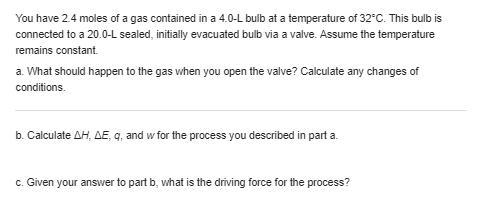
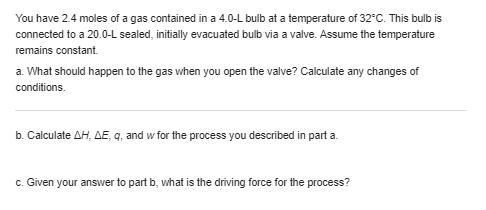
Consider 2.4 moles of a gas contained in a 4.0 L bulb at a constant temperature of 32°C. This bulb is connected to an evacuated

20.0 L sealed bulb via a valve. Assume that the temperature remains constant.a.What should happen to the gas when you open the valve?b.Calculate ΔH, ΔE, q, and w for the process you described above.

Chemistry
1 answer:
Luden [163]2 years ago
7 0

Complete Question

The complete question is shown on the first uploaded image

Answer

a

As the valve is opened , the gas will flow into the empty container until the both containers have the same pressure

b

\Delta H = 0\ , \Delta E = 0 , q= 0 , w= 0

c

The driving force for this process is the increase in entropy this is because the movement of the internal energy of the gas into a larger volume, what this does is that it increases the amount of disorder(entropy).

Explanation

In order to obtain the parameter in the part B of the question we are first obtain the initial pressure, using the ideal gas equation  

                      P = \frac{nRT}{V}

                     P = \frac{(2.4mol)(0.0821\frac{1 atm}{K \cdot \ mol} )}{4.0L}

                         P =15 \ atm

The next thing is to obtain the new pressure of the gas , using boyle's law

              P_1V_1 = P_2V_2

                  P_2 = \frac{P_1 V_1}{V_2}

                  P_2 = \frac{(15 \ atm)(4.0L)}{24.0 L}

                  P_2 = 2.5 \ atm    

Since the this process is isothermal , the change in heat is equal to zero

                      i.e  q = 0 J

  The workdone to move  the gas to the other container is zero because the  the pressure at this second container is zero due to the fact that it is a vacuum

    i.e  w = -P_{external} \Delta V

              =-(0 \ atm) (24.0 - 4.0L)

              = 0L \cdot atm

  Since the change in heat is zero and the workdone is zero then the change in internal energy is equal to 0

     This is because the change in internal energy is equal to a summation of change in heat and the workdone

                i.e \Delta E = q + w

                            = 0J

Generally the change in enthalpy is mathematically represented as

                \Delta H = n C_p \Delta T

Since the temperature is zero this means that the change in temperature is zero , substituting this value for change in temperature into the equation for  change in enthalpy

           \Delta H = n C_p (0)

                   = 0J


You might be interested in
A student obtained an unknown metal sample that weighed 65.3 g and at a temperature of 99.8oC, he placed it in a calorimeter con
lawyer [7]

Answer:

0.377 J/gºC

Explanation:

From the question given above, the following data were obtained:

Mass of metal (Mₘ) = 65.3 g

Initial temperature of metal (Tₘ) = 99.8 °C

Mass of water (Mᵥᵥ) = 43.7 g

Initial temperature of water (Tᵥᵥ) = 25.7 °C

Equilibrium temperature (Tₑ) = 34.5 °C

Specific heat capacity of water (Cᵥᵥ) = 4.18 J/gºC

Specific heat capacity of metal (Cₘ) =?

The specific heat capacity of metal can be obtained as illustrated below:

Heat lost by metal = heat gained by water.

MₘCₘ(Tₘ – Tₑ) = MᵥᵥCᵥᵥ(Tₑ – Cᵥᵥ)

65.3 × Cₘ (99.8 – 34.5) = 43.7 × 4.18 (34.5 – 25.7)

65.3Cₘ × 65.3 = 182.666 × 8.8

4264.09Cₘ = 1607.4608

Divide both side by 4264.09

Cₘ = 1607.4608 / 4264.09

Cₘ = 0.377 J/gºC

Therefore the specific heat capacity of the metal is 0.377 J/gºC

3 0
2 years ago
When heating a flammable or volatile solvent for a recrystallization, which of these statements are correct? More than one answe
otez555 [7]

Explanation:

A volatile substance is defined as the substance which can easily evaporate into the atmosphere due to weak intermolecular forces present within its molecules.

Whereas a flammable substance is defined as a substance which is able to catch fire easily when it comes in contact with flame.

Hence, when we heat a flammable or volatile solvent for a recrystallization then it should be kept in mind that should heat the solvent in a stoppered flask to keep vapor away from any open flames so that it won't catch fire.

And, you should ensure that no one else is using an open flame near your experiment.

Thus, we can conclude that following statements are correct:

  • You should heat the solvent in a stoppered flask to keep vapor away from any open flames.
  • You should ensure that no one else is using an open flame near your experiment.
3 0
2 years ago
If a 0.4856 gram sample of khp is dissolved in sufficient water to prepare 250 ml of solution, and 25 ml of the solution require
dangina [55]

Mass of potassium hydrogen pthalate KHP is 0.4856 g, its molar mass is 204.22 g/mol, number of moles of KHP can be calculated as follows:

n=\frac{m}{M}

Here, m is mass and M is molar mass, putting the values,

n=\frac{0.4856 g}{204.22 g/mol}=0.00237 mol

This will be number of moles of NaOH at equivalent point.

Detailed calculations:

Molarity is defined as number of moles in 1 L of solution, for 250 mL of solution, molarity will be:

M=\frac{0.00237 mol}{250 \times 10^{-3}L}=0.009511 M

For 25 mL, apply dilution law as follows:

M_{1}V_{1}=M_{2}V_{2}

Putting the values,

0.009511\times 250=M_{2}\times 25 mL

On rearranging,

M_{2}=\frac{0.009511\times 250}{25}=0.09511 M

Convert molarity into number of moles,

n=M\times V=0.09511 mol/L\times 25\times 10^{-3}L=0.00237 mol

At equivalent point, number of moles of KHP will be equal to NaOH, thus, number of moles of NaOH will be 0.00237 mol.

Calculation for molarity:

Volume of NaOH is 18.75 mL, thus, molarity can be calculated as follows:

M=\frac{n}{V}

Putting the values,

M=\frac{0.00237 mol}{18.75\times 10^{-3}L}=0.1264 M

Therefore, molarity of NaOH is 0.1264 M
7 0
2 years ago
Grapefruit juice is approximately ph 3, and tomato juice is approximately ph 4. a glass of grapefruit juice contains _____ h+ as
Elden [556K]
<span>Grapefruit juice is approximately pH 3, andtomato juice is approximately pH 4. A glass of grapefruit juice contains _3_ H+ as a glass of tomato juice.</span><span>
</span>
6 0
2 years ago
The intrinsic solubility of sulfathiazole, an old antimicrobial, is 0.002 mol/l. it is a weak acid and its pka is 7.12. what is
lys-0071 [83]

The formula we will use is:

pH = 0.5 (pKa – log C)

where C is the concentration of sulfathiazole in molarity or mol / L

Since all values are given, we can compute directly for pH:


pH = 0.5 (7.12 – log 0.002)

<span>pH = 4.91</span>

4 0
2 years ago
Other questions:
  • In the correct lewis structure for the nitrate ion, no3 –­, nitrogen has how many covalent bonds?
    7·1 answer
  • If you produce 14.5 g of O2 in the lab from a reaction that you showed by calculation could produce a maximum of 22.0 g of O2, w
    6·2 answers
  • Which set of reactants would result in a neutralization reaction?
    10·1 answer
  • Select the most acidic solution from these options. select the most basic (alkaline) solution from these options. select the lea
    9·2 answers
  • Carbonic acid reacts with water to yield bicarbonate ions and hydronium ions: h2co3+h2o⇌hco3−+h3o+ identify the conjugate acid-b
    15·2 answers
  • The water-gas shift reaction plays a central role in the chemical methods for obtaining cleaner fuels from coal: CO(g) + H2O (g)
    15·1 answer
  • In the first step of glycolysis, the given two reactions are coupled. reaction 1:reaction 2:glucose+Pi⟶glucose-6-phosphate+H2OAT
    11·1 answer
  • Shelby measured the volume of a cylinder and determined it to be 54.5 cm3 . The teacher told her that she was 4.25% too high in
    13·1 answer
  • A metal tank containing hydrogen gas has a pressure gauge that reads 575 psi. What is causing the pressure inside of the tank?
    13·1 answer
  • Identify a process that is NOT reversible. Identify a process that is NOT reversible. melting of snow baking of bread deposition
    8·1 answer
Add answer
Login
Not registered? Fast signup
Signup
Login Signup
Ask question!