answer.
Ask question
Login Signup
Ask question
All categories
  • English
  • Mathematics
  • Social Studies
  • Business
  • History
  • Health
  • Geography
  • Biology
  • Physics
  • Chemistry
  • Computers and Technology
  • Arts
  • World Languages
  • Spanish
  • French
  • German
  • Advanced Placement (AP)
  • SAT
  • Medicine
  • Law
  • Engineering
Andreas93 [3]
2 years ago
5

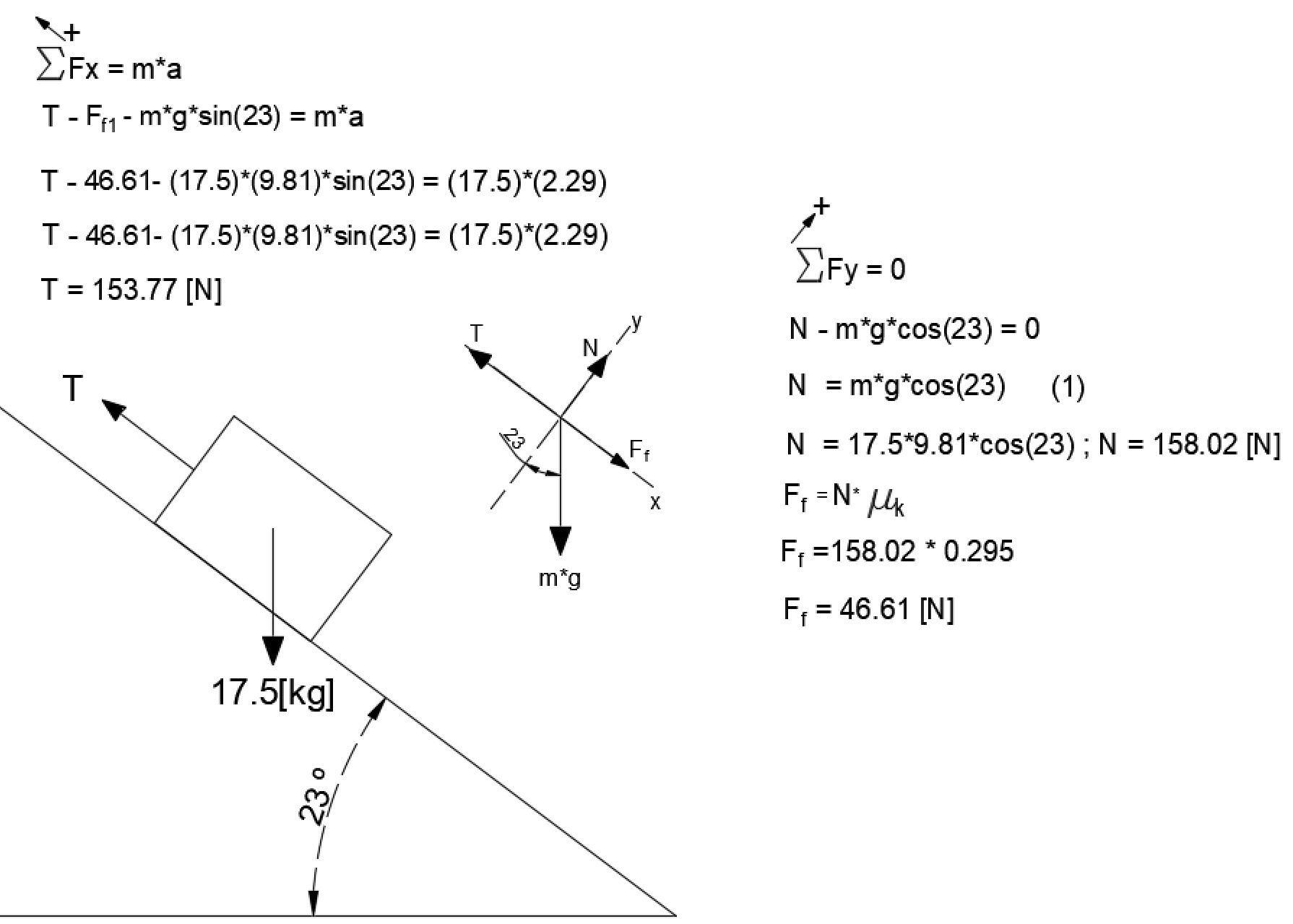
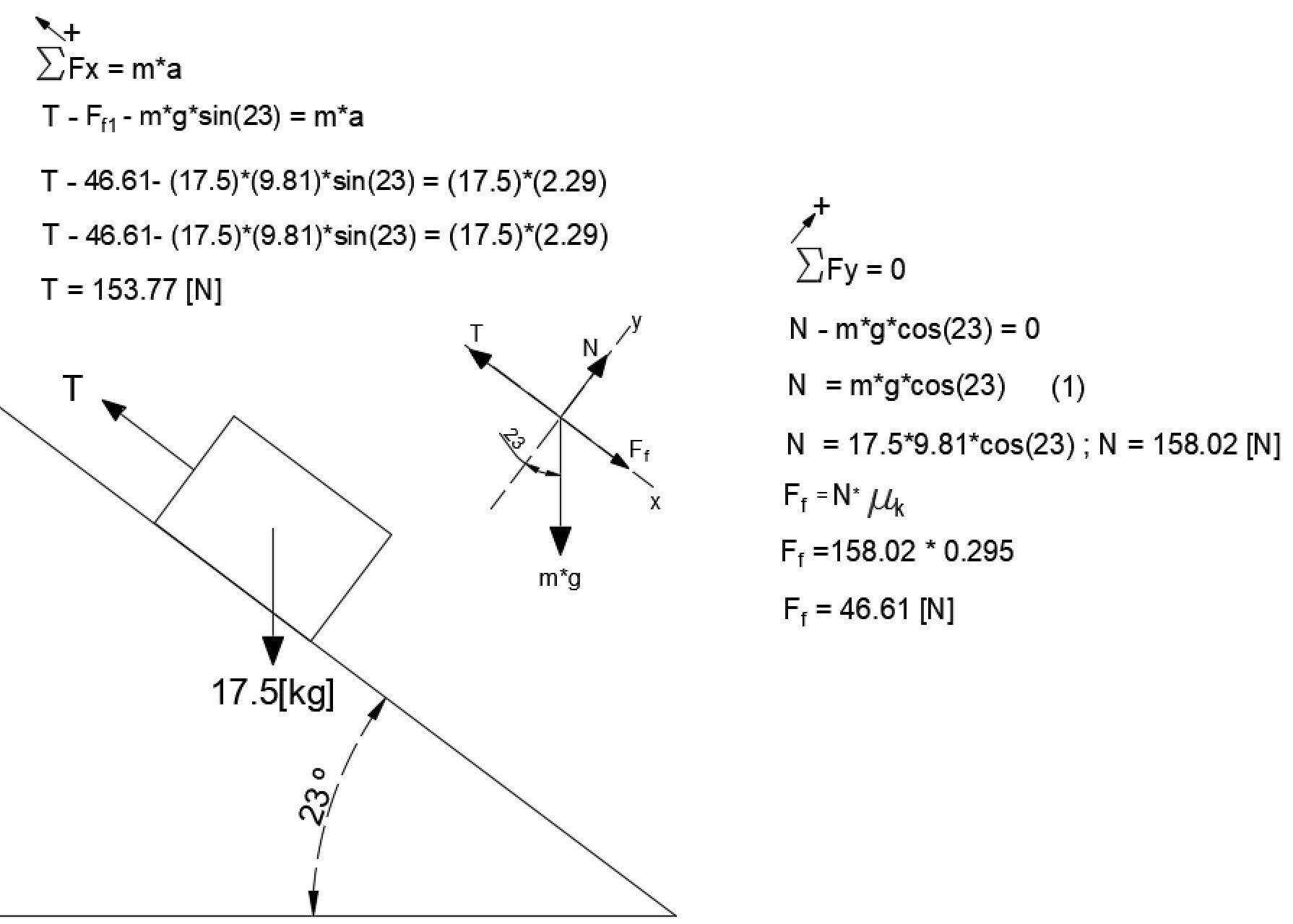
A box of mass m = 17.5 kg is pulled up a ramp that is inclined at an angle θ = 23.0 ∘ angle with respect to the horizontal. The

coefficient of kinetic friction between the box and the ramp is μ k = 0.295 , and the rope pulling the box is parallel to the ramp. If the box accelerates up the ramp at a rate of a = 2.29 m/s 2 , calculate the tension F T in the rope. Use g = 9.81 m/s 2 for the acceleration due to gravity.

Physics
1 answer:
Olenka [21]2 years ago
5 0

Answer:

T = 153.77 [N]

Explanation:

To solve this type of problems, we must make a free body diagram, with the forces acting on the box. Then performing a sum of forces on the Y axis equal to zero we can find the value of the normal force. After finding the friction force, we performed a sum of forces equal to the product of mass by acceleration (newton's second law). We can find the T-Force value.

You might be interested in
A flywheel is a mechanical device used to store rotational kinetic energy for later use. Consider a flywheel in the form of a un
Kamila [148]

Answer:

<em>a) 6738.27 J</em>

<em>b) 61.908 J</em>

<em>c)  </em>\frac{4492.18}{v_{car} ^{2} }

<em></em>

Explanation:

The complete question is

A flywheel is a mechanical device used to store rotational kinetic energy for later use. Consider a flywheel in the form of a uniform solid cylinder rotating around its axis, with moment of inertia I = 1/2 mr2.

Part (a) If such a flywheel of radius r1 = 1.1 m and mass m1 = 11 kg can spin at a maximum speed of v = 35 m/s at its rim, calculate the maximum amount of energy, in joules, that this flywheel can store?

Part (b) Consider a scenario in which the flywheel described in part (a) (r1 = 1.1 m, mass m1 = 11 kg, v = 35 m/s at the rim) is spinning freely at its maximum speed, when a second flywheel of radius r2 = 2.8 m and mass m2 = 16 kg is coaxially dropped from rest onto it and sticks to it, so that they then rotate together as a single body. Calculate the energy, in joules, that is now stored in the wheel?

Part (c) Return now to the flywheel of part (a), with mass m1, radius r1, and speed v at its rim. Imagine the flywheel delivers one third of its stored kinetic energy to car, initially at rest, leaving it with a speed vcar. Enter an expression for the mass of the car, in terms of the quantities defined here.

moment of inertia is given as

I = \frac{1}{2}mr^{2}

where m is the mass of the flywheel,

and r is the radius of the flywheel

for the flywheel with radius 1.1 m

and mass 11 kg

moment of inertia will be

I =  \frac{1}{2}*11*1.1^{2} = 6.655 kg-m^2

The maximum speed of the flywheel = 35 m/s

we know that v = ωr

where v is the linear speed = 35 m/s

ω = angular speed

r = radius

therefore,

ω = v/r = 35/1.1 = 31.82 rad/s

maximum rotational energy of the flywheel will be

E = Iw^{2} = 6.655 x 31.82^{2} = <em>6738.27 J</em>

<em></em>

b) second flywheel  has

radius = 2.8 m

mass = 16 kg

moment of inertia is

I = \frac{1}{2}mr^{2} =  \frac{1}{2}*16*2.8^{2} = 62.72 kg-m^2

According to conservation of angular momentum, the total initial angular momentum of the first flywheel, must be equal to the total final angular momentum of the combination two flywheels

for the first flywheel, rotational momentum = Iw = 6.655 x 31.82 = 211.76 kg-m^2-rad/s

for their combination, the rotational momentum is

(I_{1} +I_{2} )w

where the subscripts 1 and 2 indicates the values first and second  flywheels

(I_{1} +I_{2} )w = (6.655 + 62.72)ω

where ω here is their final angular momentum together

==> 69.375ω

Equating the two rotational momenta, we have

211.76 = 69.375ω

ω = 211.76/69.375 = 3.05 rad/s

Therefore, the energy stored in the first flywheel in this situation is

E = Iw^{2} = 6.655 x 3.05^{2} = <em>61.908 J</em>

<em></em>

<em></em>

c) one third of the initial energy of the flywheel is

6738.27/3 = 2246.09 J

For the car, the kinetic energy = \frac{1}{2}mv_{car} ^{2}

where m is the mass of the car

v_{car} is the velocity of the car

Equating the energy

2246.09 =  \frac{1}{2}mv_{car} ^{2}

making m the subject of the formula

mass of the car m = \frac{4492.18}{v_{car} ^{2} }
3 0
2 years ago
If you were to triple the size of the Earth (R = 3R⊕) and double the mass of the Earth (M = 2M⊕), how much would it change the g
EastWind [94]

Answer:

Decreased by a factor of 4.5

Explanation:

"We have Newton formula for attraction force between 2 objects with mass and a distance between them:

F_G = G\frac{M_1M_2}{R^2}

where G =6.67408 × 10^{-11} m^3/kgs^2 is the gravitational constant on Earth. M_1, M_2 are the masses of the object and Earth itself. and R distance between, or the Earth radius.

So when R is tripled and mass is doubled, we have the following ratio of the new gravity over the old ones:

\frac{F_G}{f_g} = \frac{G\frac{M_1M_2}{R^2}}{G\frac{M_1m_2}{r^2}}

\frac{F_G}{f_g} = \frac{\frac{M_2}{R^2}}{\frac{m_2}{r^2}}

\frac{F_G}{f_g} = \frac{M_2}{R^2}\frac{r^2}{m_2}

\frac{F_G}{f_g} = \frac{M_2}{m_2}(\frac{r}{R})^2

Since M_2 = 2m_2 and r = R/3

\frac{F_G}{f_g} = \frac{2}{3^2} = 2/9 = 1/4.5

So gravity would have been decreased by a factor of 4.5  

8 0
2 years ago
Which method should be used to determine which type of natural event produces the greatest number of sand dunes?
jeka94

Answer:

Stabilizing dunes involves multiple actions. Planting vegetation reduces the impact of wind and water. Wooden sand fences can help retain sand and other material needed for a healthy sand dune ecosystem. Footpaths protect dunes from damage from foot traffic.

Explanation:

5 0
2 years ago
Recall the previous question and the scenario with Zamir and Talia finding their way through a maze. Why is their displacement t
Ad libitum [116K]

Sample Response: Zamir and Talia’s total distances are different because they walked different paths in the maze. Zamir took a longer path. However, they had the same displacement because they both ended at the same position.

4 0
2 years ago
Read 2 more answers
Dentists' chairs are examples of hydraulic-lift systems. If a chair weighs 1400 N and rests on a piston with a cross-sectional a
NeX [460]

Answer:

Force applied to smaller cross section is

= 82.63 N

Explanation:

As we know

F_2 A_1 = F_1 A_2

where F1, F2 signifies the weight of the two chair in a hydraulic-lift system

And A_1, A_2 signifies the area of the two respective chairs in a hydraulic-lift system

Given -

F2=1400 N

A1 =1220 Square centimeter

A_2 = 72 Square centimeter

Substituting the given values in above equation, we get -

1400 * 72 = F1 * 1220\\F2 = 82.63

Force applied to smaller cross section is

= 82.63 N

8 0
2 years ago
Other questions:
  • Which object has the greatest inertia?
    13·2 answers
  • A block of mass m1 = 3.5 kg moves with velocity v1 = 6.3 m/s on a frictionless surface. it collides with block of mass m2 = 1.7
    6·1 answer
  • A ship sailing in the Gulf Stream is heading 25.0º west of north at a speed of 4.00 m/s relative to the water. Its velocity rela
    11·1 answer
  • A car traveling at 91.0 km/h approaches the turn off for a restaurant 30.0 m ahead. If the driver slams on the brakes with the a
    15·1 answer
  • An electric pump rated 1.5 KW lifts 200kg of water through a vertical height of 6m in 10 secs: way is the efficiency of the pump
    13·1 answer
  • You have been abducted by aliens and find yourself on a strange planet. Fortunately, you have a meter stick with you. You observ
    12·2 answers
  • A ball collides elastically with an immovable wall fixed to the earth’s surface. Which statement is false? 1. The ball's speed i
    5·1 answer
  • block of mass 0.5kg on a horizontal surface is attached to a horizontal spring of negligible mass and spring constant 50N/m . Th
    12·1 answer
  • Which statement best compares and contrasts two physical properties of matter?
    13·1 answer
  • A wooden piece is made in different shapes take length (l) = radius (r) = 2m Calculate its volume as a:
    11·1 answer
Add answer
Login
Not registered? Fast signup
Signup
Login Signup
Ask question!