answer.
Ask question
Login Signup
Ask question
All categories
  • English
  • Mathematics
  • Social Studies
  • Business
  • History
  • Health
  • Geography
  • Biology
  • Physics
  • Chemistry
  • Computers and Technology
  • Arts
  • World Languages
  • Spanish
  • French
  • German
  • Advanced Placement (AP)
  • SAT
  • Medicine
  • Law
  • Engineering
Setler79 [48]
2 years ago
7

A car weighs 2200 lb and is travelling 100 mi/h on a race track that is on a 3% upgrade. The car is preparing to pass a slower c

ar and its torque/engine speed curve is given by (with Me in ftlb and ne in revolutions per second): Me = 8ne - 0.05n; Drivetrain efficiency is 90%, drive axle slippage is 2%, wheel radius is 15 inches, frontal area is 22 ft2, drag coefficient is 0.35, and air density is 0.0022 slugs/ft3. If the car is in a gear that produces maximum torque, what would the car's maximum acceleration be?

Engineering
2 answers:
Lyrx [107]2 years ago
5 0

Answer:

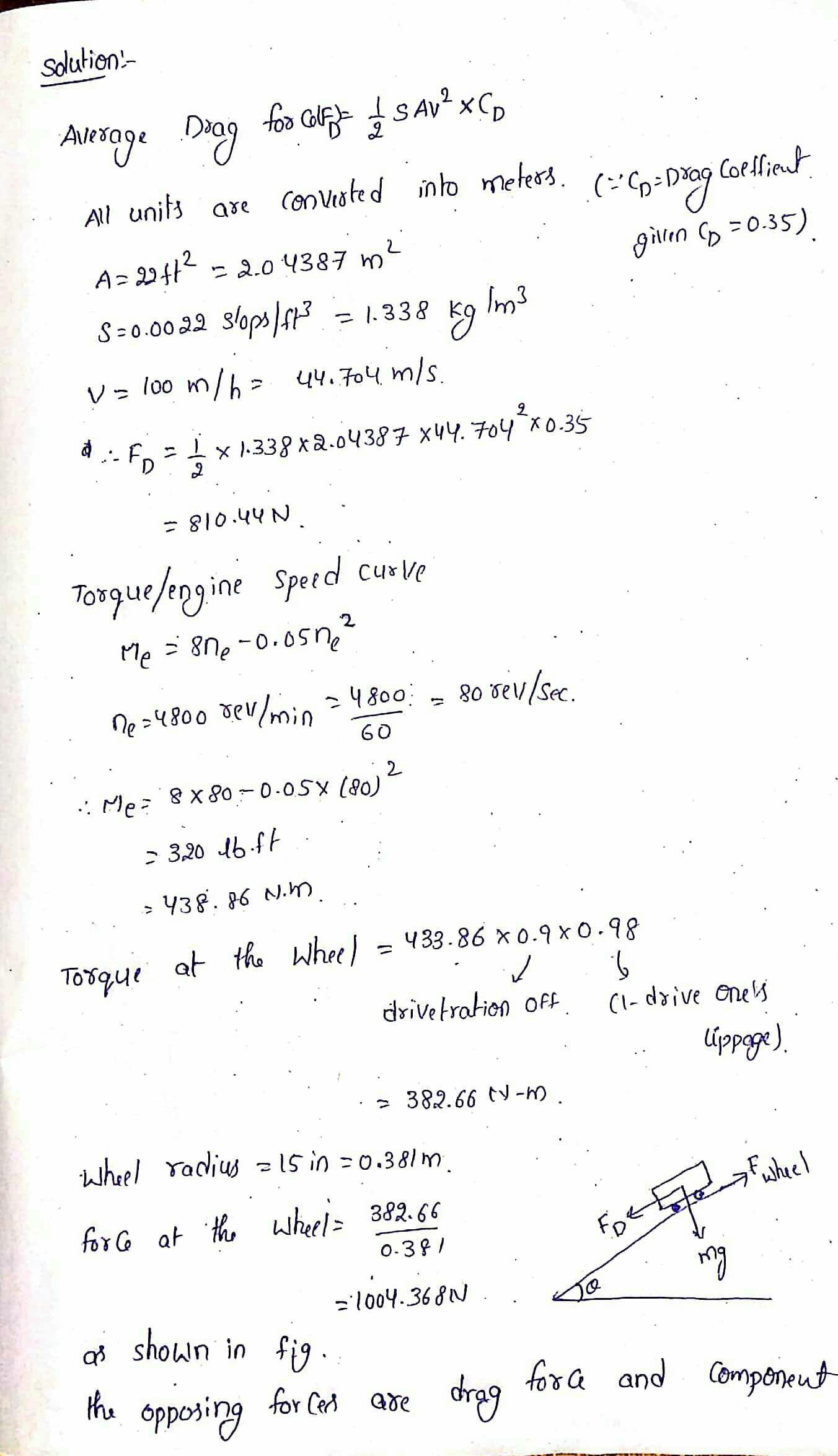
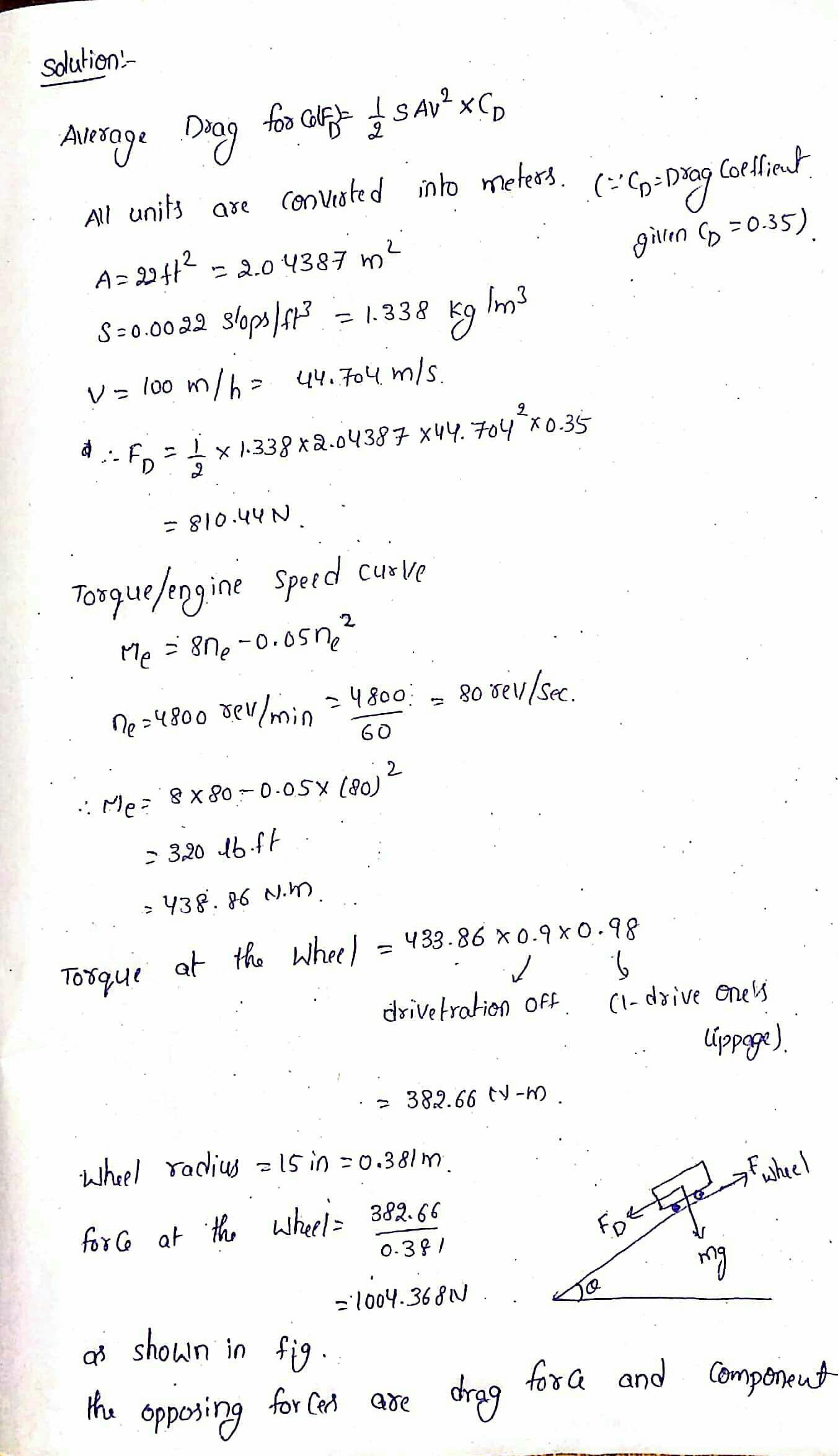
Detailed solution is given below:

White raven [17]2 years ago
4 0

Answer:

- 0.3275 ft / s^2 cars maximum acceleration

Explanation:

The average drag force is calculated as

fo = 1/2  ∝ Av^{2} α

α = drag coefficient = 0.35

∝ =  1.328

A = 22 ft^2 = 2.04387 m^2

S = 0.0022 slugs/ft3 = 1.1338 kg/m^3

V = 100 m/h = 44.704 m/s

fo = 1/2 * 1.328 * 2.04387 * 44.704^{2} * 0.35

 = 81044 N

next calculate the torque/engine  speed curve

Me = 8ne - 0.05 * ne^{2}

ne = 4800 rev /min = 80 rev /sec

Me = 8.80 - 0.05 * 80 ^2

= 320 Ib ft = 438.86 Nm

next calculate torque at the curve

= torque speed * drive train efficiency * 1 - drive axle slippage

= 433.86 * 0.9 * 0.98

= 382.66 N-m

force at the wheel ( F wheel) = 1004.368 N

radius = 15 in = 0.381 m

the opposing forces to this are drag force and weight along the upgrade

race track given = 0.03

which means the angle ∅ can be gotten from tan ∅ = 0.03  or ∅ =  1.71835

car mass = 2200 Ib = 997.9032 kg

to calculate the car's maximum acceleration we apply newton's second law

A max = F wheel - Fo - mg sin∅

1004.368 - 810.44 - 997.9032 * 9.8 * sin ∅

= 997.9032 Ra

= a = -0.09983 m/s^2

= - 0.3275 ft / s^2
         

You might be interested in
Determine F12 and F21 for the following configurations: (a) A long semicircular duct with diameter of 0.1 meters: (b) A hemisphe
uysha [10]

Answer:

long duct: 1.0 and 0.424

Hemisphere 1.0 ; 0.125; 0.5

Explanation:

For a long duct:

By inspection, F_{12} = 1.0

Calculating by reciprocity, F_{21} = \frac{A_{1} }{A_{2}F_{12}  }  = \frac{2RL}{\frac{3}{4}*2\pi RL  }* 1.0\\                                                         = 0.424

Hemisphere:

By reciprocity gives = 0.125

using the summation rule: F_{21} + F_{22} + F_{23} = 1

However, because this is a hemisphere, the value will be= 0.5 * 1

                                                                                               = 0.5

6 0
2 years ago
Evan notices a small fire in his workplace. Since the fire is small and the atmosphere is not smoky he decides to fight the fire
Norma-Jean [14]

Answer:

not calling the firemean

Explanation:

7 0
2 years ago
An excited electron in an Na atom emits radiation at a wavelength 589 nm and returns to the ground state. If the mean time for t
11Alexandr11 [23.1K]

Answer:   Inherent width in the emission line: 9.20 × 10⁻¹⁵ m or 9.20 fm

                length of the photon emitted: 6.0 m

Explanation:

The emitted wavelength is 589 nm and the transition time is ∆t = 20 ns.

Recall the Heisenberg's uncertainty principle:-

                                 ∆t∆E ≈ h ( Planck's Constant)

The transition time ∆t corresponds to the energy that is ∆E

E=h/t = \frac{(1/2\pi)*6.626*10x^{-34} J.s}{20*10x^{-9} } = 5.273*10x^{-27} J =  3.29* 10^{-8} eV.

The corresponding uncertainty in the emitted frequency ∆v is:

∆v= ∆E/h = (5.273*10^-27 J)/(6.626*10^ J.s)=  7.958 × 10^6 s^-1

To find the corresponding spread in wavelength and hence the line width ∆λ, we can differentiate

                                                    λ = c/v

                                                    dλ/dv = -c/v² = -λ²/c

Therefore,

      ∆λ = (λ²/c)*(∆v) = {(589*10⁻⁹ m)²/(3.0*10⁸ m/s)} * (7.958*10⁶ s⁻¹)

                                 =  9.20 × 10⁻¹⁵ m or 9.20 fm

     The length of the photon (<em>l)</em> is

l = (light velocity) × (emission duration)

  = (3.0 × 10⁸  m/s)(20 × 10⁻⁹ s) = 6.0 m          


6 0
2 years ago
Poles are values of Laplace transform variable, s, that make denominator of transfer function zero. Zeros are values of Laplace
Ostrovityanka [42]

Answer:

Zero 1 = -1

Zero 2 = -3

Pole 1 = 0

Pole 2 = -2

Pole 3 = -4

Pole 4 = -6

Gain = 4

Explanation:

For any given transfer function, the general form is given as

T.F = k [N(s)] ÷ [D(s)]

where k = gain of the transfer function

N(s) is the numerator polynomial of the transfer function whose roots are the zeros of the transfer function.

D(s) is the denominator polynomial of the transfer function whose roots are the poles of the transfer function.

k [N(s)] = 4s² + 16s + 12 = 4[s² + 4s + 3]

it is evident that

Gain = k = 4

N(s) = (s² + 4s + 3) = (s² + s + 3s + 3)

= s(s + 1) + 3 (s + 1) = (s + 1)(s + 3)

The zeros are -1 and -3

D(s) = s⁴ + 12s³ + 44s² + 48s

= s(s³ + 12s² + 44s + 48)

= s(s + 2)(s + 4)(s + 6)

The roots are then, 0, -2, -4 and -6.

Hope this Helps!!!

3 0
2 years ago
A thermal energy storage unit consists of a large rectangular channel, which is well insulated on its outer surface and encloses
yaroslaw [1]

Answer:

the temperature of the aluminum at this time is 456.25° C

Explanation:

Given that:

width w of the aluminium slab = 0.05 m

the initial temperature T_1 = 25° C

T{\infty} =600^0C

h = 100 W/m²

The properties of Aluminium at temperature of 600° C by considering the conditions for which the storage unit is charged; we have ;

density ρ = 2702 kg/m³

thermal conductivity k = 231 W/m.K

Specific heat c = 1033 J/Kg.K

Let's first find the Biot Number Bi which can be expressed by the equation:

Bi = \dfrac{hL_c}{k} \\ \\ Bi = \dfrac{h \dfrac{w}{2}}{k}

Bi = \dfrac{hL_c}{k} \\ \\ Bi = \dfrac{100 \times \dfrac{0.05}{2}}{231}

Bi = \dfrac{2.5}{231}

Bi = 0.0108

The time constant value \tau_t is :

\tau_t = \dfrac{pL_cc}{h} \\ \\ \tau_t = \dfrac{p \dfrac{w}{2}c}{h}

\tau_t = \dfrac{2702* \dfrac{0.05}{2}*1033}{100}

\tau_t = \dfrac{2702* 0.025*1033}{100}

\tau_t = 697.79

Considering Lumped capacitance analysis since value for Bi is less than 1

Then;

Q= (pVc)\theta_1 [1-e^{\dfrac {-t}{ \tau_1}}]

where;

Q = -\Delta E _{st} which correlates with the change in the internal energy of the solid.

So;

Q= (pVc)\theta_1 [1-e^{\dfrac {-t}{ \tau_1}}]= -\Delta E _{st}

The maximum value for the change in the internal energy of the solid  is :

(pVc)\theta_1 = -\Delta E _{st}max

By equating the two previous equation together ; we have:

\dfrac{-\Delta E _{st}}{\Delta E _{st}{max}}= \dfrac{  (pVc)\theta_1 [1-e^{\dfrac {-t}{ \tau_1}}]} { (pVc)\theta_1}

Similarly; we need to understand that the ratio of the energy storage to the maximum possible energy storage = 0.75

Thus;

0.75=  [1-e^{\dfrac {-t}{ \tau_1}}]}

So;

0.75=  [1-e^{\dfrac {-t}{ 697.79}}]}

1-0.75=  [e^{\dfrac {-t}{ 697.79}}]}

0.25 =  e^{\dfrac {-t}{ 697.79}}

In(0.25) =  {\dfrac {-t}{ 697.79}}

-1.386294361= \dfrac{-t}{697.79}

t = 1.386294361 × 697.79

t = 967.34 s

Finally; the temperature of Aluminium is determined as follows;

\dfrac{T - T _{\infty}}{T_1-T_{\infty}}= e ^ {\dfrac{-t}{\tau_t}}

\dfrac{T - 600}{25-600}= e ^ {\dfrac{-967.34}{697.79}

\dfrac{T - 600}{25-600}= 0.25

\dfrac{T - 600}{-575}= 0.25

T - 600 = -575 × 0.25

T - 600 = -143.75

T = -143.75 + 600

T = 456.25° C

Hence; the temperature of the aluminum at this time is 456.25° C

3 0
2 years ago
Other questions:
  • The wall of drying oven is constructed by sandwiching insulation material of thermal conductivity k = 0.05 W/m°K between thin me
    8·1 answer
  • A driver traveling at 65 mi/h rounds a curve on a level grade to see a truck overturned across the roadway at a distance of 350
    13·1 answer
  • Suppose that a class CalendarDate has been defined for storing a calendar date with month, day and year components. (In our sect
    6·1 answer
  • A digital-to-analog converter uses a reference voltage of 120 V dc and has eight binary digit precision. In one of the sampling
    12·2 answers
  • Two AISI 304 stainless steel plates 10 mm thick are subjected to a contact pressure of 1 bar under vacuum conditions for which t
    9·1 answer
  • 2. A ¼ in. diameter rod must be machined on a lathe to a smaller diameter for use as a specimen in a tension test. The rod mater
    9·1 answer
  • A desktop computer is to be cooled by a fan whose flow rate is 0.34 m3/min. Determine the mass flow rate of air through the fan
    12·1 answer
  • A pipe is insulated such that the outer radius of the insulation is less than the critical radius. Now the insulation is taken o
    11·1 answer
  • A commercial refrigerator with refrigerant-134a as the working fluid is used to keep the refrigerated space at -30C by rejecting
    13·1 answer
  • What are practical considerations you might encounter when you increase the moment of inertia (I) while keeping the cross-sectio
    13·1 answer
Add answer
Login
Not registered? Fast signup
Signup
Login Signup
Ask question!