answer.
Ask question
Login Signup
Ask question
All categories
  • English
  • Mathematics
  • Social Studies
  • Business
  • History
  • Health
  • Geography
  • Biology
  • Physics
  • Chemistry
  • Computers and Technology
  • Arts
  • World Languages
  • Spanish
  • French
  • German
  • Advanced Placement (AP)
  • SAT
  • Medicine
  • Law
  • Engineering
GrogVix [38]
2 years ago
10

A tightrope walker is walking between two buildings holding a pole with length L = 16.0 m, and mass m p = 20.0 kg. The daredevil

grips the pole with each hand a distance d = 0.585 m from the center of the pole. A bird of mass m b = 585 g lands on the very end of the left‑hand side of the pole. Assuming the daredevil applies upward forces with the left and right hands in a direction perpendicular to the pole, what magnitude of force F left and F right must the left and right hand exert to counteract the torque of the bird?

Physics
1 answer:
Sati [7]2 years ago
4 0

Answer:

F1 = 140.2[N]; F2 = 61.72[N]

Explanation:

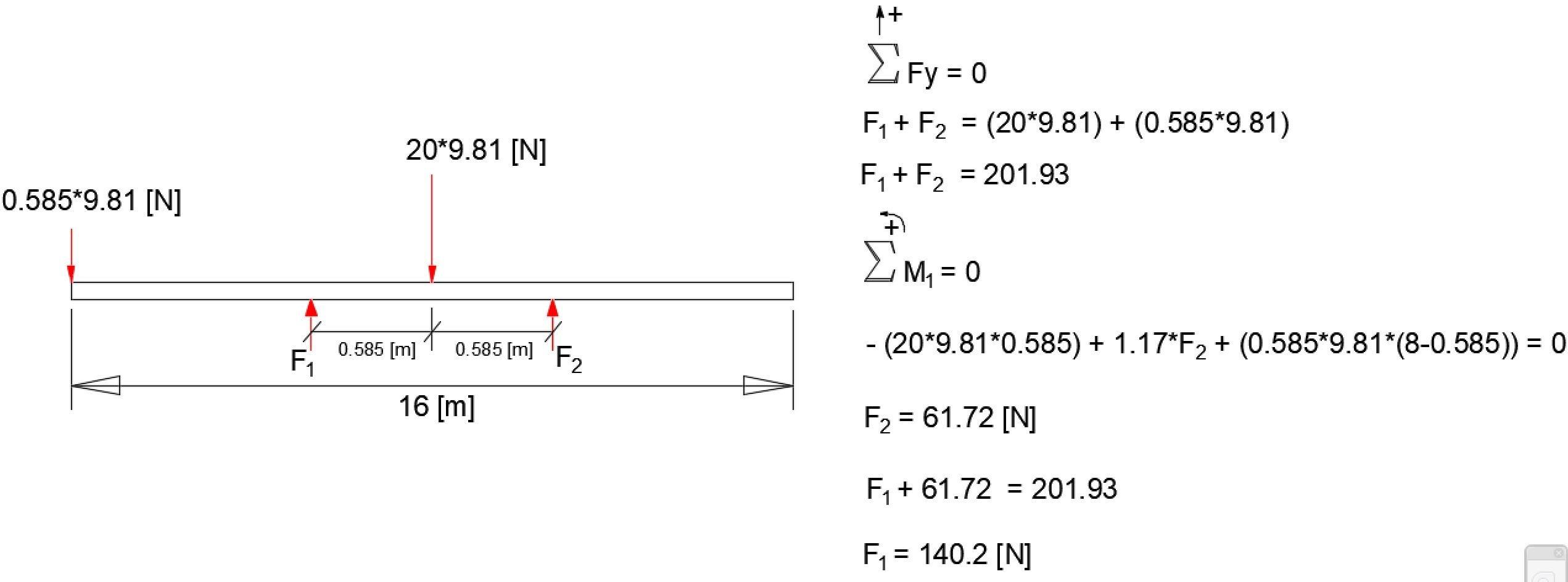
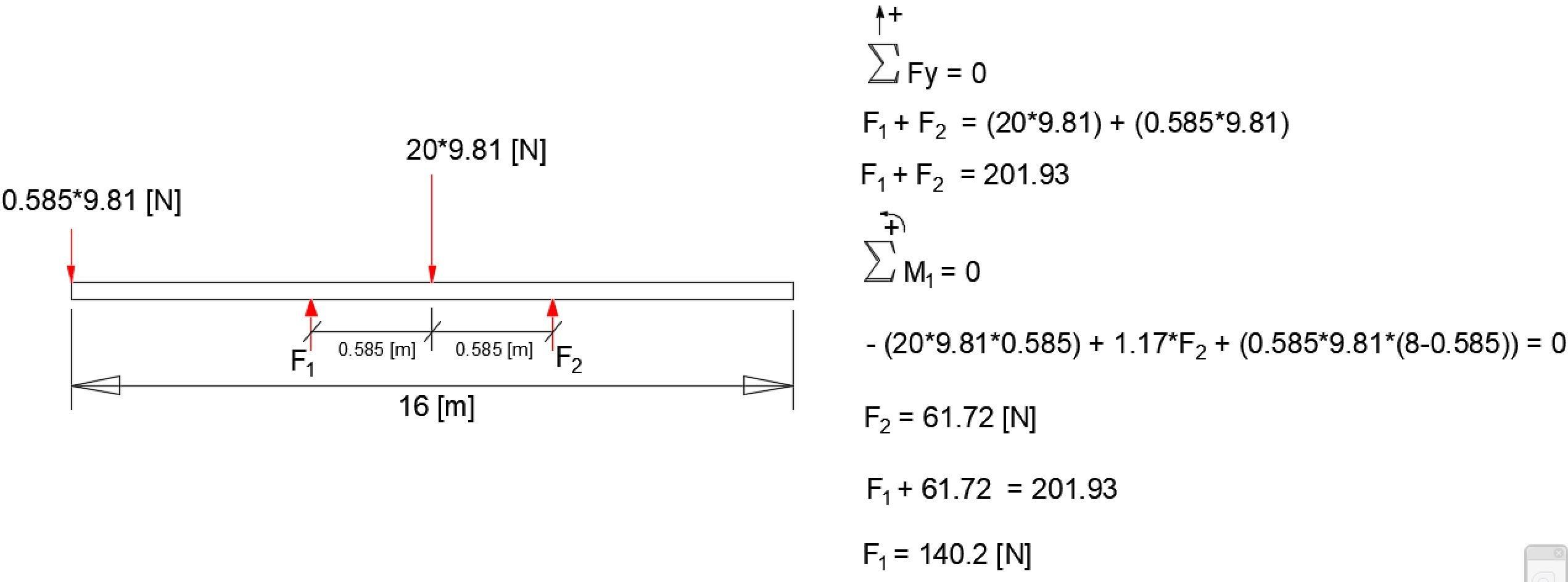
To solve this problem, we must make a free body diagram, with the different forces and distances that apply on the Daredevil and its bar.

In the attached image is a free body diagram, with the different forces and distances that are on the equilibrium bar.

First, we performed a sum of forces at y-axis equal to zero, in this way we deduced one of the equations for the forces of the arms F1 & F2. It takes another equation, to find each of the forces.

Then we do a sum of moments equal to zero, at the point of force F1, in this way we can find an equation for Force F2. With the force F2 we replace in the first equation and we can find the force F1.

In this way the forces are:

F1 = 140.2[N]

F2 = 61.72[N]

In the attached image we can see the equations developed to find the forces F1 & F2

You might be interested in
un tanque de gasolina de 40 litros fue llenado por la noche, cuando la temperatura era de 68 grados farenheit. Al dia siguiente
Sedaia [141]

Answer:

Volume of gasoline that expands and spills out is 1.33 ltr

Explanation:

As we know that when temperature of the liquid is increased then its volume will expand and it is given as

\Delta V = V_o\gamma \Delta T

here we know that

V_o = 40 Ltr

volume expansion coefficient of the gasoline is given as

\gamma = 950 × 10^{–6}

change in temperature is given as

\Delta T = (131 - 68) \times \frac{5}{9}

\Delta T = 35 ^oC

Now we have

\Delta V = 40(950 \times 10^{-6})(35)

\Delta V = 1.33 Ltr

3 0
2 years ago
An electron moves with a constant horizontal velocity of 3.0 × 10⁶ m/s and no initial vertical velocity as it enters a deflector
Ghella [55]

Answer:

a = 5.05 x 10¹⁴ m/s²

Explanation:

Consider the motion along the horizontal direction

v_{x} = velocity along the horizontal direction = 3.0 x 10⁶ m/s

t = time of travel

X = horizontal distance traveled = 11 cm = 0.11 m

Time of travel can be given as

t = \frac{X}{v_{x}}

inserting the values

t = 0.11/(3.0 x 10⁶)

t = 3.67 x 10⁻⁸ sec

Consider the motion along the vertical direction

Y = vertical distance traveled = 34 cm = 0.34 m

a = acceleration = ?

t = time of travel  = 3.67 x 10⁻⁸ sec

v_{y} = initial velocity along the vertical direction = 0 m/s

Using the kinematics equation

Y = v_{y} t + (0.5) a t²

0.34 = (0) (3.67 x 10⁻⁸) + (0.5) a (3.67 x 10⁻⁸)²

a = 5.05 x 10¹⁴ m/s²

7 0
2 years ago
A storage tank holds methane at 120 K, with a quality of 25 %, and it warms up by 5°C per hour due to a failure in the refrigera
lord [1]

One of the fundamental pillars to solve this problem is the use of thermodynamic tables to be able to find the values of the specific volume of saturated liquid and evaporation. We will be guided by the table B.7.1 'Saturated Methane' from which we will obtain the properties of this gas at the given temperature. Later considering the isobaric process we will calculate with that volume the properties in state two. Finally we will calculate the times through the differences of the temperatures and reasons of change of heat.

Table B.7.1: Saturated Methane

T_1 = 120K

p_1 = 191.6kPa

v_f = 0.002439m^3/kg

v_{fg} = 0.30367 m^3/kg

Calculate the specific volume of the methane at state 1

v_1 = v_f+x_1v_{fg}

v_1 = 0.002439+ (0.25)(0.30367)

v_1 = 0.0783m^3/kg

Assume the tank is rigid, specific volume remains constant

v_2 = v_1

v_2 = 0.0783m^3/kg

Now from the same table we can obtain the properties,

At v_g = 0.0783m^3/kg

T_2 = 145K

p_2 = 823.7kPa

We can calculate the time taken for the methane to become a single phase

t = \frac{T_2-T_1}{\dot{T}}

Here

T_1 = Initial temperature of Methane

\dot{T} = Warming rate

Replacing

t = \frac{(145-273)-(120-273)}{5}

t = \frac{25}{5}

t = 5hr

Therefore the time taken for the methane to become a single phase is 5hr

5 0
2 years ago
Does the surrounding air become warm or cool when vapour phase of H2O condenses? Explain
mel-nik [20]
The surrounding air will become warm when water vapor condenses. The vapors when become water will give away latent heat they have, we know that latent heat is required for the object to change states, so, the latent heat the water vapor had when it became water vapor from water will be given out when it again becomes water.
8 0
2 years ago
What is the average force (average with respect to height of the barbell from the ground) exerted by the weightlifter in the pro
Novay_Z [31]

This question is incomplete, the complete question is;

A weightlifter holds a 1,300 N barbell 1 meter above the ground. One end of a 2-meter-long chain hangs from the center of the barbell. The chain has a total weight of 400 N. How much work (in J) is required to lift the barbell to a height of 2 m?

What is the average force (average with respect to height of the barbell from the ground) exerted by the weightlifter in the process?

Answer: Average force exerted by the weightlifter in the process = 1600N

Explanation:

To find Work done to lift a barbell and half of the hanging chain we say;

W₁ = ( 1300N + (1/2 × 400N)) × 1m

W₁ = (1300 + 200) Nm

W₁ = 1500J

now work done to lift the upper half of the chain we say:

W₂ = (1/2 × 400N) ×  (1/2 × 1m)

W₂ = 200N × 0.5m

W₂ = 100J

So total work done will be

W = W₁ + W₂

W = 1500J + 100J

W = 1600J

To find the average force exerted by the weight lifter, we say;

F = W/D

F = (1600 / 1m) N

F = 1600N

∴Average force = 1600N
6 0
2 years ago
Other questions:
  • Alyssa is carrying a water balloon while running down a field at a speed of 14 m/s. She tosses the water balloon forward toward
    9·2 answers
  • Order the steps to take when drawing electron dot diagrams. Count the dots to make sure that all of the valence electrons are re
    17·3 answers
  • A motorist inflates the tires of her car to a pressure of 180 kPa on a day when the temperature is -8.0° C. When she arrives at
    9·1 answer
  • What mass needs to be attached to a spring with a force constant of 7N/m in order to make a simple harmonic oscillator oscillate
    9·1 answer
  • You are using a lightweight rope to pull a sled along level ground. The sled weighs 485 N, the coefficient of kinetic friction b
    11·1 answer
  • The CBR method of flexible pavement design gives an idea about the:
    10·1 answer
  • Sir Lance a Lost new draw bridge was designed poorly and stops at an angle of 20o below the horizontal. Sir Lost and his steed s
    9·1 answer
  • You use a slingshot to launch a potato horizontally from the edge of a cliff with speed v0. The acceleration due to gravity is g
    13·1 answer
  • A squeeze bottle squeezes when pressed. It regains its shape when pressed .It regains its shape when the pressure from your hand
    5·1 answer
  • Two masses, each having a value of M, are vibrating vertically on a spring with a Hooke's law constant, k. At the lowest point o
    9·1 answer
Add answer
Login
Not registered? Fast signup
Signup
Login Signup
Ask question!