answer.
Ask question
Login Signup
Ask question
All categories
  • English
  • Mathematics
  • Social Studies
  • Business
  • History
  • Health
  • Geography
  • Biology
  • Physics
  • Chemistry
  • Computers and Technology
  • Arts
  • World Languages
  • Spanish
  • French
  • German
  • Advanced Placement (AP)
  • SAT
  • Medicine
  • Law
  • Engineering
AysviL [449]
2 years ago
8

The 40-ft-long A-36 steel rails on a train track are laid with a small gap between them to allow for thermal expansion. Determin

e the required gap delta so that the rails just touch one another when the temperature is increased from T1, = -20°F to T2 = 90°F. Using this gap, what would be the axial force in the rails if the temperature were to rise to T3 = 110 degree F?
Engineering
1 answer:
vfiekz [6]2 years ago
8 0

Answer:

Ф = 0.02838 ft

F  = 1,032 N

Explanation:

To find out gap delta,

As it is case of free thermal expansion,

First we start with, some assumptions we have to made to solve this problem.

1. Thermal Expansion Coefficient of Steel is ∝= 6.45 ×10^(-6)

2. Modulas of elasticity for A-36 steel is E= 200 GPa

3. Area of rail is assumed to be unit area.

The gape required can be given by,

Ф = ∝  × ΔT  × L  ... where Ф= Gap Delta in ft

                                          ΔT= Temperature rise in F

                                               = 90- (-20)

                                               =  110 F

Ф =  6.45 ×10^(-6) × 110 × 40

Ф =  28,380 × 10^(-6) ft

Ф = 0.02838 ft     .... total gape required for expansion of steel rails

Stress induced in rails is given by,

   σ     =  ∝  × ΔT  × E

          =  6.45 ×10^(-6)   × 110  × 200

  σ      =  1,41,900 Pa

Now, let's find axial force in rails,

Here,we have to consider  ΔT= 20 F.

As due to temperature change, axial force generated in rails can be find by,

F = A × ∝ × ΔT× E × L

F = 1 × 6.45 × 10^(-6) × 20 × 200 × 10^(-9) × 40

F = 25,800 × 40 × 10^(-3)

F = 10,32,000 × 10^(-3)

F= 1,032 N

Finally, due to temperature change, rail is subjected to axial force, axial stress.

You might be interested in
A surface grinding operation is used to finish a flat plate that is 5.50 in wide and 12.500 in long. The starting thickness is 1
valina [46]

Answer:

77.40

Explanation:

Initial width = 5.5 Inches

Initial length = 12.5 inches

Initial thickness = 1.085 inches

After grinding

Thickness of flat plate  = 1 inch

Grinding wheel

starting diameter( di )= 6.013 inches

width of grinding wheel = 0.5 inch

After operation

Diameter of grinding wheel ( df ) = 5.997

<u>Calculate the grinding ratio in this operation</u>

First step : determine the volume of material removed from flat plate

= Length of flat plate * width of flat plate * change in thickness

= 12.5 * 5.5 * ( 1.085 - 1 )

= 5.8437 in^3

Volume of material from grinding wheel

= π / 4 * ( di^2 - df^2 ) * width  

= π / 4  * ( 6.013^2 - 5.997^2 ) * 0.5

= 0.0755 in^3

<u>Finally the Grinding ratio</u>

= 5.8437  / 0.0755

= 77.4

5 0
2 years ago
The rigid beam is supported by a pin at C and an A992 steel guy wire AB of length 6 ft. If the wire has a diameter of 0.2 in., d
irga5000 [103]

Answer:

change in length = 0.0913 in

Explanation:

given data

length = 6 ft

diameter = 0.2 in

load of w = 200 lb/ft

solution

we apply here first equilibrium moment about C that is express as

∑M(c)  = 0    .............1

so it can express as to get force in AB

10× 200 × ( 5) - (T cos(30)) × 10  =  0

solve it we get

Tension is wire T(AB)  = 1154.7 lb

and we know modulus of elasticity will be here for A992

E = 29000 ksi

and area will be

Area = \frac{\pi }{4}\times 0.2^2  

so change in length will be express as

change in length = \frac{PL}{AE}      ................2

put here value and we get

change in length = \frac{1154.7 \times 6 \times 12}{\frac{\pi }{4}\times 0.2^2 \times 29000 \times 1000}

change in length = 0.0913 in

8 0
2 years ago
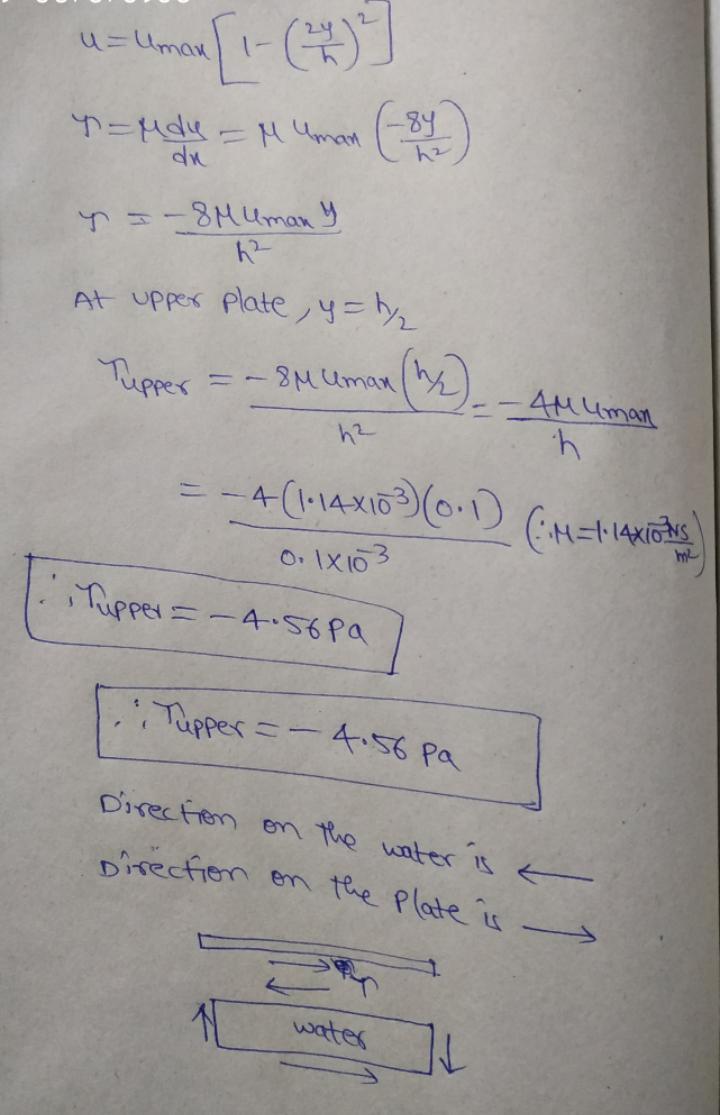
The velocity distribution for laminar flow between parallel plates is given by u umax = 1 − ( 2y h ) 2 Where h is the distance s
Lynna [10]

Answer:

Explanation:

For we to calculate the shear stress on the upper plate and give its direction. Sketch the variation of shear stress across the channel, I used hand in solving it, check attached file below

5 0
2 years ago
Identify the four engineering economy symbols and their values from the following problem statement. Use a question mark with th
Vilka [71]

Answer:

The company will have $311,424 in its investment set-aside account.

Explanation:

To determine the amount of money that the company will have after 7 years with an interest rate of 11% per year, we must calculate the price to start with an increase of 11%, and then repeat the operation until reaching seven years:

Year 0: 150,000

Year 1: 150,000 x 1.11 = 166,500

Year 2: 166,000 x 1.11 = 184,815

Year 3: 184,815 x 1.11 = 205,144.65

Year 4: 205,144.65 x 1.11 = 227,710.56

Year 5: 227,710.56 x 1.11 = 252,758.72

Year 6: 252,758.72 x 1.11 = 280,562.18

Year 7: 280,562.18 x 1.11 = 311,424

3 0
2 years ago
The pump of a water distribution system is powered by a 6-kW electric motor whose efficiency is 95 percent. The water flow rate
Sonja [21]

Answer:

a) Mechanical efficiency (\varepsilon)=63.15%  b) Temperature rise= 0.028ºC

Explanation:

For the item a) you have to define the mechanical power introduced (Wmec) to the system and the power transferred to the water (Pw).

The power input (electric motor) is equal to the motor power multiplied by the efficiency. Thus, Wmec=0.95*6kW=5.7 kW.

Then, the power transferred (Pw) to the fluid is equal to the flow rate (Q) multiplied by the pressure jump \Delta P. So P_W = Q*\Delta P=0.018m^3/s * 200x10^3 Pa=3600W.

The efficiency is defined as the ratio between the output energy and the input energy. Then, the mechanical efficiency is \varepsilon=3.6kW/5.7kW=0.6315=63.15\%

For the b) item you have to consider that the inefficiency goes to the fluid as heat. So it is necessary to use the equation of the heat capacity but in a "flux" way. Calling <em>H</em> to the heat transfered to the fluid, the specif heat of the water and \rho the density of the water:

[tex]H=(5.7-3.6) kW=\rho*Q*c*\Delta T=1000kg/m^3*0.018m^3/s*4186J/(kg \ºC)*\Delta T[/tex]

Finally, the temperature rise is:

\Delta T=2100/75348 \ºC=0.028 \ºC

7 0
2 years ago
Other questions:
  • Water flows downward through a vertical 10-mm-diameter galvanized iron pipe with an average velocity for 5.0 m/s and exits as a
    5·1 answer
  • What is the PW (at i 5%) of SuperTool's new test equipment? The development cost is $1.2M. Net revenues will begin at $300,000 f
    9·1 answer
  • When a man returns to his well-sealed house on a summer day, he finds that the house is at 35°C. He turns on the air conditioner
    13·1 answer
  • Two airstreams are mixed steadily and adiabatically. The first stream enters at 35°C and 30 percent relative humidity at a rate
    6·1 answer
  • Water enters a circular tube whose walls are maintained at constant temperature at specified flow rate and temperature. For full
    8·1 answer
  • 2.24 Carbon dioxide (CO2) gas in a piston-cylinder assembly undergoes three processes in series that begin and end at the same s
    6·1 answer
  • An airplane in level flight at an altitude h and a uniform speed v passes directly over a radar tracking station A. Calculate th
    5·1 answer
  • Air ows steadily in a thermally insulated pipe with a constant diameter of 6.35 cm, and an average friction factor of 0.005. At
    5·1 answer
  • Find the velocity and rate of flow of water through a rectangular channel of 6m wide and 3m deep when it's running full. The cha
    13·1 answer
  • Most fatal collisions in Florida happen during
    8·2 answers
Add answer
Login
Not registered? Fast signup
Signup
Login Signup
Ask question!