answer.
Ask question
Login Signup
Ask question
All categories
  • English
  • Mathematics
  • Social Studies
  • Business
  • History
  • Health
  • Geography
  • Biology
  • Physics
  • Chemistry
  • Computers and Technology
  • Arts
  • World Languages
  • Spanish
  • French
  • German
  • Advanced Placement (AP)
  • SAT
  • Medicine
  • Law
  • Engineering
Murrr4er [49]
2 years ago
11

Which answer includes all the following that are chemical changes and not physical changes? I. freezing of water II. rusting of

iron III. dropping a piece of iron into hydrochloric acid (H2 is produced) IV. burning a piece of wood V. emission of light by a kerosene oil lamp
Chemistry
1 answer:
Zinaida [17]2 years ago
6 0

Answer:

rusting of iron

dropping a piece of iron into hydrochloric acid (H2 is produced)

burning a piece of wood

emission of light by a kerosene oil lamp

Explanation:

A chemical change is not easily reversible, a new substance is formed and it often involves absorption or evolution of heat.

All the processes listed above are chemical changes. How ever, freezing of water is a physical change. It is easily reversible and no new substance is formed.

You might be interested in
Henri becquerel and the curies found out that _____.
natulia [17]

Henri becquerel and the curies found out that atoms were not indivisible and indestructible

Explanation:

The French Physicist, Henri Becquerel, created the appearance of radioactivity. He shared the Nobel Prize in Physics with Marie Curie and Pierre Curie (Marie's husband) in 1903 for their work in radiation. A radionuclide will emit transmission through the process of radioactive sense.

5 0
2 years ago
Read 2 more answers
A sample of gas contains 0.1800 mol of CO(g) and 0.1800 mol of NO(g) and occupies a volume of 23.2 L. The following reaction tak
baherus [9]

Answer:

The volume of the sample is 17.4L

Explanation:

The reaction that occurs requires the same amount of CO and NO. As the moles added of both reactants are the same you don't have any limiting reactant. The only thing we need is the reaction where 4 moles of gases (2mol CO + 2mol NO) produce 3 moles of gases (2mol CO2 + 1mol N2). The moles produced are:

0.1800mol + 0.1800mol reactants =

0.3600mol reactant * (3mol products / 4mol reactants) = 0.2700 moles products.

Using Avogadro's law (States the moles of a gas are directly proportional to its pressure under constant temperature and pressure) we can find the volume of the products:

V1n2 = V2n1

<em>Where V is volume and n moles of 1, initial state and 2, final state of the gas</em>

Replacing:

V1 = 23.2L

n2 = 0.2700 moles

V2 = ??

n1 = 0.3600 moles

23.2L*0.2700mol = V2*0.3600moles

17.4L = V2

<h3>The volume of the sample is 17.4L</h3>
8 0
1 year ago
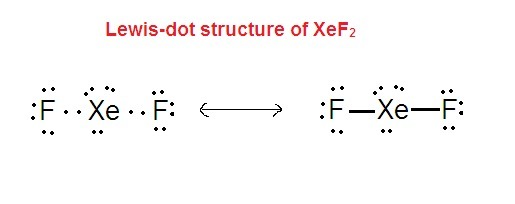
Determine the number of bonding electrons and the number of nonbonding electrons in the structure of xef2. enter the number of b
lakkis [162]

Answer : The number of bonding electrons and the number of non-bonding electrons are (4, 18).

Explanation :

The number of bonding electrons and non-bonding electrons in the structure of XeF_2 is determined by the Lewis-dot structure.

Lewis-dot structure : It tell us about the number of valence electrons of an atom within a molecule and it is also shows the bonding between the atoms of a molecule and the lone-pair of electrons.

In the given structure, 'Xe' is the central atom and 'F' is the terminal atom.

Xenon has 8 valence electrons and fluorine has 7 valence electrons.

Total number of valence electrons in XeF_2 = 8 + 2(7) = 22 electrons

From the Lewis-dot structure, we conclude that

The number of electrons used in bonding = 4

The number of electrons used in non-bonding (lone-pairs) = 22 - 4 = 18

Therefore, the number of bonding electrons and the number of non-bonding electrons are (4, 18).

The Lewis-dot structure of XeF_2 is shown below.

4 0
2 years ago
Read 2 more answers
Pure platinum is too soft to be used in jewelry because it scratches easily. To increase the hardness so that it can be used in
Zina [86]

Answer:

percentage mass of platinum in the alloy ≈ 90.60 %

Explanation:

The alloy is 8.528 g sample of an alloy containing platinum and cobalt . The alloy react with excess nitric acid to form cobalt(ii) nitrate . Platinum is resistant to acid so it will definitely not react with the acid only the cobalt metal in the alloy will react with the acid.

The chemical reaction can be represented as follows:

Co (s) + HNO₃ (aq) → Co(NO₃)₂ (aq) +  NO₂ (l) + H₂O (l)

The balanced equation

Co (s) + 4HNO₃ (aq) → Co(NO₃)₂(aq) + 2NO₂ (l) + 2H₂O (l)

Cobalt is the limiting reactant

atomic mass of cobalt = 58.933 g/mol

Molar mass of Co(NO₃)₂ = 58.933 + 14 × 2 + 16 × 6 = 58.933 + 28 + 96 = 182.933  g

58.933 g of cobalt produce 182.933  g of  Co(NO₃)₂

? gram of cobalt will produce 2.49 g of Co(NO₃)₂

cross multiply

grams of cobalt that will react = (58.933 × 2.49)/182.933

grams of cobalt that will react = 146.74317000/182.933

grams of cobalt that will react= 0.8021689362 g

grams of cobalt that will react = 0.802 g

mass of platinum in the alloy  = 8.528 g - 0.802 g = 7.726 g

percentage  mass of platinum in the alloy = 7.726/8.528 × 100 = 772.600/8.528 = 90 .595 %

percentage mass of platinum in the alloy ≈ 90.60 %

6 0
2 years ago
How does 0.5 m sucrose (molecular mass 342) solution compare to 0.5 m glucose (molecular mass 180) solution?
mash [69]

Answer : Both solutions contain 3.011 X 10^{23} molecules.

Explanation : The number of molecules of 0.5 M of sucrose is equal to the number of molecules in 0.5 M of glucose. Both solutions contain 3.011 x 10^{23} molecules.

Avogadro's Number is  N_{A} =  6.022 X 10^{23} which represents particles per mole and particles may be typically molecules, atoms, ions, electrons, etc.

Here, only molarity values are given; where molarity is a measurement of concentration in terms of moles of the solute per liter of solvent.

Since each substance has the same concentration, 0.5 M, each will have the same number of molecules present per liter of solution.

Addition of molar mass for individual substance is not needed. As if both are considered in 1 Liter they would have same moles which is 0.5.

We can calculate the number of molecules for each;

Number of molecules  = N_{A} X M;

∴  Number of molecules =  6.022 X 10^{23} X 0.5 mol/L X 1 L which will be  = 3.011 X 10^{23}

Thus, these solutions compare to each other in that they have not only the same concentration, but they will have the same number of solvated sugar molecules. But the mass of glucose dissolved will be less than the mass of sucrose.

7 0
2 years ago
Read 2 more answers
Other questions:
  • In what situation do we use a volumetric flask, conical flask, pipette and graduated cylinder? Explain your answer from accuracy
    9·1 answer
  • a 9.84 ounces ingot of unknown metal is heated from 73.2 degrees fahrenheit - 191.2 degrees fahrenheit this requires 3.912 calor
    9·1 answer
  • A 6.50-g sample of copper metal at 25.0 °c is heated by the addition of 84.0 j of energy. the final temperature of the copper i
    11·1 answer
  • Identify the reaction type for each generic chemical equation
    15·2 answers
  • Methylamine (ch3nh2) is a weakly basic compound. calculate the kb for methylamine if a 0.253 m solution is 4.07% ionized.
    8·1 answer
  • The bond enthalpy of the C―N bond in the amide group of proteins can be treated as an average of C―N (276 kJ/mol) and C═N (615 k
    14·1 answer
  • A 2 L sample of N2(g) and a 1 L sample of Ar(g), each originally at 1 atm and 0°C, are combined in a 1 L tank. If the temperatu
    10·2 answers
  • Nickel-63 has a half life of 92 hours. If a
    14·1 answer
  • 8. Explain how Elianto oil is obtained from maize seeds.​
    10·1 answer
  • How many mm are equal to 4.75 x 10⁻² m?
    11·1 answer
Add answer
Login
Not registered? Fast signup
Signup
Login Signup
Ask question!