The number of bonding electrons and the number of non-bonding electrons are
Further explanation:
The Lewis structure is the chemical representation of an element along with the nonbonding pairs. For covalent molecules, the number of electrons involved in bonding and the remaining nonbonding pairs can be represented while writing the Lewis structures. Lewis structures along with the formal charges that they carry help predict the geometry, polarity, and reactivity of the molecules.
The central atom is usually the least electronegative atom other than hydrogen. Hence out of xenon and fluorine, the former will act as the central metal atom. So arrange the two atoms around the xenon. Next determine the number of valence electrons.
The total number of valence electrons of  is calculated as,
![{\text{Total valence electrons}}=\left[{\left({\text{1}}\right)\left({{\text{Valence electrons of Xenon}}}\right){+}}\left(2\right)\left({{\text{Valence electrons of Fluorine}}}\right)}\right]](https://tex.z-dn.net/?f=%7B%5Ctext%7BTotal%20valence%20electrons%7D%7D%3D%5Cleft%5B%7B%5Cleft%28%7B%5Ctext%7B1%7D%7D%5Cright%29%5Cleft%28%7B%7B%5Ctext%7BValence%20electrons%20of%20Xenon%7D%7D%7D%5Cright%29%7B%2B%7D%7D%5Cleft%282%5Cright%29%5Cleft%28%7B%7B%5Ctext%7BValence%20electrons%20of%20Fluorine%7D%7D%7D%5Cright%29%7D%5Cright%5D)
Since xenon carries 8 valence electrons and fluorine carries 7 valence electrons. So, the valence electrons of is as follows:
![\begin{aligned}{\text{Total valence electrons}}\left( {{\text{TVE}}}\right)&=\left[{\left(1\right)\left(8\right)+\left(2\right)\left(7\right)}\right]\\&=22\\\end{aligned}](https://tex.z-dn.net/?f=%5Cbegin%7Baligned%7D%7B%5Ctext%7BTotal%20valence%20electrons%7D%7D%5Cleft%28%20%7B%7B%5Ctext%7BTVE%7D%7D%7D%5Cright%29%26%3D%5Cleft%5B%7B%5Cleft%281%5Cright%29%5Cleft%288%5Cright%29%2B%5Cleft%282%5Cright%29%5Cleft%287%5Cright%29%7D%5Cright%5D%5C%5C%26%3D22%5C%5C%5Cend%7Baligned%7D)
The formal charge on an atom can be calculated as follows:
![{\mathbf{Formal charge=}}\left[\begin{gathered}\left[\begin{gathered}{\mathbf{total number of valence electrons }}\hfill\\{\mathbf{in the free atom}}\hfill\\\end{gathered}\right]{\mathbf{}}-\\\left[{{\mathbf{total number of non - bonding electrons}}}\right]-\\\frac{{\left[{{\mathbf{total number of bonding electrons}}}\right]}}{{\mathbf{2}}}\\\end{gathered}\right]](https://tex.z-dn.net/?f=%7B%5Cmathbf%7BFormal%20charge%3D%7D%7D%5Cleft%5B%5Cbegin%7Bgathered%7D%5Cleft%5B%5Cbegin%7Bgathered%7D%7B%5Cmathbf%7Btotal%20number%20of%20valence%20electrons%20%7D%7D%5Chfill%5C%5C%7B%5Cmathbf%7Bin%20the%20free%20atom%7D%7D%5Chfill%5C%5C%5Cend%7Bgathered%7D%5Cright%5D%7B%5Cmathbf%7B%7D%7D-%5C%5C%5Cleft%5B%7B%7B%5Cmathbf%7Btotal%20number%20of%20non%20-%20bonding%20electrons%7D%7D%7D%5Cright%5D-%5C%5C%5Cfrac%7B%7B%5Cleft%5B%7B%7B%5Cmathbf%7Btotal%20number%20of%20bonding%20electrons%7D%7D%7D%5Cright%5D%7D%7D%7B%7B%5Cmathbf%7B2%7D%7D%7D%5C%5C%5Cend%7Bgathered%7D%5Cright%5D)
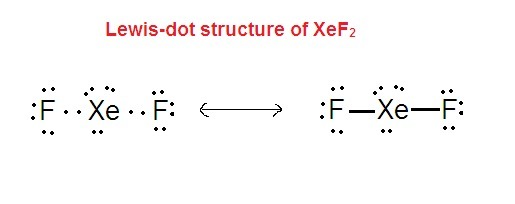
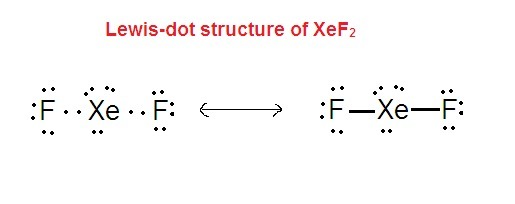
Both F forms one single bond respectively with a xenon atom. Both F has 3 lone pairs are present on it.
The total number of valence electrons in the free fluorine atom is 7.
The total number of nonbonding electrons or lone pairs in F is 6.
The total number of bonding electrons in F is 2.
Substitute these values in equation (1) to find the formal charge on F.
![\begin{aligned}{\text{Formal charge on F}&}=\left[{7-6-\frac{2}{2}}\right]\\=0\\\end{aligned}](https://tex.z-dn.net/?f=%5Cbegin%7Baligned%7D%7B%5Ctext%7BFormal%20charge%20on%20F%7D%26%7D%3D%5Cleft%5B%7B7-6-%5Cfrac%7B2%7D%7B2%7D%7D%5Cright%5D%5C%5C%3D0%5C%5C%5Cend%7Baligned%7D)
Both F has formal charge
Xe forms two single bonds and it possesses three lone pairs.
The total number of valence electrons in the free Xenon atom is 7.
The total number of nonbonding electrons or lone pairs in Xe is 6.
The total number of bonding electrons in Xe is 4.
Substitute these values in equation (1) to find the formal charge on Xe.
![\begin{aligned}{\text{Formal charge on Xe}}&=\left[{8-6-\frac{4}{2}}\right]\\&=2-2\\&=0\\\end{aligned}](https://tex.z-dn.net/?f=%5Cbegin%7Baligned%7D%7B%5Ctext%7BFormal%20charge%20on%20Xe%7D%7D%26%3D%5Cleft%5B%7B8-6-%5Cfrac%7B4%7D%7B2%7D%7D%5Cright%5D%5C%5C%26%3D2-2%5C%5C%26%3D0%5C%5C%5Cend%7Baligned%7D)
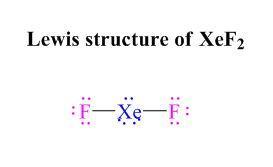
Out of 22 electron pairs, four electrons are involved in the two Xe-F bond. So now we are left with 18 electrons. These will constitute the non bonding (lone pairs). 3 electrons pairs are present on each fluorine atom and three pairs around xenon. (Refer to the attached image for the Lewis structure).
Therefore, the number of bonding electrons and the number of non-bonding electrons are (4, 18).
Learn more:
1. Molecular shape around the central atoms in the amino acid glycine: brainly.com/question/4341225
2. Lewis structures rules: brainly.com/question/11503188
Answer details:
Grade: Senior School
Subject: Chemistry
Chapter: Molecular structure and chemical bonding
Keywords: Lewis structure, valence electrons, XeF2, formal charge, double bonds, a single bond, bonding electrons, non-bonding electrons, total valence electrons.