answer.
Ask question
Login Signup
Ask question
All categories
  • English
  • Mathematics
  • Social Studies
  • Business
  • History
  • Health
  • Geography
  • Biology
  • Physics
  • Chemistry
  • Computers and Technology
  • Arts
  • World Languages
  • Spanish
  • French
  • German
  • Advanced Placement (AP)
  • SAT
  • Medicine
  • Law
  • Engineering
Oksana_A [137]
2 years ago
3

For the aqueous reaction dihydroxyacetone phosphate is the reactant and glyceraldehyde 3 phosphate is the product. dihydroxyacet

one phosphate − ⇀ ↽ − glyceraldehyde − 3 − phosphate the standard change in Gibbs free energy is Δ G ° ' = 7.53 kJ/mol . Calculate Δ G for this reaction at 298 K when [dihydroxyacetone phosphate] = 0.100 M and [glyceraldehyde-3-phosphate] = 0.00400 M . Δ G = kJ / mol
Chemistry
1 answer:
yKpoI14uk [10]2 years ago
5 0

Answer : The Gibbs free energy of the reaction is -0.445 kJ/mol.

Explanation :

The given chemical equation is:

\text{Dihydroxyacetone phosphate}\rightleftharpoons \text{Glyceraldehyde-3-phosphate}

The expression for K_{eq} of above equation is:

K_{eq}=\frac{\text{[Glyceraldehyde-3-phosphate]}}{\text{[Dihydroxyacetone phosphate]}}

Given:

[Glyceraldehyde-3-phosphate] = 0.00400 M

[Dihydroxyacetone phosphate] = 0.100 M

Now put all the given values in above equation, we get:

K_{eq}=\frac{0.004}{0.100}=0.04

The relation between standard Gibbs free energy and equilibrium constant follows:

\Delta G=\Delta G^o+RT\ln K_1

where,

\Delta G^o = Standard Gibbs free energy = 7.53 kJ/mol = 7530 J/mol

(Conversion factor: 1 kJ = 1000 J)

R = Gas constant = 8.314J/K mol

T = temperature = 298 K

Now put all the given values in above equation, we get:

\Delta G=7530J/mol+(8.3145J/Kmol)\times 298K\times \ln (0.04)\\\\\Delta G=-445J/mol=-0.455kJ/mol

Hence, the Gibbs free energy of the reaction is -0.445 kJ/mol.

You might be interested in
What is the 2s in 42,256
MissTica

42,256 = 2,000

42,256 = 200

together they'd be 2,200 (if that's what you needed as well)

5 0
2 years ago
Read 2 more answers
A 40.0 mL sample of 0.25 M KOH is added to 60.0 mL of 0.15 M Ba(OH)2. What is the molar concentration of OH-(aq) in the resultin
solmaris [256]

Answer:

C) 0.28 M

Explanation:

Considering:

Molarity=\frac{Moles\ of\ solute}{Volume\ of\ the\ solution}

Moles =Molarity \times {Volume\ of\ the\ solution}

Potassium hydroxide will furnish hydroxide ions as:

KOH\rightarrow K^{+}+OH^-

Given :

<u>For Potassium hydroxide : </u>

Molarity = 0.25 M

Volume = 40.0 mL

The conversion of mL to L is shown below:

1 mL = 10⁻³ L

Thus, volume = 40.0×10⁻³ L

Thus, moles of hydroxide ions furnished by Potassium hydroxide is same as the moles of Potassium hydroxide as shown below:

Moles =0.25 \times {40.0\times 10^{-3}}\ moles

Moles of hydroxide ions by Potassium hydroxide = 0.01 moles

Barium hydroxide will furnish hydroxide ions as:

Ba(OH)_2\rightarrow Ba^{2+}+2OH^-

Given :

<u>For Barium hydroxide : </u>

Molarity = 0.15 M

Volume = 60.0 mL

The conversion of mL to L is shown below:

1 mL = 10⁻³ L

Thus, volume = 60.0×10⁻³ L

Thus, moles of hydroxide ions furnished by Barium hydroxide is twice the moles of Barium hydroxide as shown below:

Moles =2\times 0.15 \times {60.0\times 10^{-3}}\ moles

Moles of hydroxide ions by Barium hydroxide = 0.018 moles

Total moles = 0.01 moles + 0.018 moles = 0.028 moles

Total volume = 40.0×10⁻³ L + 60.0×10⁻³ L = 100×10⁻³ L

Concentration of hydroxide ions is:

Molarity=\frac{Moles\ of\ solute}{Volume\ of\ the\ solution}

Molarity_{OH^-}=\frac{0.028 }{100\times 10^{-3}}

<u> The final concentration of hydroxide ion = 0.28 M</u>

5 0
2 years ago
Read 2 more answers
George splits a bagel in half and places both sides of the bagel in a toaster. He turns on the toaster, and within a minute the
STALIN [3.7K]
C. Convention

Explanation: I'm pretty sure it is

6 0
2 years ago
Read 2 more answers
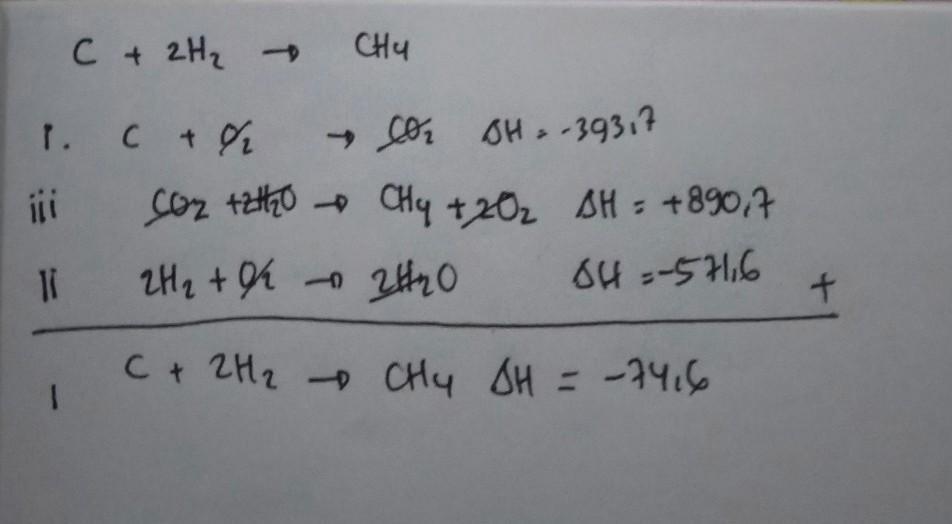
State Hess' law of constant heat summation.
AveGali [126]

Answer:

-74.6 kj/mol

Explanation:

you can see the answer at the pic

8 0
2 years ago
What is the mass, in grams, of 6.33 mol of nahco3?
zhuklara [117]
1 mole of NaHCO3 contains 84.007g,
Therefore,to get the number of mass of 6.33 mol we multiply the number of moles and the relative formula mass.
That is; 6.33 moles × 84.007 g =  531.764 g
Hence the mass of 6.33 moles of NaHCO3 is 531.764 grams
6 0
2 years ago
Other questions:
  • Suppose you have two cubes of exactly the same volume. You weigh them and find a mass of 8.91g for one and 8.88g for the other c
    13·2 answers
  • Calculate the frequency of the n = 6 line in the Lyman series of hydrogen.
    15·2 answers
  • A chemist is working on a reaction represented by this chemical equation:
    12·2 answers
  • The chlorination of methane occurs in a number of steps that results in the formation of chloromethane and hydrogen chloride. Th
    9·1 answer
  • Write the Lewis structure for ethanol (CH3CH2OH), the alcohol found in alcoholic beverages, then answer the following questions:
    14·1 answer
  • NH4NO3, whose heat of solution is 25.7 kJ/mol, is one substance that can be used in cold pack. If the goal is to decrease the te
    15·1 answer
  • If the standard free energy change for the conversion of fructopyranose to fructofuranose is 1.7 kJ/mol, what fraction of the to
    5·1 answer
  • Consider these generic half-reactions. Half-reaction E° (V) X+(aq)+e−⟶X(s) 1.52 Y2+(aq)+2e−⟶Y(s) −1.17 Z3+(aq)+3e−⟶Z(s) 0.84 Ide
    8·1 answer
  • Ammonia gas occupies a volume of 2,725ml at a pressure of 701 kPa. What volume would it occupy at 101 kPa?
    9·1 answer
  • If 28.0% of a sample of gallium-66 decays in 4.46 hours, what is the half-life of this isotope (in hours)?
    10·1 answer
Add answer
Login
Not registered? Fast signup
Signup
Login Signup
Ask question!