answer.
Ask question
Login Signup
Ask question
All categories
  • English
  • Mathematics
  • Social Studies
  • Business
  • History
  • Health
  • Geography
  • Biology
  • Physics
  • Chemistry
  • Computers and Technology
  • Arts
  • World Languages
  • Spanish
  • French
  • German
  • Advanced Placement (AP)
  • SAT
  • Medicine
  • Law
  • Engineering
djverab [1.8K]
2 years ago
11

Machine movement can be divided into what two main categories?

Engineering
2 answers:
pishuonlain [190]2 years ago
8 0

Answer:

motion and power

Explanation:

avanturin [10]2 years ago
8 0

Answer:motion and action

Explanation: i did motion and power but it was wrong.

You might be interested in
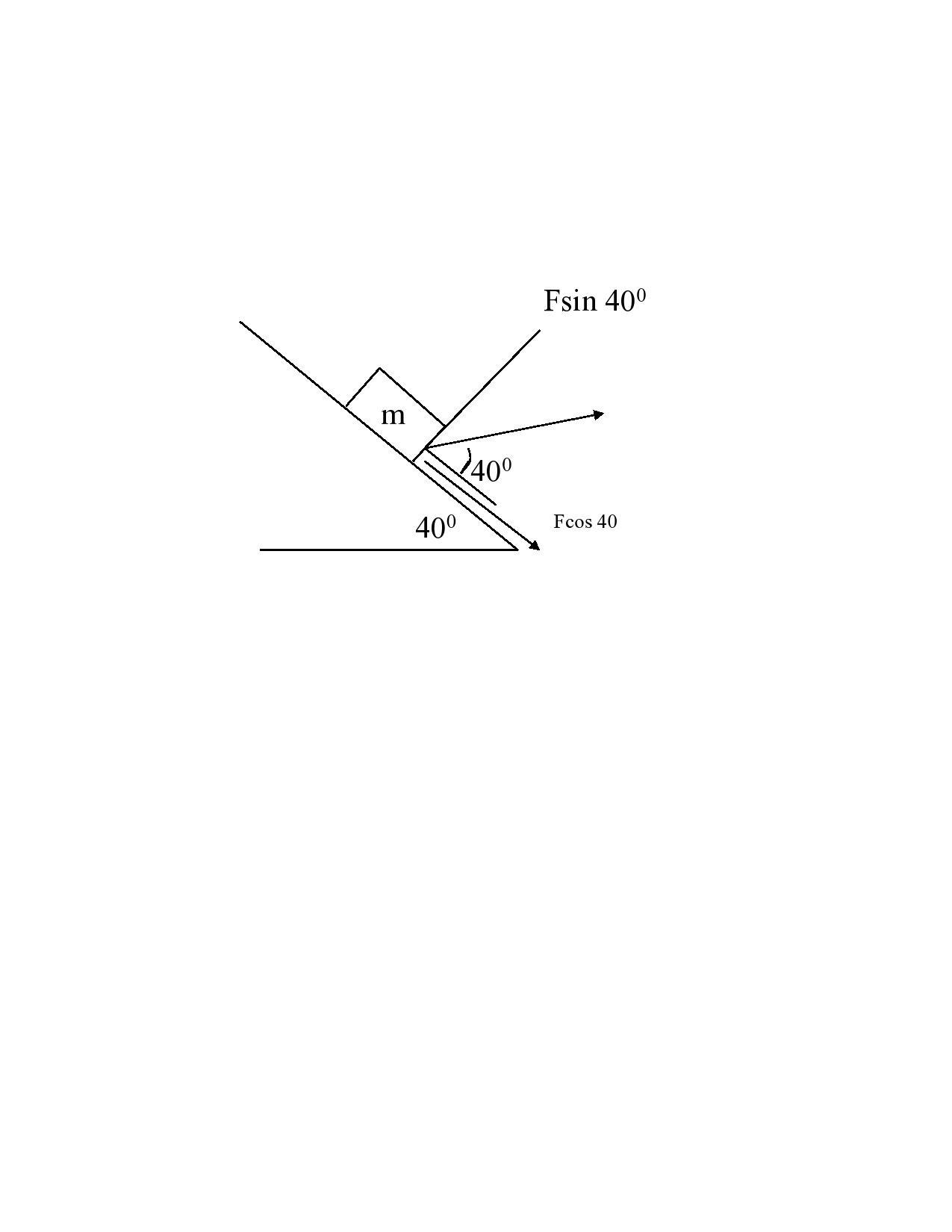
The 10-kg block slides down 2 m on the rough surface with kinetic friction coefficient μk = 0.2. What is the work done by the fr
Rashid [163]

Answer:

153.2 J

Explanation:

Let's first list our given parameters;

mass (m) of the block = 10 kg

which slides down ( i.e displacement) = 2 m

kinetic coefficient of friction (μk) = 0.2

In the diagram shown below;  if we take an integral look at the component of force in the direction of the displacement; we have

F_x= Fcos 40°

F_x= 100 (cos 40°)

F_x= 76.60 N

Workdone by the friction force can now be determined as:

W = F_x × displacement

W = 76.60 × 2

W = 153.2 J

∴  the work done by the friction force = 153.2 J

7 0
2 years ago
A system consisting of 3 lb of water vapor in a piston–cylinder assembly, initially at 350°F and a volume of 71.7 ft3, is expand
Alla [95]

Answer:

isobaric expansion = 281.09 Btu

isothermal compression= 72 Btu

Explanation:

The first law of thermodynamics is:

Q_{AB}=W_{AB}+deltaU_{AB}

where:

Q=heat transferred

W= work

U=internal energy  

W_{AB}=P*(V_{B}-V_{A})

U_{AB}=n*C_{v}(T_{2}-T_{1})

P=pressure, V= volume, T= temperature, n =  moles, Cv= specific heat at constant volume.

In a isobaric process heat transferred is:

Q=P*(V_{B}-V_{A})+n*C_{v}(T_{2}-T_{1})

For an isothermal process (T2-T1 = 0) so

Q=P*(V_{B}-V_{A})= W_{AB}

From the data we know that the energy transferred to the system in the isothermal compression by work was 72 Btu that is the heat transferred to the system.

For the first process

Q=P*(V_{B}-V_{A})+n*C_{v}(T_{2}-T_{1})

we have to properties at the beginning of the process : temperature (350°F) and specific volume (V/mass)

specific-volume=\frac{71.7 ft^{3}}{3Lb}=23.9\frac{ft^{3}}{Lb}

we use this information in the appropriate unit to find the pressure in thermodynamic tables.

T1= 176°C

v1= 1.49 m^3/kg

P=1.37 bar

in the second state we have

P=1.37 bar =137000Pa

v_{2}=\frac{85.38ft^{3}}{3Lb}= 28.46\frac{ft^{3}}{Lb}

with thee properties we check in the thermodynamic tables

T2= 255°C

n=mass/Mw = 3Lb*\frac {1kg}{2.2Lb}*\frac{1000gr}{1kg}*\frac{1mol}{18gr}=75.75 mol

we usually find Cp on tables for water but from the Mayer relation we have:

C_{v}=C_{p}+R

Cp for water vapor is: 33.12 J/mol*K

R=8.314 J/mol*K

Cv= 41.434 J/mol*K

replacing in the equation for Q

Q=137000 Pa*(2.41m^{3}-2.030m^{3})+75.75mol*41.434\frac{ J}{mol*K}*(528.15-449.81 K)=296569J

296569J =281.09 Btu

5 0
2 years ago
A three-phase line has an impedance of 0.4 j2.7 ohms per phase. The line feeds two balanced three-phase loads that are connected
Viktor [21]

Answer:

a. The magnitude of the line source voltage is

Vs = 4160 V

b. Total real and reactive power loss in the line is

Ploss = 12 kW

Qloss = j81 kvar

Sloss = 12 + j81 kVA

c. Real power and reactive power supplied at the sending end of the line

Ss = 540.046 + j476.95 kVA

Ps = 540.046 kW

Qs = j476.95 kvar

Explanation:

a. The magnitude of the line voltage at the source end of the line.

The voltage at the source end of the line is given by

Vs = Vload + (Total current×Zline)

Complex power of first load:

S₁ = 560.1 < cos⁻¹(0.707)

S₁ = 560.1 < 45° kVA

Complex power of second load:

S₂ = P₂×1 (unity power factor)

S₂ = 132×1

S₂ = 132 kVA

S₂ = 132 < cos⁻¹(1)

S₂ = 132 < 0° kVA

Total Complex power of load is

S = S₁ + S₂

S = 560.1 < 45° + 132 < 0°

S = 660 < 36.87° kVA

Total current is

I = S*/(3×Vload)   ( * represents conjugate)

The phase voltage of load is

Vload = 3810.5/√3

Vload = 2200 V

I = 660 < -36.87°/(3×2200)

I = 100 < -36.87° A

The phase source voltage is

Vs = Vload + (Total current×Zline)

Vs = 2200 + (100 < -36.87°)×(0.4 + j2.7)

Vs = 2401.7 < 4.58° V

The magnitude of the line source voltage is

Vs = 2401.7×√3

Vs = 4160 V

b. Total real and reactive power loss in the line.

The 3-phase real power loss is given by

Ploss = 3×R×I²

Where R is the resistance of the line.

Ploss = 3×0.4×100²

Ploss = 12000 W

Ploss = 12 kW

The 3-phase reactive power loss is given by

Qloss = 3×X×I²

Where X is the reactance of the line.

Qloss = 3×j2.7×100²

Qloss = j81000 var

Qloss = j81 kvar

Sloss = Ploss + Qloss

Sloss = 12 + j81 kVA

c. Real power and reactive power supplied at the sending end of the line

The complex power at sending end of the line is

Ss = 3×Vs×I*

Ss = 3×(2401.7 < 4.58)×(100 < 36.87°)

Ss = 540.046 + j476.95 kVA

So the sending end real power is

Ps = 540.046 kW

So the sending end reactive power is

Qs = j476.95 kvar

7 0
2 years ago
(3) Calculate the heat flux through a sheet of brass 7.5 mm (0.30 in.) thick if the temperatures at the two faces are 150°Cand 5
bezimeni [28]

Answer:

a.) 1.453MW/m2,  b.)  2,477,933.33 BTU/hr  c.) 22,733.33 BTU/hr  d.) 1,238,966.67 BTU/hr

Explanation:

Heat flux is the rate at which thermal (heat) energy is transferred per unit surface area. It is measured in W/m2

Heat transfer(loss or gain) is unit of energy per unit time. It is measured in W or BTU/hr

1W = 3.41 BTU/hr

Given parameters:

thickness, t = 7.5mm = 7.5/1000 = 0.0075m

Temperatures 150 C = 150 + 273 = 423 K

                        50 C = 50 + 273 = 323 K

Temperature difference, T = 423 - 323 = 100 K

We are assuming steady heat flow;

a.) Heat flux, Q" = kT/t

K= thermal conductivity of the material

The thermal conductivity of brass, k = 109.0 W/m.K

Heat flux, Q" = \frac{109 * 100}{0.0075} = 1,453,333.33 W/m^{2} \\ Heat flux, Q" = 1.453MW/m^{2} \\

b.) Area of sheet, A = 0.5m2

Heat loss, Q = kAT/t

Heat loss, Q = \frac{109*0.5*100}{0.0075} = 726,666.667W

Heat loss, Q = 726,666.667 * 3.41 = 2,477,933.33 BTU/hr

c.) Material is now given as soda lime glass.

Thermal conductivity of soda lime glass, k is approximately 1W/m.K

Heat loss, Q=\frac{1*0.5*100}{0.0075} = 6,666.67W

Heat loss, Q = 6,666.67 * 3.41 = 22,733.33 BTU/hr

d.) Thickness, t is given as 15mm = 15/1000 = 0.015m

Heat loss, Q=\frac{109*0.5*100}{0.015} =363,333.33W

Heat loss, Q = 363,333.33 * 3.41 = 1,238,966.67 BTU/hr

5 0
2 years ago
referring to either the CMS file or code book index, what is the cross reference for reduction of a dislocation?
Oksi-84 [34.3K]

Answer:

reposition

Explanation:

if you go to your icd 10 pcs index located on page 1 then  look up reduction the subterm is of a dislocation which leads you to the answer reposition

4 0
2 years ago
Other questions:
  • a. Replacing standard incandescent lightbulbs with energy-efficient compact fluorescent lightbulbs can save a lot of energy. Cal
    9·1 answer
  • Consider a very long rectangular fin attached to a flat surface such that the temperature at the end of the fin is essentially t
    9·1 answer
  • The velocity of a particle which moves along the s-axis is given by v = 2-4t+5t^(3/2), where t is in seconds and v is in meters
    11·2 answers
  • 4.9 Given that I 4 amps when Vs 40 volts and Is 4 amps and I 1 amp when Vs 20 volts and Is 0, use superposition and linearity to
    5·1 answer
  • The Hamming encoder/decoder in the lecture detected and corrected one error bit. By adding a thirteen bit which is the exclusive
    13·1 answer
  • A well-insulated tank in a vapor power plant operates at steady state. Saturated liquid water enters at inlet 1 at a rate of 125
    8·1 answer
  • With thermodynamics, one cannot determine ________.
    14·1 answer
  • Two airstreams are mixed steadily and adiabatically. The first stream enters at 35°C and 30 percent relative humidity at a rate
    6·1 answer
  • ) A given system has four sensors that can produce an output of 0 or 1. The system operates properly when exactly one of the sen
    9·1 answer
  • Water at 70 kPa and 1008C is compressed isentropically in a closed system to 4 MPa. Determine the final temperature of the water
    6·1 answer
Add answer
Login
Not registered? Fast signup
Signup
Login Signup
Ask question!