answer.
Ask question
Login Signup
Ask question
All categories
  • English
  • Mathematics
  • Social Studies
  • Business
  • History
  • Health
  • Geography
  • Biology
  • Physics
  • Chemistry
  • Computers and Technology
  • Arts
  • World Languages
  • Spanish
  • French
  • German
  • Advanced Placement (AP)
  • SAT
  • Medicine
  • Law
  • Engineering
Usimov [2.4K]
2 years ago
5

For the speed equation along centerline of a diffuser, calculate the fluid acceleration along the diffuser centerline as a funct

ion of x and the given parameters. For L = 1.56 m, uentrance = 24.5 m/s, and uexit = 17.5 m/s, calculate the acceleration at x = 0 and x = 1.0 m.
Engineering
2 answers:
Marrrta [24]2 years ago
8 0

Answer:

a = v\cdot \frac{dv}{dx}, v (x) = v_{in}\cdot \left[1 + \left(\frac{1}{L}\right)\cdot \left(\frac{v_{in}}{v_{out}}-1  \right)\cdot x \right]^{-1}, \frac{dv}{dx} = -v_{in}\cdot \left(\frac{1}{L}\right) \cdot \left(\frac{v_{in}}{v_{out}}-1  \right) \cdot \left[1 + \left(\frac{1}{L}\right)\cdot \left(\frac{v_{in}}{v_{out}} -1 \right) \cdot x \right]^{-2}

Explanation:

Let suppose that fluid is incompressible and diffuser works at steady state. A diffuser reduces velocity at the expense of pressure, which can be modelled by using the Principle of Mass Conservation:

\dot m_{in} - \dot m_{out} = 0

\dot m_{in} = \dot m_{out}

\dot V_{in} = \dot V_{out}

v_{in} \cdot A_{in} = v_{out}\cdot A_{out}

The following relation are found:

\frac{v_{out}}{v_{in}} = \frac{A_{in}}{A_{out}}

The new relationship is determined by means of linear interpolation:

A (x) = A_{in} +\frac{A_{out}-A_{in}}{L}\cdot x

\frac{A(x)}{A_{in}} = 1 + \left(\frac{1}{L}\right)\cdot \left( \frac{A_{out}}{A_{in}}-1\right)\cdot x

After some algebraic manipulation, the following for the velocity as a function of position is obtained hereafter:

\frac{v_{in}}{v(x)} = 1 + \left(\frac{1}{L}\right)\cdot \left(\frac{v_{in}}{v_{out}}-1\right) \cdot x

v(x) = \frac{v_{in}}{1 + \left(\frac{1}{L}\right)\cdot \left(\frac{v_{in}}{v_{out}}-1  \right)\cdot x}

v (x) = v_{in}\cdot \left[1 + \left(\frac{1}{L}\right)\cdot \left(\frac{v_{in}}{v_{out}}-1  \right)\cdot x \right]^{-1}

The acceleration can be calculated by using the following derivative:

a = v\cdot \frac{dv}{dx}

The derivative of the velocity in terms of position is:

\frac{dv}{dx} = -v_{in}\cdot \left(\frac{1}{L}\right) \cdot \left(\frac{v_{in}}{v_{out}}-1  \right) \cdot \left[1 + \left(\frac{1}{L}\right)\cdot \left(\frac{v_{in}}{v_{out}} -1 \right) \cdot x \right]^{-2}

The expression for acceleration is derived by replacing each variable and simplifying the resultant formula.

VARVARA [1.3K]2 years ago
8 0

Answer:

At x = 0, acceleration = 0

At x = 1.0, Acceleration = - 124.08m/s²

Explanation:

Given Data;

L = 1.56m

Entrance (u)= 24.5m/s

exit (u) = 17.5m/s

x = 1.0m

The speed along the centreline of a diffuser is given as;

u =u entry + ((u exit - u entry)x²)/L²-------------------------1

For acceleration in the x-direction, we have

ax = udu/dx + vdu/dy + wdu/dz + du/dt ------------------2

Since it's one dimensional flow, equation 2 reduces to

ax = udu/dx -----------------------------------3

substituting equation 1 into equation 3, we have

ax =  2Uentry (Uexit - Uentry)x/L² + 2(Uexit - Uentry)²*x³/L⁴  ---4

At x = 0, substituting into equation 4, we have

a(0) = 2uentry(uexit-uentry) (0)/L² + 2 (uexit - u entry)²(0)³/L⁴

a(0) = 0

At x = 1.0m, equation 4 becomes

a(1) = 2 *24.5(17.5 -24.5)(1)/1.56² + 2(17.5-24.5)²(1)³/1.56⁴

     =( 49 * -2.87) + 16.547

     = -140.63

    = - 124.08m/s²

You might be interested in
It is said that Archimedes discovered his principle during a bath while thinking about how he could determine if King Hiero’s cr
arlik [135]

Answer: The crown is not made of pure gold.

Explanation:

Archimedes discovered that any solid, of any shape, when submerged in a liquid receives an upward force, equal to the weight of the volume of the liquid removed by the solid, which is equal to the solid volume.

So, if any body is weighed in air, the normal force will be equal to the gravity force (which we call weight) which can be expressed as follows:

Fg = m g = δ V g = 34.7 N

When submerged in water, the normal force is equal to the difference between the actual weight, and the upward force due to Archimedes' principle, called buoyant force, as follows:

Fn = Fg - Ep = δx. V. g - δH20 . V. g = 31.5 N

Dividing Fg between Fn, and simplifying common terms, we have:

δx / (δx - δh20) = 34.7 / 31.5 = 1.10

Solving for δx, we get the following value:

δx = 11,000 Kg/m3, less dense than pure gold, so we can conclude that the crown was not made of pure gold.

3 0
2 years ago
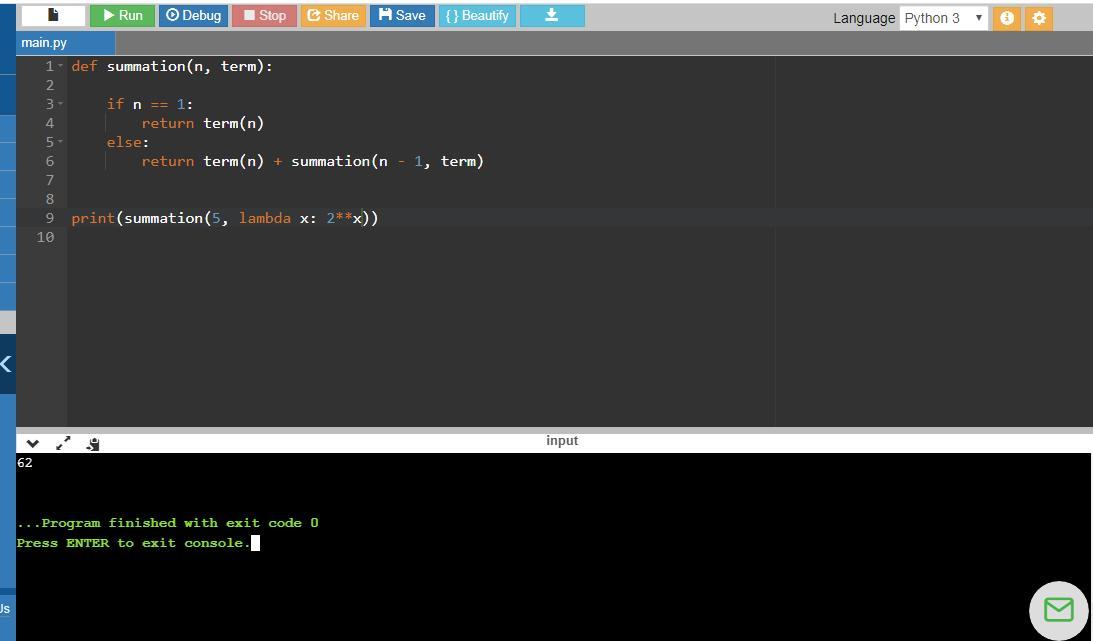
Q3: Summation Write a recursive implementation of summation, which takes a positive integer n and a function term. It applies te
harina [27]

Answer:

Here is the recursive function summation:

def summation(n, term):      

   if n == 1:  

       return term(n)

   else:

       return term(n) + summation(n - 1, term)

Explanation:

The function summation() has two arguments where n is a positive integer and term is a function term. term has the lambda function which is a small function having an argument and an expression e.g lambda b: b+20

So the summation() function is a recursive function which returns sum of the first n terms in the sequence defined by term ( a lambda function).

If you want to check if this function works, you can call this function by passing values to it like given in the question.

summation(5, lambda x: 2**x)

Here the value of n is 5 and the term is a lambda function x: 2**x

If you want to see the results of this function on output screen then use:

print(summation(5, lambda x: 2**x))

The print() function will print the results on screen.

This returns the sum of first 5 terms in sequence defined in the function x: 2**x

In recursive methods there are two cases: base case and recursive case. Base case is the stopping case which means that the recursion will stop when the base case/ base condition evaluates to true. The recursive case is when the function keeps calling itself so the recursive function keepsexecuting until the base case becomes true.

Here the base case is if n == 1:  So the recursive function calling itself until the value of n becomes 1.  

Recursive case is:

       return term(n) + summation(n - 1, term)

For the above example with n= 5 and term = x:2**x the recursions starts from n and adds all the terms of the series one by one and the value of n keeps decrementing by 1 at every recursive call.

When the value of n is equal to 1 the base case gets true and the recursion ends and the result of the sum is displayed in output.

This is how the summation() function works for the above function call:

2^1 + 2^2 + 2^3 + 2^4 + 2^5

n is 5 So this term function is called recursively 5 times and at every recursive call its value decreases by 1. Here the term function is used to compute 2 raise to power n. So in first recursive call the 2 raise to the power 5 is computed, then 5 is decremented and then in second recursive call to summation(), 2 raise to the power 4 is calculated, in third recursive call  to summation(), 2 raise to the power 3 is calculated, in fourth recursive call  to summation(), 2 raise to the power 2 is calculated, in fifth recursive call  to summation(), 2 raise to the power 1 is calculated, then the base condition is reached as n==1. So the recursion stops and the sum of the above computed power function results is returned which is 62.

2^1 + 2^2 + 2^3 + 2^4 + 2^5 = 62

The screen shot of recursive function along with the output of explained examples is attached.

6 0
2 years ago
A 20 dBm power source is connected to the input of a directional coupler having a coupling factor of 20 dB, a directivity of 35
lukranit [14]

Answer:

P_O = 0.989 watt = 19.9 dBm

Explanation:

Given data:

P_1 power = 20 dBm  = 0.1 watt

coupling factor is 20dB

Directivity = 35 dB

We know that

coupling factor = 10 log \frac{P_1}{P_f}

solving for  final power

20 = 10 log\frac{P_1}{P_f}

2 = log \frac{P_1}{P_f}

100 = \frac{0.1}{P_f}

P_f = 0.001 watt = 0 dBm

Directivity D =  10 \frac{P_f}{P_b}

35 = 10 \frac{0.001}{P_b}

P_b = 3.162 \times 10^{-7} wattt

output Power  = P_1 -P_f - P_b

                       = 0.1 - 0.001 - 3.162 \times 10^{-7}

P_O = 0.989 watt = 19.9 dBm

6 0
2 years ago
A hand crank generator is used to power a light bulb. The person turning the crank uses 22 Newtons of input force to turn the cr
ikadub [295]

Answer:

1. The input power is 17.6 Watts

2. The output power is 0.7232 Watts

3.The efficiency of the hand crank generator is approximately 4.109%

Explanation:

The given parameters are;

The force with which the crank generator is turned = 22 Newtons

The rate at which the crank is turned = 8 revolutions per 3 seconds

The distance the hand moves during each revolution = 0.3 meters

The current recorded by the multimeter = 0.08 amps

The voltage recorded by the multimeter = 9.04 volts

1. Power = The rate of doing work = Work done/(Time taken to do the work) = Force × Distance/Time

∴ The power input of the hand crank generator = 22 × 0.3 × 8/3 = 17.6 Watts

2. The power output to the bulb, P, is given by the formula for electrical power as follows;

Power = Current, I × Voltage V

∴ P = 0.08 ×  9.04 = 0.7232 Watts

3. Efficiency in percentage = Output/Input × 100

Therefore, the efficiency of the hand crank generator = )Output power/(Input power)) × 100 = (0.7232/17.6) × 100 ≈ 4.109%

8 0
2 years ago
Es una de las alternativas para obtener capital y como facilidad puede ayudarte a financiarte por más de 40 días, contando con e
andriy [413]

Answer:

Apalancamiento.

Explanation:

El apalancamiento es el uso de dinero prestado (deuda) para aumentar el rendimiento esperado del capital. El apalancamiento se mide como la relación entre la deuda que devenga intereses y los activos totales. Cuanto mayor sea la deuda que devenga intereses, mayor será el apalancamiento financiero o "aceleración". Esto puede tener un efecto positivo o negativo.

Los costos por intereses de este capital de préstamo suelen ser fijos y se deducen de los ingresos. Un préstamo permite que una organización genere más ingresos sin un aumento necesario en el capital. Como no es necesario recaudar ni mantener capital social adicional, no se requieren pagos de dividendos adicionales (que no se pueden deducir de las ganancias). Sin embargo, un alto apalancamiento puede ser beneficioso durante los tiempos de auge, pero puede conducir a serios problemas de flujo de efectivo durante una recesión, ya que es posible que no haya suficientes retornos para cubrir mayores costos de intereses y obligaciones de reembolso.

3 0
1 year ago
Other questions:
  • The uniform 8–ft board is pushed down into the water so it makes an angle of θ = 30o with the water surface. If the cross sectio
    14·1 answer
  • A negative pressure respirator brings fresh air to you through a hose<br>A) True<br>B)False​
    15·2 answers
  • A platinum resistance temperature sensor has a resistance of 120 Ω at 0℃ and forms one arm of a Wheatstone bridge. At this tempe
    12·1 answer
  • Two physical properties that have a major influence on the cracking of workpieces, tools, or dies during thermal cycling are the
    13·1 answer
  • The critical resolved shear stress for iron is 27 MPa (4000 psi). Determine the maximum possible yield strength for a single cry
    12·1 answer
  • A vineyard owner is planting several new rows of grapevines, and needs to know how many grapevines to plant in each row. She has
    8·1 answer
  • A gas pressure difference is applied to the legs of a U-tube manometer filled with a liquid with specific gravity of 1.7. The ma
    15·2 answers
  • A 2-m3 rigid tank initially contains air at 100 kPa and 22oC. The tank is connected to a supply line through a valve. Air is flo
    9·1 answer
  • - Consider a 2024-T4 aluminum material with ultimate tensile strength of 70 ksi. In a given application, a component of this mat
    7·1 answer
  • Interlocking stacked material is done by​ _____.
    10·2 answers
Add answer
Login
Not registered? Fast signup
Signup
Login Signup
Ask question!