answer.
Ask question
Login Signup
Ask question
All categories
  • English
  • Mathematics
  • Social Studies
  • Business
  • History
  • Health
  • Geography
  • Biology
  • Physics
  • Chemistry
  • Computers and Technology
  • Arts
  • World Languages
  • Spanish
  • French
  • German
  • Advanced Placement (AP)
  • SAT
  • Medicine
  • Law
  • Engineering
Elden [556K]
2 years ago
14

5.3-16 A professor recently received an unexpected $10 (a futile bribe attached to a test). Being the savvy investor that she is

, the professor decides to invest the $10 into a savings account that earns 0.5% interest compounded monthly (6.17% APY). Furthermore, she decides to supplement this initial investment with an additional $5 deposit made every month, beginning the month immediately following her initial investment.
(a) Model the professor's savings account as a constant coefficient linear difference equation. Designate yln] as the account balance at month n, where n corresponds to the first month that interest is awarded (and that her $5 deposits begin).
(b) Determine a closed-form solution for y[n] That is, you should express yIn] as a function only of n.
(c) If we consider the professor's bank account as a system, what is the system impulse response h[n]? What is the system transfer function Hz]?
(d) Explain this fact: if the input to the professor's bank account is the everlasting exponential xn] 1 is not y[n] I"H[I]-HII]. 1, then the output
Engineering
1 answer:
artcher [175]2 years ago
4 0

Answer:

a) y (n + 1) = 1.005 y(n) + 5U n

y (n + 1) - 1.005 y(n) = 5U (n)

b) Z^-1(Z(y0)=y(n) = [1010(1.005)^n - 1000(1)^n] U(n)

c) h(n) = (1.005)^n U(n - 1) + 10(1.005)^n U(n)

Explanation:

Her bank account can be modeled as:

y (n + 1) = y (n) + 0.5% y(n) + $5

y (n + 1) = 1.005 y(n) + 5U n

Given that y (0) = $10

y (n + 1) - 1.005 y(n) = 5U (n)

Apply Z transform on both sides

= ZY ((Z) - Z(y0) - 1.005) Z = 5 U (Z)

U(Z) = Z {U(n)} = Z/ Z - 1

Y(Z) [Z- 1.005] = Z y(0) + 5Z/ Z - 1

= 10Z/ Z - 1.005 + 5Z/(Z - 1) (Z - 1.005)

Y(Z) = 10Z/ Z - 1.005 + 1000Z/ Z - 1.005 + 1000Z/ Z - 1

= 1010Z/Z- 1.005 - 1000Z/Z-1

Apply inverse Z transform

Z^-1(Z(y0)) = y(n) = [1010(1.005)^n - 1000(1)^n] U(n)

Impulse response in output when input f(n) = S(n)

That is,

y(n + 1)= 1. 005y (n) + 8n

y(n + 1) - 1.005y (n) = 8n

Apply Z transform

ZY (Z) - Z(y0) - 1.005y(Z) = 1

HZ (Z - 1.005) = 1 + 10Z [Therefore y(Z) = H(Z)]

H(Z) = 1/ Z - 1.005 + 10Z/Z - 1. 005

Apply inverse laplace transform

= h(n) = (1.005)^n U(n - 1) + 10(1.005)^n U(n)

You might be interested in
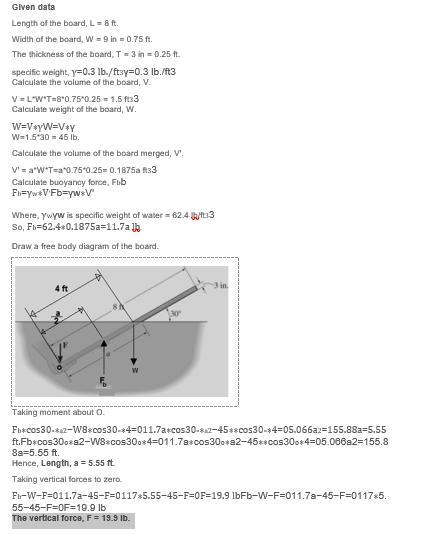
The uniform 8–ft board is pushed down into the water so it makes an angle of θ = 30o with the water surface. If the cross sectio
lana66690 [7]

Answer:

The vertical force, F = 19.9 lb.

Explanation:

3 0
2 years ago
A thin-walled tube with a diameter of 12 mm and length of 25 m is used to carry exhaust gas from a smoke stack to the laboratory
nlexa [21]

Answer:

(a)  h₁   = 204.45 W/m²k

(b) h₀ = 46.80 W/m².k

(c) T = T = 15.50°C

Explanation:

Given Data;

Diameter = 12mm

Length = 25 m

Entry temperature = 200°C

Flow rate = 0.006 kg/s

velocity = 2.5 m/s.

Step 1: Calculating the mean temperature;

(200 + 15)/2

Mean temperature = 107.5°C = 380.5 K

The properties of air at mean temperature 380.5 K are given as:

v = 24.2689*10⁻⁶m²/s

a = 35.024*10⁻⁶m²/s

μ    = 221.6 *10⁻⁷Ns/m²

k = 0.0323 W/m.k

Cp = 1012 J/kg.k

Step 2: Calculating the prantl number using the formula;

Pr = v/a

   = 24.2689*10⁻⁶/ 35.024*10⁻⁶

   = 0.693

Step3: Calculating the reynolds number using the formula;

Re = 4m/πDμ

    = 4 *0.006/π*12*10⁻³ * 221.6 *10⁻⁷

    = 0.024/8.355*10⁻⁷

    = 28725

Since Re is greater than 2000, the flow is turbulent. Nu becomes;

Nu = 0.023Re^0.8 *Pr^0.3

Nu = 0.023 * 28725^0.8 * 0.693^0.3

     = 75.955

(a) calculating the heat transfer coefficient:

Nu = hD/k

h = Nu *k/D

  = (75.955 * 0.0323)/12*10^-3

h   = 204.45 W/m²k

(b)

Properties of air at 15°C

v = 14.82 *10⁻⁶m²/s

k = 0.0253 W/m.k

a = 20.873 *10⁻⁶m²/s

Pr(outside) = v/a

                  = 14.82 *10⁻⁶/20.873 *10⁻⁶

                 = 0.71

Re(outside) = VD/v

                   = 2.5 * 12*10⁻³/14.82*10⁻⁶

                    =2024.29

Using Zakauskus correlation,

Nu = 0.26Re^0.6 * Pr^0.37 * (Pr(outside)/Pr)^1/4

    = 0.26 * 2024.29^0.6 *  0.71^0.37 * (0.71/0.693)^1/4

    = 22.199

Nu = h₀D/k

h₀ = Nu*k/D

     = 22.199* 0.0253/12*10⁻³

h₀ = 46.80 W/m².k

 (c)

Calculating the overall heat transfer coefficient using the formula;

1/U =1/h₁ +1/h₀

1/U = 1/204.45 + 1/46.80

1/U = 0.026259

U = 1/0.026259

U = 38.08

Calculating the temperature of the exhaust using the formula;

T -T₀/T₁-T₀ = e^-[uπDL/Cpm]

T - 15/200-15 = e^-[38.08*π*12*10⁻³*25/1012*0.006]

T - 15/185 = e^-5.911

T -15 = 185 * 0.002709

T = 15+0.50

T = 15.50°C

6 0
2 years ago
Is an isothermal process necessarily internally reversible? Explain your answer with an example
torisob [31]

Answer:

please give me brainlist and follow

Explanation:

Example of an irreverseble isothermal process is mixing of two fluids on the same temperature - it requires a lot of energy to unmix Jack and coke. ... Example of an reversible process with changing temperature is isentropic expansion.

5 0
1 year ago
A person puts a few apples into the freezer at -15oC to cool them quickly for guests who are about to arrive. Initially, the app
frosja888 [35]

Answer:

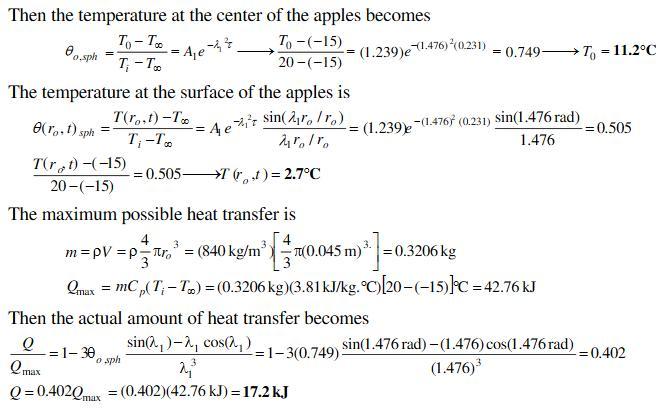
Temperature at center of apples = 11.2⁰C

Temperature at surface of apples = 2.7⁰C

Amount of Heat transferred = 17.2kJ

Explanation:

The properties of apple are given as:

k = 0.418 W/m.°C

ρ = 840 kg/m³

Cр = 3.81 kJ/kg.°C

α = 1.3*10 ⁻⁷ m²/s

h = 8 W/m².°C

d = 0.09m

r = 0.045m

t = 1 hour = 3600s

<h2>Solution</h2>

Biot number is given as:

Bi = \frac{hr}{k}= \frac{8\cdot0.045}{0.418}=0.861

The constants λ₁ and A₁ corresponding to Biot number (from the table) are:

λ₁ = 1.476

A₁ = 1.239

Fourier Number is:

T = \frac{a\cdot{t}}{r^2} = \frac{(1.3\cdot10^{-7})(3600)}{0.045^2}= 0.231> 0.2

As Fourier Number > 0.2 , one term approximates solutions are applicable

The temperature at the center of apples, The temperature at surface of apples and Amount of heat transfer is found in the ATTACHMENT.

8 0
2 years ago
Laminar flow normally persists on a smooth flat plate until a critical Reynolds number value is reached. However, the flow can b
grandymaker [24]

Answer:

At L = 0.1 m

h⁻_lam = 11.004K   W/m^1.5

h⁻_turb = 7.8848K   W/m^1.8

At L = 1 m

h⁻_lam = 3.48K   W/m^1.5

h⁻_turb = 4.975K   W/m^1.8

Explanation:

Given that;

h_lam(x)= 1.74 W/m^1.5. Kx^-0.5

h_turb(x)= 3.98 W/m^1.8 Kx^-0.2

conditions for plates of length L = 0.1 m and 1 m

Now

Average heat transfer coefficient is expressed as;

h⁻ = 1/L ₀∫^L hxdx

so for Laminar flow

h_lam(x)= 1.74 . Kx^-0.5  W/m^1.5

from the expression

h⁻_lam = 1/L ₀∫^L 1.74 . Kx^-0.5   dx

= 1.74k / L { [x^(-0.5+1)] / [-0.5 + 1 ]}₀^L

= 1.74k/L = [ (x^0.5)/0.5)]⁰^L

= 1.74K × L^0.5 / L × 0.5

h⁻_lam= 3.48KL^-0.5

For turbulent flow

h_turb(x)= 3.98. Kx^-0.2 W/m^1.8

form the expression

1/L ₀∫^L 3.98 . Kx^-0.2   dx

= 3.98k / L { [x^(-0.2+1)] / [-0.2 + 1 ]}₀^L

= (3.98K/L) × (L^0.8 / 0.8)

h⁻_turb = 4.975KL^-0.2

Now at L = 0.1 m

h⁻_lam = 3.48KL^-0.5  =  3.48K(0.1)^-0.5  W/m^1.5

h⁻_lam = 11.004K   W/m^1.5

h⁻_turb = 4.975KL^-0.2 = 4.975K(0.1)^-0.2

h⁻_turb = 7.8848K   W/m^1.8

At L = 1 m

h⁻_lam = 3.48KL^-0.5  =  3.48K(1)^-0.5  W/m^1.5

h⁻_lam = 3.48K   W/m^1.5

h⁻_turb = 4.975KL^-0.2 = 4.975K(1)^-0.2

h⁻_turb = 4.975K   W/m^1.8

Therefore

At L = 0.1 m

h⁻_lam = 11.004K   W/m^1.5

h⁻_turb = 7.8848K   W/m^1.8

At L = 1 m

h⁻_lam = 3.48K   W/m^1.5

h⁻_turb = 4.975K   W/m^1.8

3 0
2 years ago
Other questions:
  • generally compound curves are not filtered recommended for A. Road B. water way C. underground road D. rail way​
    12·1 answer
  • Pam Jones worked for 41 years at the same company and had positive performance ratings and personnel records. She needed a calcu
    9·1 answer
  • A 0.9% solution of NaCl is considered isotonic to mammalian cells. what molar concentration is this?
    10·1 answer
  • An aircraft component is fabricated from an aluminum alloy that has a plane-strain fracture toughness of 40 MPa1m (36.4 ksi1in.)
    15·1 answer
  • Show that a chirped Gaussian pulse is compressed initially inside a single-mode fiber when ftC &lt; 0. Derive expressions for th
    12·1 answer
  • Define initial set and final set. Briefly discuss one method used to determine them. The following laboratory tests are performe
    12·1 answer
  • Oil enters a counterflow heat exchanger at 600 K with a mass flow rate of 10 kg/s and exits at 200 K. A separate stream of liqui
    12·1 answer
  • A soil element is subjected to a minor principle stress of 50 kPa on a plane rotated 20 ° counterclockwise from vertical. If the
    10·1 answer
  • 1. A _____ is applied to a wall or roof rafters to add strength and keep the building straight and plumb.
    9·1 answer
  • George is replacing a burned out resistor in a circuit board. The board has a 10, a 20, and a 40 on resistor, all in parallel. W
    5·1 answer
Add answer
Login
Not registered? Fast signup
Signup
Login Signup
Ask question!