answer.
Ask question
Login Signup
Ask question
All categories
  • English
  • Mathematics
  • Social Studies
  • Business
  • History
  • Health
  • Geography
  • Biology
  • Physics
  • Chemistry
  • Computers and Technology
  • Arts
  • World Languages
  • Spanish
  • French
  • German
  • Advanced Placement (AP)
  • SAT
  • Medicine
  • Law
  • Engineering
GaryK [48]
2 years ago
4

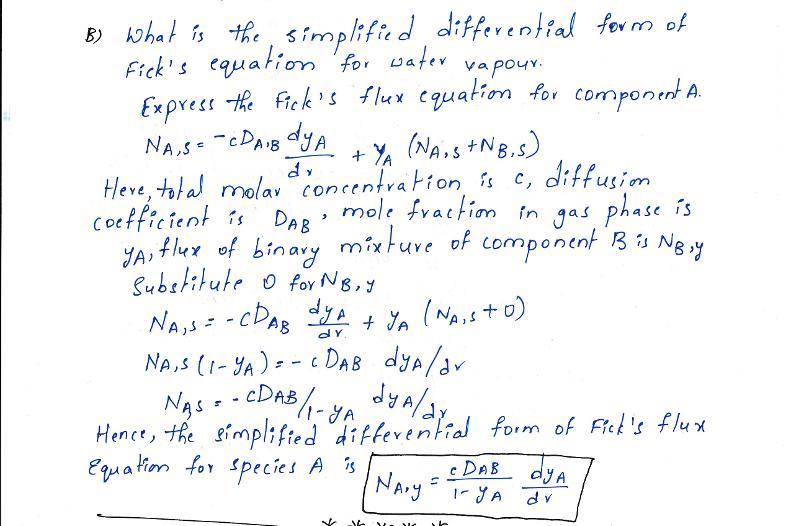
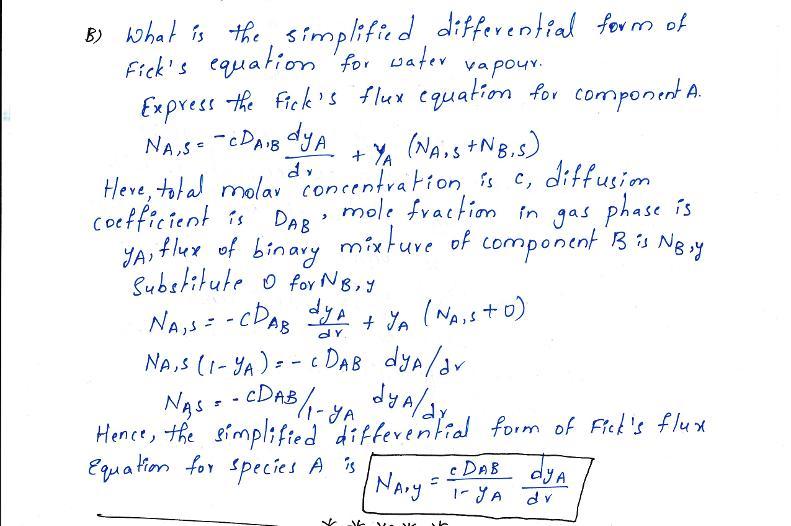
A hemispherical droplet of liquid water, lying on a flat surface, evaporates by molecular diffusion through still air surroundin

g the droplet. The droplet initially has a radius R. As the liquid water slowly evaporates, the droplet shrinks slowly with time, but the flux of the water vapor is at a nominal steady state. The temperature of the droplet and the surrounding still air are kept constant. The air contains water vapor of fixed concentration at an infinitely long distance from the droplet’s surface. After drawing a picture of the physical process, select a coordinate system that will best describe this diffusion process, list at least five reasonable assumptions for the mass-transfer aspects of the water-evaporation process, and simplify the general differential equation for mass transfer in terms of the flux NA. Finally, specify the simplified differential form of Fick’s flux equation for water vapor (species A), and propose reasonable boundary conditions.

Physics
1 answer:
sdas [7]2 years ago
3 0

Answer:

Explanation:

question answered below

You might be interested in
A Honda Civic travels in a straight line along a road. The car’s distance x from a stop sign is given as a function of time t by
aleksklad [387]

a) Average velocity: 2.8 m/s

b) Average velocity: 5.2 m/s

c) Average velocity: 7.6 m/s

Explanation:

a)

The position of the car as a function of time t is given by

x(t)=\alpha t^2 - \beta t^3

where

\alpha = 1.50 m/s^2

\beta = 0.05 m/s^3

The average velocity is given by the ratio between the displacement and the time taken:

v=\frac{\Delta x}{\Delta t}

The position at t = 0 is:

x(0)=\alpha \cdot 0^2 - \beta \cdot 0^3 = 0

The position at t = 2.00 s is:

x(2)=\alpha \cdot 2^2 - \beta \cdot 2^3=5.6 m

So the displacement is

\Delta x = x(2)-x(0)=5.6-0=5.6 m

The time interval is

\Delta t = 2.0 s - 0 s = 2.0 s

And so, the average velocity in this interval is

v=\frac{5.6 m}{2.0 s}=2.8 m/s

b)

The position at t = 0 is:

x(0)=\alpha \cdot 0^2 - \beta \cdot 0^3 = 0

While the position at t = 4.00 s is:

x(4)=\alpha \cdot 4^2 - \beta \cdot 4^3=20.8 m

So the displacement is

\Delta x = x(4)-x(0)=20.8-0=20.8 m

The time interval is

\Delta t = 4.0 - 0 = 4.0 s

So the average velocity here is

v=\frac{20.8}{4.0}=5.2 m/s

c)

The position at t = 2 s is:

x(2)=\alpha \cdot 2^2 - \beta \cdot 2^3=5.6 m

While the position at t = 4 s is:

x(4)=\alpha \cdot 4^2 - \beta \cdot 4^3=20.8 m

So the displacement is

\Delta x = 20.8 - 5.6 = 15.2 m

While the time interval is

\Delta t = 4.0 - 2.0 = 2.0 s

So the average velocity is

v=\frac{15.2}{2.0}=7.6 m/s

Learn more about average velocity:

brainly.com/question/8893949

brainly.com/question/5063905

#LearnwithBrainly
6 0
2 years ago
A 900-kg car traveling east at 15.0 m/s collides with a 750-kg car traveling north at 20.0 m/s. The cars stick together. Assume
dalvyx [7]

Explanation:

It is given that,

Mass of the car 1, m_1=900\ kg

Initial speed of car 1, u_1=15i\ m/s (east)

Mass of the car 2, m_2=750\ kg

Initial speed of car 2, u_1=20j\ m/s (north)

(b) As the cars stick together. It is a case of inelastic collision. Let V is the common speed after the collision. Using the conservation of momentum as :

m_1u_1+m_2u_2=(m_1+m_2)V

900\times 15i +750\times 20j=(900+750)V

13500i+15000j=1650V

V=(8.18i+9.09j)\ m/s

The magnitude of speed,

|V|=\sqrt{8.18^2+9.09^2}

V = 12.22 m/s

(b) Let \theta is the direction the wreckage move just after the collision. It is given by :

tan\theta=\dfrac{v_y}{v_x}

tan\theta=\dfrac{9.09}{8.18}

\theta=48.01^{\circ}

Hence, this is the required solution.

4 0
2 years ago
A damped harmonic oscillator consists of a block of mass 2.5 kg attached to a spring with spring constant 10 N/m to which is app
Cerrena [4.2K]

Answer:

0.5% per oscillation

Explanation:

The term 'damped oscillation' means an oscillation that fades away with time. For Example; a swinging pendulum.

Kinetic energy, KE= 1/2×mv^2-------------------------------------------------------------------------------------------------------------(1).

Where m= Mass, v= velocity.

Also, Elastic potential energy,PE=1/2×kX^2----------------------------------------------------------------------------------------------------------------------(2).

Where k= force constant, X= displacement.

Mechanical energy= potential energy (when a damped oscillator reaches maximum displacement).

Therefore, we use equation (3) to get the resonance frequency,

W^2= k/m--------------------------------------------------------------------------------------(3)

Slotting values into equation (3).

= 10/2.5.

= ✓4.

= 2 s^-1.

Recall that, F= -kX

F^2= (-0.1)^2

Potential energy,PE= 1/2 ×0.01

Potential energy= 0.05 ×100

= 0.5% per oscillation.

6 0
2 years ago
Assume that a uniform magnetic field is directed into thispage. If an electron is released with an initial velocity directedfrom
Feliz [49]

Answer:

B). to the right

Explanation:

Since the direction of magnetic field is into the page

So here we know that

B = B_o(-\hat k)

now the velocity is from bottom to top

so we have

v = v_o \hat j

now the force on the moving charge is given as

\vec F = q(\vec v \times \vec B)

now we have

\vec F = (-e)(v_o \hat j \times B_o(-\hat k))

\vec F = e v_o B \hat i

so force will be towards Right

7 0
2 years ago
What frequency is received by a person watching an oncoming ambulance moving at 110 km/h and emitting a steady 800-Hz sound from
Strike441 [17]

To develop this problem we will apply the concepts related to the Doppler effect. The frequency of sound perceive by observer changes from source emitting the sound. The frequency received by observer f_{obs} is more than the frequency emitted by the source. The expression to find the frequency received by the person is,

f_{obs} = f_s (\frac{v_w}{v_w-v_s})

f_s= Frequency of the source

v_w= Speed of sound

v_s= Speed of source

The velocity of the ambulance is

v_s = 119km/h (\frac{1000m}{1km})(\frac{1h}{3600s})

v_s = 30.55m/s

Replacing at the expression to frequency of observer we have,

f_{obs} = 800Hz(\frac{345m/s}{345m/s-30.55m/s})

f_{obs} = 878Hz

Therefore the frequency receive by observer is 878Hz

8 0
2 years ago
Other questions:
  • "A hole is punched in a full milk carton, 10 cm below the top. What is the initial velocity of outflow?"
    14·2 answers
  • A series circuit has two 10-ohm bulb is added in a series. Technician A says that the three bulbs will be dimmer than when only
    14·1 answer
  • A runner generates 1260 W of thermal energy. If this heat has to be removed only by evaporation, how much water does this runner
    8·1 answer
  • A water wave traveling in a straight line on a lake is described by the equation:y(x,t)=(2.75cm)cos(0.410rad/cm x+6.20rad/s t)Wh
    11·1 answer
  • In the photoelectric effect, the greater the frequency of the illuminating light, the greater the:_______
    7·1 answer
  • A proposed space elevator would consist of a cable stretching from the earth's surface to a satellite, orbiting far in space, th
    6·1 answer
  • A passenger compartment of a rotating amusement park ride contains a bench on which a book of mass
    6·1 answer
  • As computer structures get smaller and smaller, quantum rules start to create difficulties. Suppose electrons move through a cha
    11·1 answer
  • A large semi-truck, with mass 31x crashes into a small sedan with mass x . If the semi-truck exerts a force F on the sedan, what
    13·1 answer
  • Consider a double Atwood machine constructed as follows: A mass 4m is suspended from a string that passes over a massless pulley
    7·1 answer
Add answer
Login
Not registered? Fast signup
Signup
Login Signup
Ask question!