answer.
Ask question
Login Signup
Ask question
All categories
  • English
  • Mathematics
  • Social Studies
  • Business
  • History
  • Health
  • Geography
  • Biology
  • Physics
  • Chemistry
  • Computers and Technology
  • Arts
  • World Languages
  • Spanish
  • French
  • German
  • Advanced Placement (AP)
  • SAT
  • Medicine
  • Law
  • Engineering
LekaFEV [45]
2 years ago
15

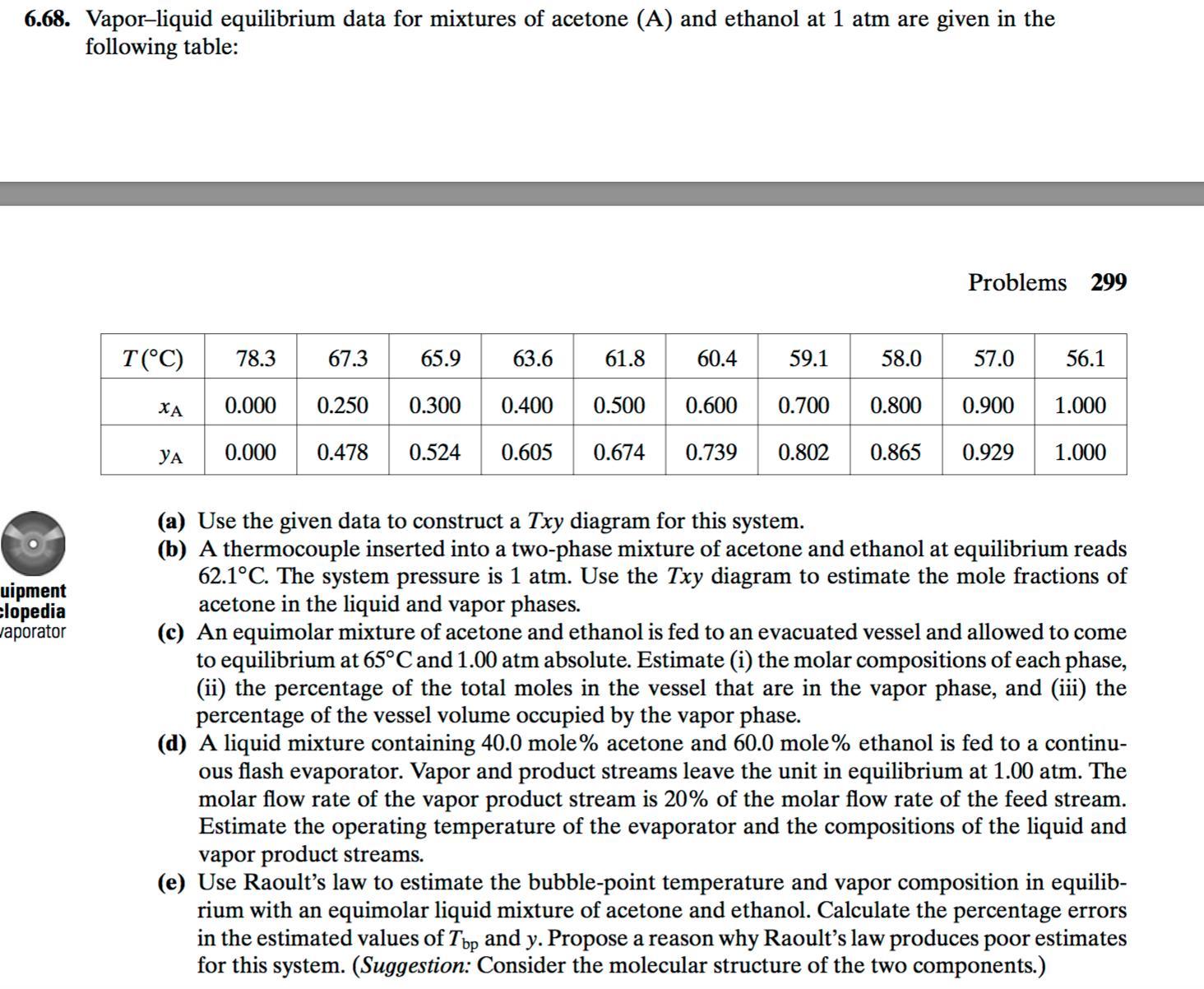
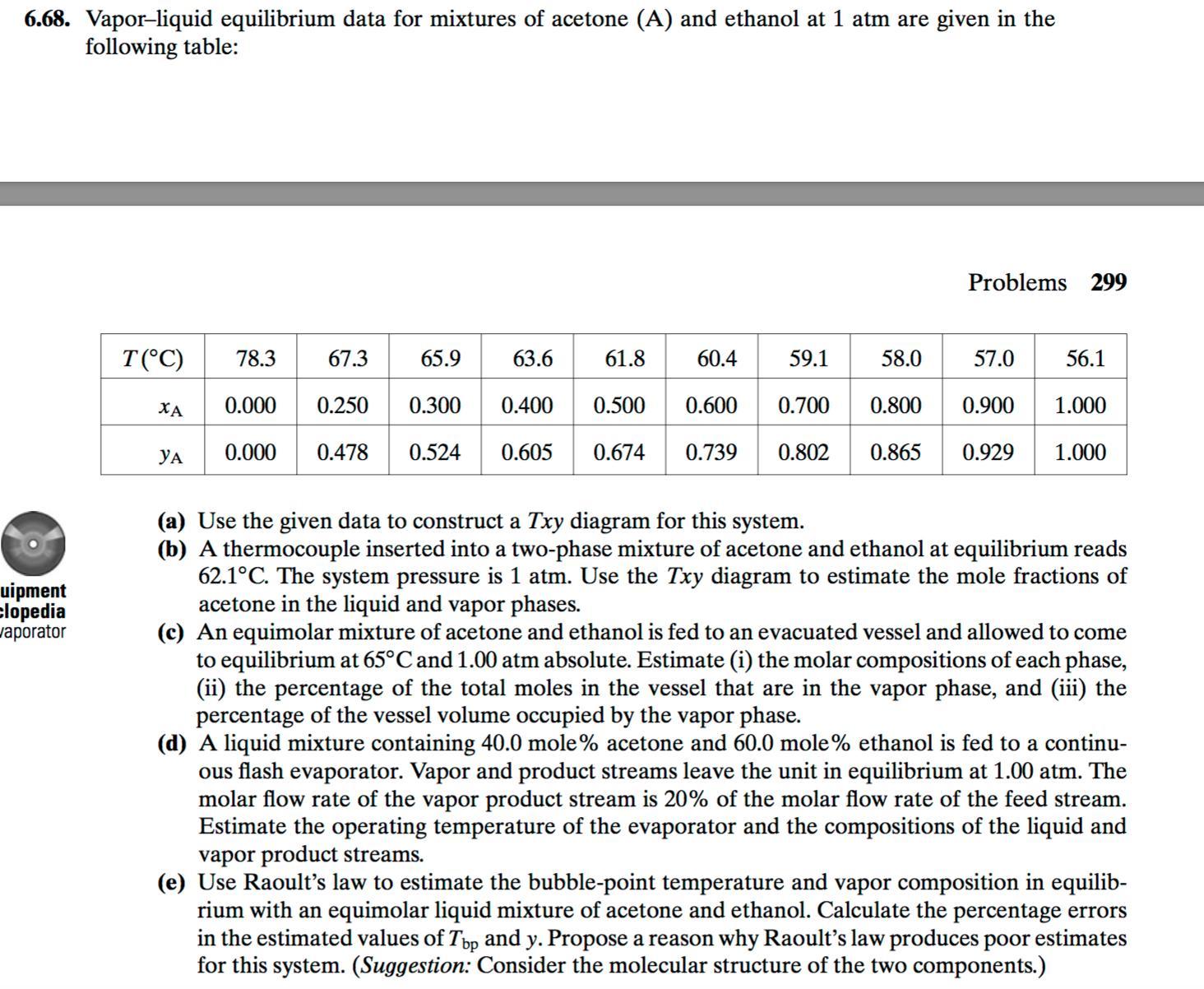
An equimolar mixture of acetone and ethanol is fed to an evacuated vessel and allowedto come to equilibrium at 65°C and 1.00 atm

absolute. State a quick way to show thatthe system has two phases. Estimate (i) the molar compositions of each phase, (ii) thepercentage of the total moles in the vessel that are in the vapor phase, and (iii) thepercentage of the vessel volume occupied by the vapor phase.

Chemistry
1 answer:
frutty [35]2 years ago
3 0

The question is incomplete, the table of the question is given below

Answer:

I) xA= 0.34, yA= 0.55

ii) 76.2 mole % vapor

iii) Percentage of vapor volume = 98%

Explanation:

i) xA= 0.34, yA= 0.55

 xA= 0.34, yA= 0.55

ii)      0.50 = 0.55 nv + 0.34 nL

     Therefore, nV =    0.762 mol vapor and nL = 0.238 mol liquid

This shows 76.2 mole % vapor

iii)  ρA= 0.791 g/cm3 and,  ρE = 0.789 g/cm3

Therefore, ρ = 0.790 g/cm3

Now, we have:

MA = 58.08 g/mol and ME= 46.07 g/mol

So Ml = (0.34 x 58.08)+[(1 -0.34) x 46.07] = 50.15 g/mol

1 mol liquid = (0.762 mol vapor/0.238 mol liquid) = 3.2 mol vapor

Liquid volume = Vl= [1 mol x (50.15 g/mol)] / (0.790 g/cm3) = 63.48 cm3

Vapour volume = Vv = 3.2 mol x(22400 cm3/mol) x [(65+273)/273] = 88747 cm3

Therefore, percentage of vapour volume = 88747 / (88747+63.48) = 99.9 %

You might be interested in
Diborane, B2H6 a possible rocket propellant, can be made by using lithium hydride (LiH): 6 LiH+ 2 BCl2àB2H6+ 6 LiCl . If you mix
Genrish500 [490]

Answer :

(a) Limiting reactant = LiH

(b) The excess reactant = BCl_3

(c) The percent of excess reactant is, 50.87 %

(d) The percent yield of B_2H_6 or percent conversion of LiH to B_2H_6 is, 38.80 %

(e) The mass of LiCl produced is, 1066.42 lb

Explanation : Given,

Mass of LiH = 200 lb = 90718.5 g

conversion used : (1 lb = 453.592 g)

Mass of BCl_3 = 1000 lb = 453592 g

Molar mass of LiH = 7.95 g/mole

Molar mass of BCl_3 = 117.17 g/mole

Molar mass of B_2H_6 = 27.66 g/mole

Molar mass of LiCl = 42.39 g/mole

First we have to calculate the moles of LiH and BCl_3.

\text{Moles of }LiH=\frac{\text{Mass of }LiH}{\text{Molar mass of }LiH}=\frac{90718.5g}{7.95g/mole}=11411.13moles

\text{Moles of }BCl_3=\frac{\text{Mass of }BCl_3}{\text{Molar mass of }BCl_3}=\frac{453592g}{117.17g/mole}=3871.23moles

Now we have to calculate the limiting and excess reagent.

The balanced chemical reaction is,

6LiH+2BCl_3\rightarrow B_2H_6+6LiCl

From the balanced reaction we conclude that

As, 6 moles of LiH react with 1 mole of BCl_3

So, 11411.13 moles of LiH react with \frac{11411.13}{6}=1901.855 moles of BCl_3

From this we conclude that, BCl_3 is an excess reagent because the given moles are greater than the required moles and LiH is a limiting reagent and it limits the formation of product.

Moles of remaining excess reactant = 3871.23 - 1901.855 = 1969.375 moles

Total excess reactant = 3871.23 moles

Now we have to determine the percent of excess reactant (BCl_3).

\% \text{ excess reactant}=\frac{\text{Moles of remaining excess reactant}}{\text{Moles of total excess reagent}}\times 100

\% \text{ excess reactant}=\frac{1969.375}{3871.23}\times 100=50.87\%

The percent of excess reactant is, 50.87 %

Now we have to calculate the moles of B_2H_6.

As, 6 moles of LiH react to give 1 mole of B_2H_6

So, 11411.13 moles of LiH react to give \frac{11411.13}{6}=1901.855 moles of B_2H_6

Now we have to calculate the mass of B_2H_6.

\text{Mass of }B_2H_6=\text{Moles of }B_2H_6\times \text{Molar mass of }B_2H_6

\text{Mass of }B_2H_6=(1901.855mole)\times (27.66g/mole)=52605.3093g

Now we have to calculate the percent yield of B_2H_6.

\%\text{ yield of }B_2H_6=\frac{\text{Actual yield of }B_2H_6}{\text{Theoretical yield of }B_2H_6}\times 100=\frac{20411.7g}{52605.3093g}\times 100=38.80\%

The percent yield of B_2H_6 or percent conversion of LiH to B_2H_6 is, 38.80 %

Now we have to calculate the moles of LiCl.

As, 6 moles of LiH react to give 6 mole of LiCl

So, 11411.13 moles of LiH react to give 11411.13 moles of LiCl

Now we have to calculate the mass of LiCl.

\text{Mass of }LiCl=\text{Moles of }LiCl\times \text{Molar mass of }LiCl

\text{Mass of }LiCl=(11411.13mole)\times (42.39g/mole)=483717.8007g=1066.42lb

The mass of LiCl produced is, 1066.42 lb

8 0
2 years ago
analysis of a compound indicates that it contains 1.04 grams K 0.70 g Cr and 0.86 g O. Find its empirical formula
MrMuchimi
1.04gK*1molK/39.01g K= 0.0267 mol K
0.70gCr*1mol/52.0g Cr = <span>0.0135 mol Cr   
0.86 gO* 1 mol/16.0 g O = 0.0538 mol O
</span>0.0267 mol K/0.0135 = 2 mol K
0.0135 mol Cr  /0.0135= 1 mol Cr
 0.0538 mol O/0.035= 4 mol Cr
K2CrO4
6 0
2 years ago
Read 2 more answers
2KOH+H2SO4=k2SO4+2H2O Is a balanced equation, displaying the combination of potassium hydroxide with sulfuric acid increase pota
Lerok [7]

Answer:

The number of moles of potassium hydroxide, KOH required to make 4 moles of K₂SO₄ is 8 moles of KOH

Explanation:

2KOH + H₂SO₄ → K₂SO₄ + 2H₂O

From the above reaction, we have 2 moles of KOH combining with 1 mole of H₂SO₄ to produce 1 mole of K₂SO₄  and 2 moles of H₂O.

Therefore the number of moles of potassium hydroxide that will be needed to make 4 moles of K₂SO₄ is;

8KOH + 4H₂SO₄ → 4K₂SO₄ + 8H₂O

8 moles of KOH is required to make 4 moles of K₂SO₄.

6 0
2 years ago
The plastic straws were placed under the wooden block to
Sveta_85 [38]
Answer: C
I hope this helped you
6 0
2 years ago
Phosphorous acid, H3PO3(aq), is a diprotic oxyacid that is an important compound in industry and agriculture. K pKa1 K pKa2 1.30
FrozenT [24]

Answer:

* Before addition of any KOH:

pH = 0,0301

*After addition of 25.0 mL KOH:

pH = 1,30

*After addition of 50.0 mL KOH:

pH = 2,87

*After addition of 75.0 mL KOH:

pH = 6,70

*After addition of 100.0 mL KOH:

pH = 10,7

Explanation:

H₃PO₃ has the following equilibriums:

H₃PO₃ ⇄ H₂PO₃⁻ H⁺

k = [H₂PO₃⁻] [H⁺] / [H₃PO₃] k = 10^-(1,30) <em>(1)</em>

H₂PO₃⁻ ⇄ HPO₃²⁻ + H⁺

k = [HPO₃²⁻] [H⁺] / [H₂PO₃⁻] k = 10^-(6,70) <em>(2)</em>

Moles of H₃PO₃ are:

0,0500L×(1,8mol/L) = 0,09 moles of H₃PO₃

* Before addition of any KOH:

Using (1), moles in equilibrium are:

H₃PO₃: 0,09-x

H₂PO₃⁻: x

H⁺: x

Replacing:

10^{-1.30} = \frac{x^2}{0.09-x}

4.51x10⁻³ - 0.050x -x² = 0

The right solution of x is:

x = 0.0466589

As volume is 0,050L

[H⁺] = 0.0466589moles / 0,050L = 0,933M

As pH = -log [H⁺]

<em>pH = 0,0301</em>

*After addition of 25.0 mL KOH:

0,025L×1,8M = 0,045 moles of KOH that reacts with H₃PO₃ thus:

KOH + H₃PO₃ → H₂PO₃⁻ + H₂O

That means moles of KOH will be the same of H₂PO₃⁻ and moles of H₃PO₃ are 0,09moles - 0,045moles = 0,045moles

Henderson-Hasselbalch formula is:

pH = pka + log₁₀ [A⁻] /[HA]

Where A⁻ is H₂PO₃⁻ and HA is H₃PO₃.

Replacing:

pH = 1,30 + log₁₀ [0,045mol] / [0,045mol]

<em>pH = 1,30</em>

*After addition of 50.0 mL KOH:

The addition of 50.0 mL KOH consume all H₃PO₃. Thus, in the solution you will have just H₂PO₃⁻. Thus, moles in solution for the equilibrium will be:

H₂PO₃⁻: 0,09-x

HPO₃²⁻: x

H⁺: x

Replacing:

10^{-6.70} = \frac{x^2}{0.09-x}

1.8x10⁻⁸ - 2x10⁻⁷x - x² = 0

The right solution of x is:

x = 0.000134064

As volume is 50,0mL + 50,0mL = 100,0mL

[H⁺] = 0.000134064moles / 0,100L = 1.34x10⁻³M

As pH = -log [H⁺]

<em>pH = 2,87</em>

*After addition of 75.0 mL KOH:

Applying Henderson-Hasselbalch formula you will have 0,045 moles of both H₂PO₃⁻ HPO₃²⁻ and pka: 6,70:

pH = 6,70 + log₁₀ [0,045mol] / [0,045mol]

<em>pH = 6,70</em>

*After addition of 100.0 mL KOH:

You will have just 0,09moles of HPO₃²⁻, the equilibrium will be:

HPO₃²⁻ + H₂O ⇄ H₂PO₃⁻ + OH⁻ with kb = kw/ka = 1x10⁻¹⁴/10^-(6,70) = 5,01x10⁻⁸

kb = [H₂PO₃⁻] [OH⁻] / [HPO₃²⁻]

Moles are:

H₂PO₃⁻: x

OH⁻: x

HPO₃²⁻: 0,09-x

Replacing:

5.01x10^{-8} = \frac{x^2}{0.09-x}

4.5x10⁻⁹ - 5.01x10⁻⁸x - x² = 0

The right solution of x is:

x = 0.000067057

As volume is 50,0mL + 100,0mL = 150,0mL

[OH⁻] = 0.000067057moles / 0,150L = 4.47x10⁻⁴M

As pH = 14-pOH; pOH = -log [OH⁻]

<em>pH = 10,7</em>

<em></em>

I hope it helps!
6 0
2 years ago
Other questions:
  • in collecting the precipitate, why would it be inappropriate to heat the reacted mixture and evaporate off the water?
    6·1 answer
  • A 5 mole sample of liquid acetone is converted to a gas at 75.0°C. If 628 J are required to raise the temperature of the liquid
    12·1 answer
  • What does the chemical formula cacl2 show about the compound it represents? The person who answered this question first was wron
    12·2 answers
  • Silver (ag) has a molar mass of 107.8682 g, nitrogen has a molar mass of 14.0067 g, and oxygen has a molar mass of 15.9994 g. wh
    13·2 answers
  • A ground state hydrogen atom absorbs a photon of light having a wavelength of 93.73 nm. It then gives off a photon having a wave
    10·1 answer
  • The coinage metals (Group 1B) copper, silver, and gold have specific heats of 0.385, 0.233, and 0.129 J/g-K, respectively. Among
    13·2 answers
  • What is the pOH of a solution that has a hydronium ion concentration [H3O+] of 8.26 x 10⁻⁵ M
    9·1 answer
  • what is molarity of a sodium hydroxide solution made by combining 2.0 L of 0.60 M NaOH with 495 mL of 3.0 M NaOH? Assume the vol
    5·1 answer
  • Calculate the ratio of H+ ions to OH– ions at a pH = 6. Find the concentration of H+ ions to OH– ions listed in Table B of your
    6·1 answer
  • A chunk of a metal alloy displaces 0.58 L of water and has a mass of 2.9 kg. What is the density of the alloy in g/cm3?
    8·1 answer
Add answer
Login
Not registered? Fast signup
Signup
Login Signup
Ask question!