answer.
Ask question
Login Signup
Ask question
All categories
  • English
  • Mathematics
  • Social Studies
  • Business
  • History
  • Health
  • Geography
  • Biology
  • Physics
  • Chemistry
  • Computers and Technology
  • Arts
  • World Languages
  • Spanish
  • French
  • German
  • Advanced Placement (AP)
  • SAT
  • Medicine
  • Law
  • Engineering
Viktor [21]
2 years ago
6

Calculate the ratio of H+ ions to OH– ions at a pH = 6. Find the concentration of H+ ions to OH– ions listed in Table B of your

Student Guide. Then divide the H+ concentration by the OH– concentration. Record this calculated ratio in Table A of your Student Guide.
Compare your approximated and calculated ratios of H+ ions to OH– ions at a pH = 6. Are they the same? Why or why not? Record your explanation in Table A.
What is the concentration of H+ ions at a pH = 6?
What is the concentration of OH– ions at a pH = 6?
What is the ratio of H+ ions to OH– ions at a pH = 6?
Chemistry
1 answer:
ipn [44]2 years ago
4 0

Answer:

The concentration of H+ ions at a pH of 6 is 0.000001. FIVE ZEROS AFTER THE DECIMAL

The concentration of OH- ions at a pH of 6 is 0.00000001. SEVEN ZEROS AFTER THE DECIMAL

The ratio of H+ ions to OH- ions at a pH of 6 is 100:1

Explanation:

For the concentrations of the H+ ions and OH- ions look at your chart on the student guide, it should be table B. But make sure to count the zeros right.

For the ratio it is easy, take the concentration of O+ ions and divide it by the concentration of the OH-. I recommend using desmos scientific calculator and just copying and pasting it into there. Good luck on your course!

You might be interested in
Atorvastatin is sold under the trade name Lipitor and is used for lowering cholesterol. Annual global sales of this compound exc
kotegsom [21]

Answer:

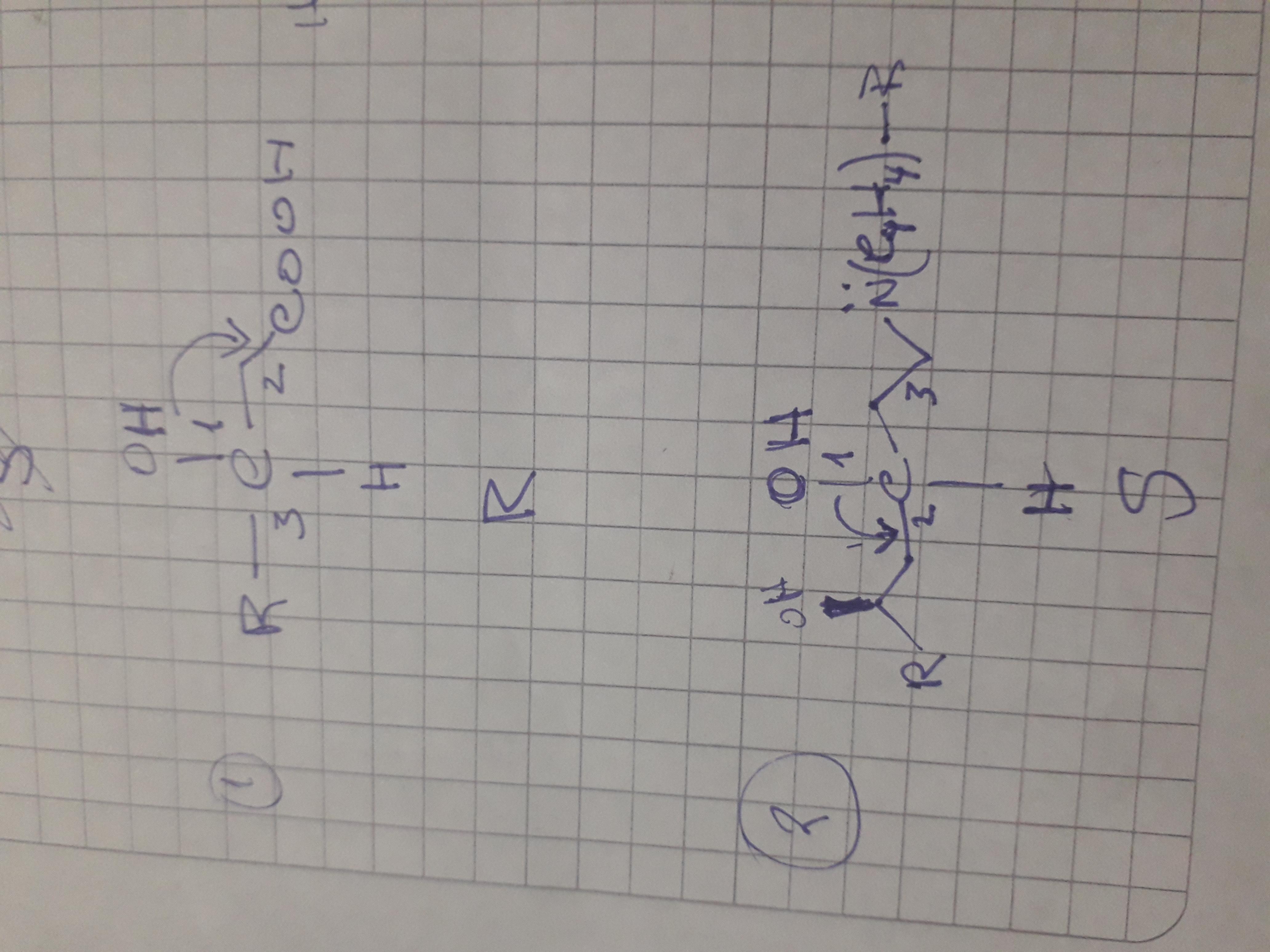
Atorvastatin has two chiral centers. The question doesn't include the box where have to answer but I can show you in an image where are located and their configuration.

Explanation:

The first image shows the chemical structure of atorvastatin and their chiral centers identified as 1 and 2 respectively.

The second image shows the Fischer projections corresponding to every chiral carbon 1 and 2. I wrote R so suggest that there are more carbon atoms forward but not only corresponds to carbon atoms.

You can see that the chiral carbon 1 has R configuration due to the direction from the main substituent to the second follow the clockwise.

The chiral carbon 2 has S configuration due to the direction from the main substituent to the second one go anticlockwise.

4 0
2 years ago
In which orbitals would the valence electrons for carbon <br> c. be placed?
katrin2010 [14]

Answer: 2s and 2p

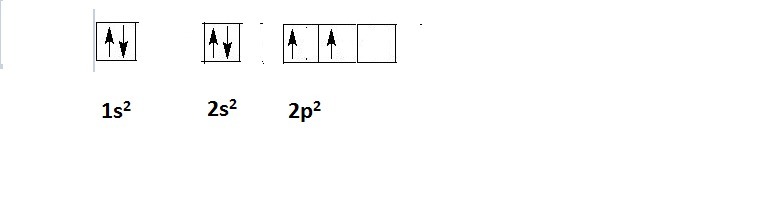
Explanation: Carbon is an element with atomic number of 6 and thus contains 6 electrons. The electrons are filled in order of increasing energies and follows Afbau's rule.The electrons are singly filled first in each orbital having same spin, then only pairing occurs. This rule was known as Hund's Rule.

The valence electrons are the electrons which are present in last shell. Thus valence electrons are 4, two in s and 2 in p orbitals.

C: 6:1s^22s^22p_x^12p_y^1


8 0
2 years ago
Read 2 more answers
A. The measured pH of a 0.100 M HCl solution at 25 degrees Celsius is 1.092. From this information, calculate the activity coeff
ra1l [238]

Answer:

activity coefficient \mathbf{\gamma =0.809}

activity coefficient \mathbf{\gamma = 0.791}

The change in pH in part A = 0.092

The change in pH in part B =  0.102

Explanation:

From the given information:

pH of HCl solution = 1.092

Activity of the pH solution [a] = 10^{-1.092}

[a] = 0.0809 M

Recall that [a] = \gamma × C

where;

\gamma  = activity coefficient

C = concentration

Making the activity coefficient the subject of the formula, we have:

\gamma = \dfrac{[a]}{C}

\gamma = \dfrac{0.0809 \ M}{0.100  \ M}

\mathbf{\gamma =0.809}

B.

The pH of a solution of HCl and KCl = 2.102

[a] = 10^{-2.102}

[a] = 0.00791 M

activity coefficient \gamma = \dfrac{0.00791 \ M}{0.01 \ M}

\mathbf{\gamma = 0.791}

C. The change in pH in part A = 1.091 - 1.0 = 0.092

The change in pH in part B = 2.102 -2.00 = 0.102

3 0
2 years ago
There are two types of nucleic acids, dna and rna. nearly all organisms use dna, not rna, as the central repository for genetic
Leya [2.2K]
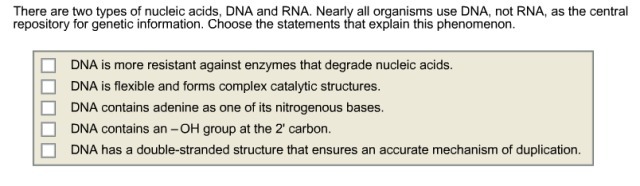
Found the choices. Pls see attachment. 

The statements that explains this phenomenon are:
1) DNA contains adenine as one of its nitrogenous bases.
2) DNA has a double-stranded structure that ensures an accurate mechanism of duplication.

6 0
2 years ago
What is the value of Keq for the reaction expressed in scientific notation? 2.1 x 10⁻² 2.1 x 10² 1.2 x 10³ 1.2 x 10⁻³
Lady_Fox [76]

Complete question:

Consider the reaction.

At equilibrium at 600 K, the concentrations are as follows.

2HF -----> H₂ + F₂

[HF] = 5.82 x 10⁻² M

[H2] = 8.4 x 10⁻³ M

[F2] = 8.4 x 10⁻³ M

What is the value of Keq for the reaction expressed in scientific notation?

2.1 x 10⁻²

2.1 x 10²

1.2 x 10³

1.2 x 10⁻³

Answer:

2.1 × 10^-2

Explanation:

Kequilibrum(Keq) = product/reactant

Equation for the reaction :

2HF -----> H₂ + F₂

Therefore,

Keq = [H2][F2] / [HF]^2

Keq = [8.4 x 10⁻³][8.4 x 10⁻³] / [5.82 x 10⁻²]^2

Keq = [70.56 × 10^(-3 + - 3)]/[33.8724 × 10^(-2×2)]

Keq = [70.56 × 10^-6] / [33.8724 × 10^-4]

Keq = 2.0665 × 10^(-6 - (-4))

Keq = 2.0665 × 10^(-6 + 4)

Keq = 2.1 × 10^-2

7 0
2 years ago
Read 2 more answers
Other questions:
  • Determine the mass of oxygen in a 7.20 g sample of Al2(SO4)3.
    9·2 answers
  • An iron atom has a mass of ×9.2710−23g and a cooking pot has a mass of 0.500kg
    12·2 answers
  • A 15.0 kg iron weightlifting plate has a volume of 1910 cm3 . What is the density of the iron plate in g/cm3?
    9·1 answer
  • A compound is found to have a molar mass of 598 g/mol. if 35.8 mg of the compound is dissolved in enough water to make 175 ml of
    10·1 answer
  • Calculate the first and second velocities of the car with one washer attached to the pulley, using the formulas v1 = 0.25 m / t1
    7·2 answers
  • Your lab partner named this compound 3-methyl-4-n-propylhexane, but that is not correct.
    9·1 answer
  • A food substance kept at 0°C becomes rotten (as determined by a good quantitative test) in 8.3 days. The same food rots in 10.6
    14·1 answer
  • The ph of an aqueous solution at 25.0°c is 10.66. what is the molarity of h+ in this solution? the ph of an aqueous solution at
    8·1 answer
  • How many total bond are in the Lewis structure for HSIN?
    14·1 answer
  • HELPP 20+ POINTS!!!
    12·1 answer
Add answer
Login
Not registered? Fast signup
Signup
Login Signup
Ask question!