answer.
Ask question
Login Signup
Ask question
All categories
  • English
  • Mathematics
  • Social Studies
  • Business
  • History
  • Health
  • Geography
  • Biology
  • Physics
  • Chemistry
  • Computers and Technology
  • Arts
  • World Languages
  • Spanish
  • French
  • German
  • Advanced Placement (AP)
  • SAT
  • Medicine
  • Law
  • Engineering
Mashutka [201]
2 years ago
6

Atorvastatin is sold under the trade name Lipitor and is used for lowering cholesterol. Annual global sales of this compound exc

eed $13 billion. Assign a configuration to each chiral center in atorvastatin: In the boxes below, first input the numbers corresponding to the chiral centers in numerical order as a comma separated list (e.g., "1,3,4"). Then input the configurations of the chiral centers in the same order and format (e.g., "R,S,S"). chiral center(s): Configuration(s):

Chemistry
1 answer:
kotegsom [21]2 years ago
4 0

Answer:

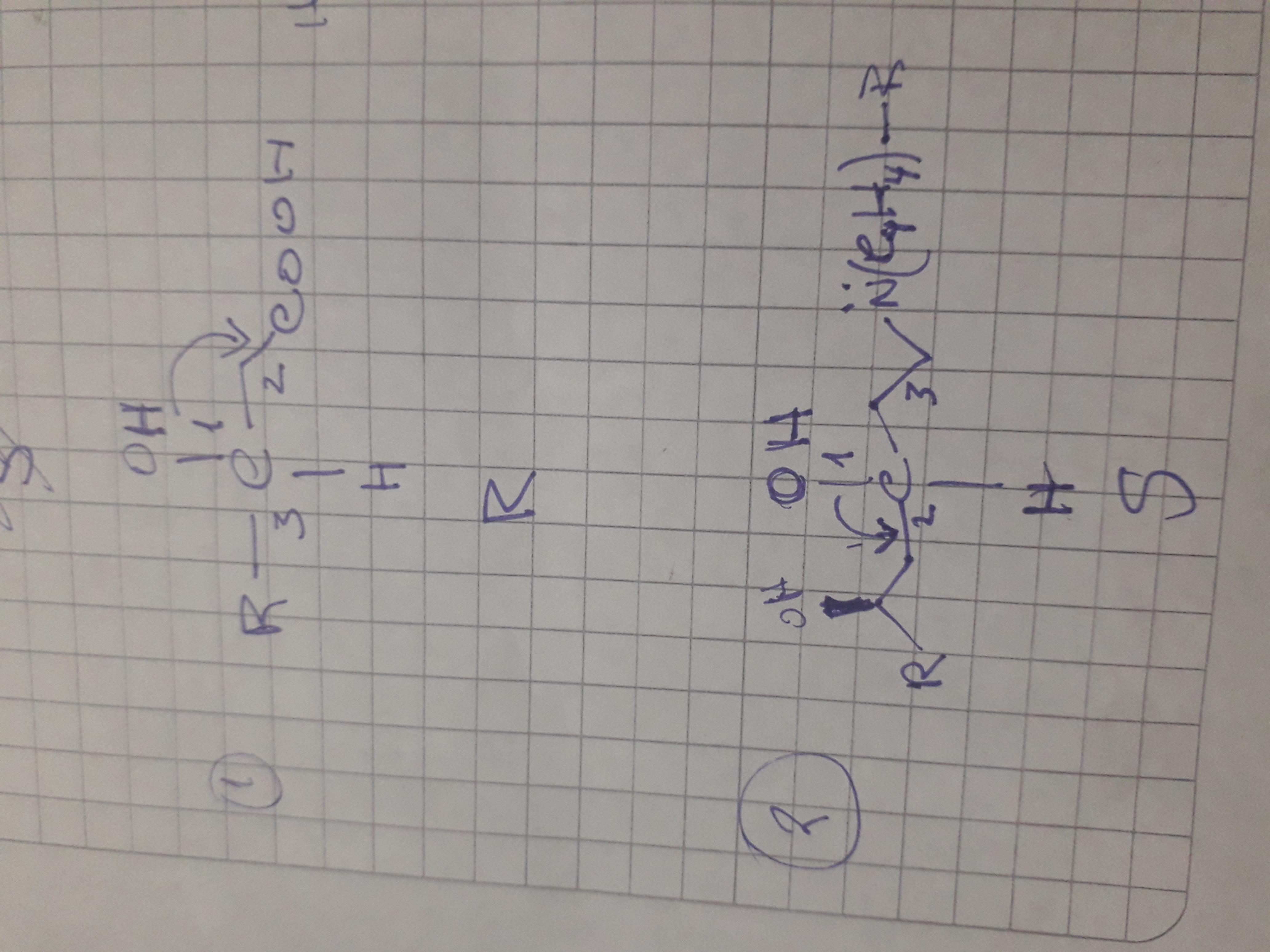
Atorvastatin has two chiral centers. The question doesn't include the box where have to answer but I can show you in an image where are located and their configuration.

Explanation:

The first image shows the chemical structure of atorvastatin and their chiral centers identified as 1 and 2 respectively.

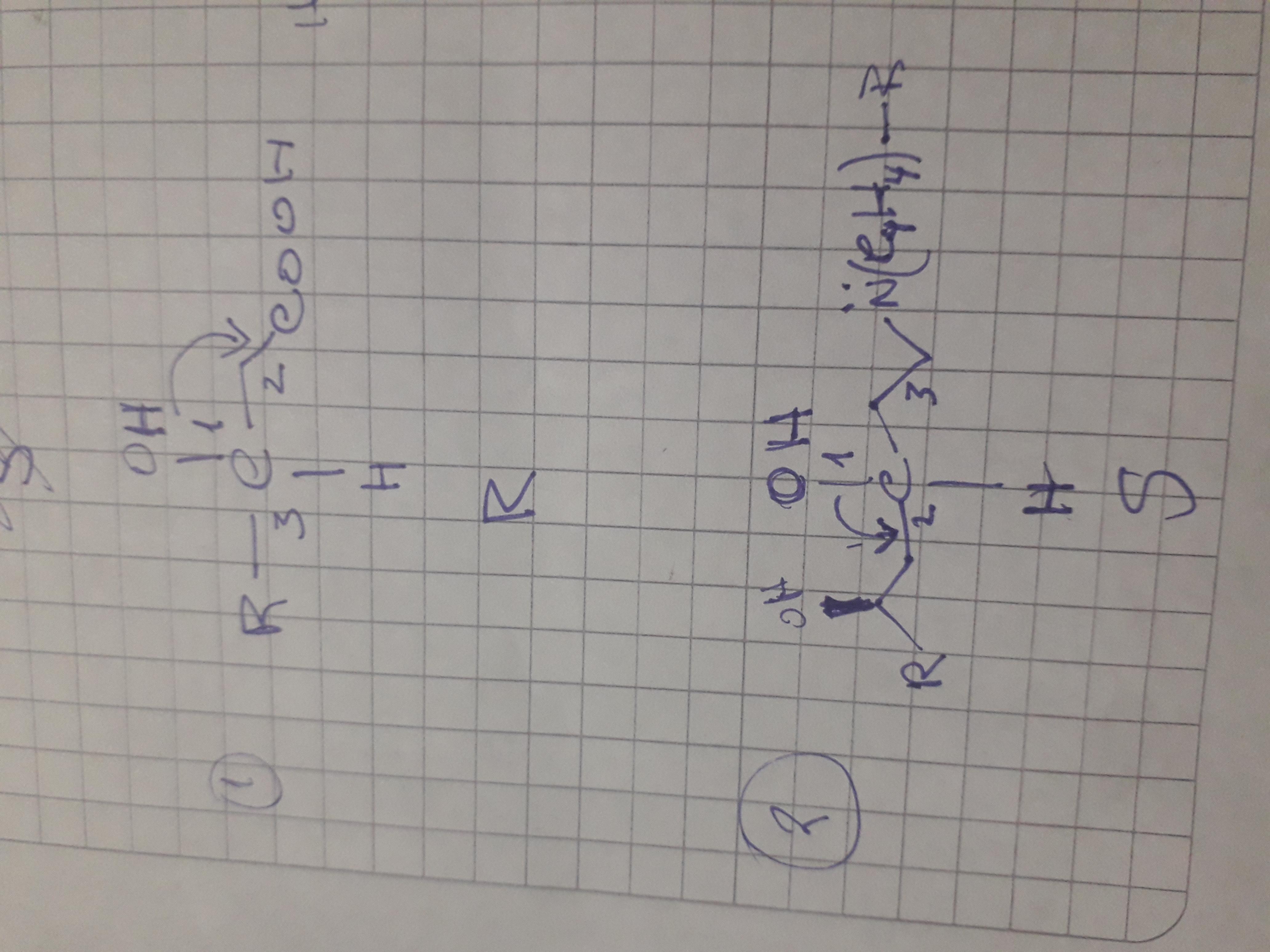
The second image shows the Fischer projections corresponding to every chiral carbon 1 and 2. I wrote R so suggest that there are more carbon atoms forward but not only corresponds to carbon atoms.

You can see that the chiral carbon 1 has R configuration due to the direction from the main substituent to the second follow the clockwise.

The chiral carbon 2 has S configuration due to the direction from the main substituent to the second one go anticlockwise.

You might be interested in
Hydrochloric acid (75.0 mL of 0.250 M) is added to 225.0 mL of 0.0550 M Ba(OH)2 solution. What is the concentration of the exces
Shalnov [3]

Answer:  The concentration of excess [OH^-] in solution is 0.017 M.

Explanation:

1. Molarity=\frac{moles}{\text {Volume in L}}

moles of HCl=Molarity\times {\text {Volume in L}}=0.250\times 0.075=0.019moles

1 mole of HCl give = 1 mole of H^+

Thus 0.019 moles of HCl give = 0.019 mole of H^+

2. moles of Ba(OH)_2=Molarity\times {\text {Volume in L}}=0.0550\times 0.225=0.012moles

According to stoichiometry:

1 mole of Ba(OH)_2 gives = 2 moles of OH^-

Thus 0.012 moles of Ba(OH)_2 give = 2 \times 0.012=0.024 moles of OH^-

H^++OH^-\rightarrow H_2O

As 1 mole of H^+ neutralize 1 mole of OH^-

0.019 mole of H^+ will neutralize 0.019 mole of OH^-

Thus (0.024-0.019)= 0.005 moles of OH^- will be left.

[OH^-]=\frac{\text {moles left}}{\text {Total volume in L}}=\frac{0.005}{0.3L}=0.017M

Thus molarity of [OH^-] in solution is 0.017 M.

4 0
2 years ago
Read 2 more answers
Given: CaC2 + N2 → CaCN2 + C In this chemical reaction, how many grams of N2 must be consumed to produce 265 grams of CaCN2? Exp
weeeeeb [17]

Answer : The grams of N_2 consumed is, 89.6 grams.

Solution : Given,

Mass of CaCN_2 = 265 g

Molar mass of CaCN_2 = 80 g/mole

Molar mass of N_2 = 28 g/mole

First we have to calculate the moles of CaCN_2.

\text{Moles of }CaCN_2=\frac{\text{Mass of }CaCN_2}{\text{Molar mass of }CaCN_2}=\frac{265g}{80g/mole}=3.2moles

The given balanced reaction is,

CaC_2+N_2\rightarrow CaCN_2+C

from the reaction, we conclude that

As, 1 mole of CaCN_2 produces from 1 mole of N_2

So, 3.2 moles of CaCN_2 produces from 3.2 moles of N_2

Now we have to calculate the mass of N_2

\text{Mass of }N_2=\text{Moles of }N_2\times \text{Molar mass of }N_2

\text{Mass of }N_2=(3.2moles)\times (28g/mole)=89.6g

Therefore, the grams of N_2 consumed is, 89.6 grams.

5 0
2 years ago
Read 2 more answers
Write the formulas for the following ionic compounds: (a) copper bromide (containing the Cu+ ion), (b) manganese oxide (containi
ivann1987 [24]

Answer:The formulas of ionic compounds are:

a)CuBr

b)Mn_2O_3

c)Hg_2I_2

d)Mg_3(PO_4)_2

Explanation:

Formulas for the an ionic compounds is determine by:

Criss-cross method, the oxidation state of the ions gets exchanged and they form the subscripts of the other ions. This results in the formation of a neutral compound.

(a) Copper bromide :Given that it contains Cu^+ ion.

Cu^++Br^-\rightarrow CuBr

(b) Manganese oxide : Given that it contains Mn^{3+} ion.

Mn^{3+}+O^{2-}\rightarrow Mn_2O_3

(c)Mercury iodide :Given that it contains Hg_2^{2+}

Hg_2^{2+}+I^-\rightarrow Hg_2I_2

(d) Magnesium phosphate :Given that it contains PO_4^{3-}

Mg^{2+}+PO_4^{3-}\rightarrow Mg_3(PO_4)_2

4 0
2 years ago
A gas is heated from 263.0 K to 298.0 K and the volume is increased from 24.0 liters to 35.0 liters by moving a large piston wit
Triss [41]

Answer:

The final pressure is approximately 0.78 atm

Explanation:

The original temperature of the gas, T₁ = 263.0 K

The final temperature of the gas, T₂ = 298.0 K

The original volume of the gas, V₁ = 24.0 liters

The final volume of the gas, V₂ = 35.0 liters

The original pressure of the gas, P₁ = 1.00 atm

Let P₂ represent the final pressure, we get;

\dfrac{P_1 \cdot V_1}{T_1} = \dfrac{P_2 \cdot V_2}{T_2}

P_2 = \dfrac{P_1 \cdot V_1 \cdot T_2}{T_1 \cdot V_2}

P_2 = \dfrac{1 \times 24.0 \times 298}{263.0 \times  35.0} = 0.776969038566

∴ The final pressure P₂ ≈ 0.78 atm.

4 0
2 years ago
At 10.°C, 20.g of oxygen gas exerts a pressure of 2.1atm in a rigid, 7.0L cylinder. Assuming ideal behavior, if the temperature
Alja [10]

Answer:

Final pressure = 2.3225 atm

Amontons’s law states that

At constant volume and number of molecules, the pressure of a given mass of gas is directly proportional to its temperature

Explanation:

Temperature causes increased excitement of gas molecules increasing the number of collisions with the walls of the container which is sensed as increase in pressure

Amontons’s law: P/T = Constant at constant V and n

That is P1/T1 = P2/T2

Where temperature is given in Kelvin

Hence T1 of 10°C = 273.15 + 10 = 283.15K

Also temperature T2 of 40°C = 313.15 K

Hence

P2 = (P1/T1)×T2 = (2.1/283.15)×313.15 = 2.3225 atm

3 0
2 years ago
Other questions:
  • PLEASE HELP!!! Which of John Dalton's contributions are present in the modern atomic model and which were eventually disproven a
    12·1 answer
  • At 73.0 ∘c , what is the maximum value of the reaction quotient, q, needed to produce a non-negative e value for the reaction so
    11·1 answer
  • Five darts strike near the center of the target. Who ever threw the darks is?
    9·1 answer
  • 1. Calculate the work, w, gained or lost by the system when a gas expands from 15 L to 50 L against a constant external pressure
    14·1 answer
  • You are holding four identical balloons each containing 10.0g of a different gas. The balloon containing which gas is the larges
    15·1 answer
  • 3.0 mL of 0.02 M Fe(NO3)3 solution is mixed with 3.0 mL of 0.002 M NaNCS and diluted to the mark with HNO3 in 10 mL volumetric f
    6·1 answer
  • Which option describes energy being released as heat?
    11·2 answers
  • You mix 500.0 mL of 0.250 M iron(III) chloride solution with 425.0 mL of 0.350 M barium chloride solution. Assuming the volumes
    13·1 answer
  • The elements chlorine and iodine have similar chemical properties because they _____. Group of answer choices have the same numb
    7·1 answer
  • What will be the charge of the ion formed from each of these atoms ?
    9·1 answer
Add answer
Login
Not registered? Fast signup
Signup
Login Signup
Ask question!