answer.
Ask question
Login Signup
Ask question
All categories
  • English
  • Mathematics
  • Social Studies
  • Business
  • History
  • Health
  • Geography
  • Biology
  • Physics
  • Chemistry
  • Computers and Technology
  • Arts
  • World Languages
  • Spanish
  • French
  • German
  • Advanced Placement (AP)
  • SAT
  • Medicine
  • Law
  • Engineering
nlexa [21]
2 years ago
13

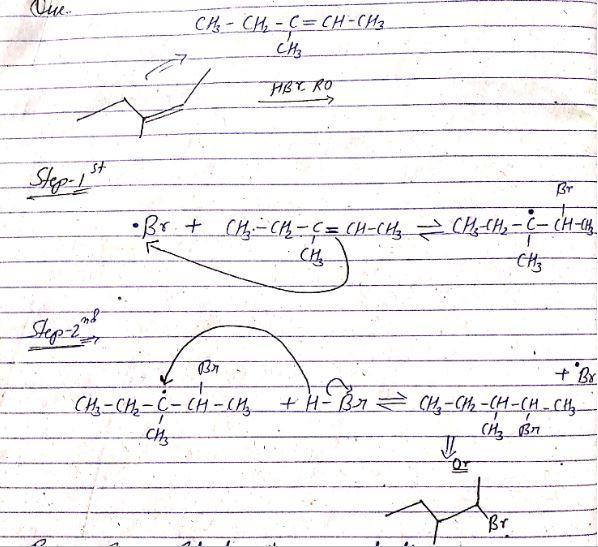
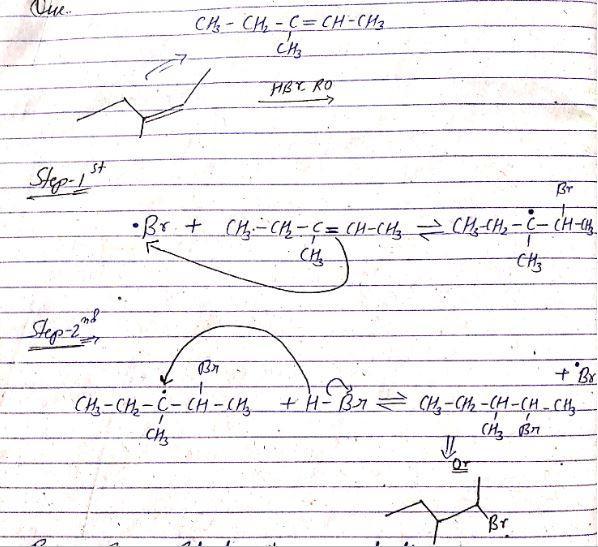
Draw the mechanism arrows for both propagation steps for the radical addition of HBr to the alkene. When drawing single-headed r

adical arrows, this software requires that they meet at one atom (not in space between atoms like you may do in class). In the second box you will need to draw the first product and another reactant. In the last box you will need to draw an additional product.

Chemistry
1 answer:
Vitek1552 [10]2 years ago
7 0

Answer:

See the attached file for the structure

Explanation:

See the attached file for the explanation

You might be interested in
Name one manufactured device or natural phenomenon that emits electromagnetic radiation in each of the following wavelengths: ra
Bas_tet [7]
Radio - Radio station transmits radio wavelength which is received by the
Radio. 
<span>
Microwaves - Microwave Oven to heat up foods. </span>

<span>IR (infrared) - TV remote Control, to transmit IR light to a sensor in the TV so it can do some functions like increasing the volume, changing the channel etc. </span>


<span>Visible light - Sunlight or Light Bulbs </span>

<span>Ultraviolet - UV Lamps for sun tan, for detecting forged money </span>

<span>X-rays - Chest X-ray machines, Backscatter Xray (body scanner in airport security)
</span>
Gamma rays - Gamma rays<span> Medical Equipment which are used to kill cancer cells, to sterilize medical </span>equipment<span> </span>
7 0
2 years ago
If you find that the hydrogen alpha line in a star’s spectrum occurs at a wavelength of 656.45 nm, what is the star’s approximat
Paladinen [302]

Answer:

The answer to the question is

The star’s approximate radial velocity is 68.52 km/s

Explanation:

To solve the

The formula is

\frac{\lambda-\lambda_{rw}}{\lambda_{rw}} = \frac{v_r}{c} where

v_r = velocity of the star

λ = Star's spectrum wavelength = 656.45 nm

\lambda_{rw} = Rest wavelength = 656.30 nm

c = Speed of light = 299 792 458 m / s

Therefore we have

\frac{656.45-656.30}{656.30} =\frac{v_r}{299 792 458} or v_r = 68518.7699 m/s or 68.52 km/s

8 0
2 years ago
Methane (CH4) reacts with excess oxygen gas (O2) to produce carbon dioxide (CO2) and water (H2O). What is the percent yield of c
musickatia [10]
(29.8 g) / [0.184 mol (44.00964 g CO2/mol)] =0.832= 83.2% yield CO2

(hope this helps)
4 0
2 years ago
Read 2 more answers
The sun has been up for several hours, and it has been shining on these trees. What can the trees do because they are in sunligh
Nonamiya [84]

Answer:

1. C. take in carbon from the air. The carbon is used to make energy storage

molecules.

2. b Carbon is moving into the air and out of the air at the same time

Explanation:

Question 1:

Trees are plants, which are autotrophic organisms i.e. set of organisms that are capable of producing their own food via a process called PHOTOSYNTHESIS. This photosynthetic process produces sugars (glucose) in the presence of SUNLIGHT. According to this question, the sun has been up for several hours, and has been shining on these trees. This means that the trees can take in carbo dioxide (CO2) in order to perform the process of photosynthesis. Also, the number of energy storage molecules in the trees (ATP) will INCREASE.

What can the trees do because they are in sunlight? What does this mean for the ?

8 0
2 years ago
Calculate the molality of a 20.0% by mass ammonium sulfate (nh4)2so4 solution. the density of the solution is 1.117 g/ml.
olasank [31]
Hello!

We have the following data:

m1 (solute mass) = 20 % m/m
M1 (Molar mass of solute) (NH4)2 SO4 = ?
m2 (mass of the solvent) = ? (in Kg)

First we find the solute mass (m1), knowing that:

20% m/m = 20g/100mL

20 ------ 100 mL (0,1 L)
y g --------------- 1 L

y = 20/0,1 
y = 200 g --> m1 = 200 g

Let's find Solute's Molar Mass, let's see:

M1 of (Nh4)2SO4
N = 2*14 = 28
H = (2*4)*1 = 8
S = 1*32 = 32
O = 4*16 = 64
----------------------
M1 of (Nh4)2SO4 = 28+8+32+64 => M1 = 132 g/mol

We must find the volume of the solvent and therefore its mass (m2), let us see:

d = 1,117 g/mL
m = 200 g
v (volumen of solute) = ?

d =  \dfrac{m}{V} \to V =  \dfrac{m}{d}

V =  \dfrac{200\:\diagup\!\!\!\!g}{1,117\:\diagup\!\!\!\!g/mL} \to V = 179\:mL\:(volumen\:of\:solute)

<span>The solvent volume will be:
</span>
1000 -179 => V = 821 mL (volumen of disolvent)

If: 1 mL = 1g

<span>Then the mass of the solvent is:
</span>
m2 (mass of the solvent) = 821 g → m2 (mass of the solvent) = 0,821 Kg

Now, we apply all the data found to the formula of Molality, let us see:

\omega =  \dfrac{m_1}{M_1*m_2}

\omega =  \dfrac{200}{132*0,821}

\omega =  \dfrac{200}{108,372}

\boxed{\boxed{\omega \approx 1,8\:Molal}}\end{array}}\qquad\checkmark

_________________________________
_________________________________


<span>Another way to find the answer:
</span>
We have the following data: 

W (molality) = ? (in molal)
n (number of mols) = ?
m1 (solute mass) = 20 % m/m = 20g/100mL → (in g to 1L) = 200 g
m2 (disolvent mass) the remaining percentage, in the case: 80 % m/m = 800 g → m2 (disolvent mass) = 0,8 Kg
M1 (Molar mass of solute) (NH4)2 SO4 
N = 2*14 = 28
H = (2*4)*1 = 8
S = 1*32 = 32
O = 4*16 = 64
----------------------
M1 of (Nh4)2SO4 = 28+8+32+64 => M1 = 132 g/mol 


<span>Let's find the number of mols (n), let's see:

</span>n =  \dfrac{m_1}{M_1}

n = \dfrac{200}{132}

n \approx 1,5\:mol

Now, we apply all the data found to the formula of Molality, let us see:

\omega =  \dfrac{n}{m_2}

\omega =  \dfrac{1,5}{0,8}

&#10;\boxed{\boxed{\omega \approx 1,8\:Molal}}\end{array}}\qquad\checkmark

I hope this helps. =)
7 0
2 years ago
Other questions:
  • Elements that can be described by the hardness shininess and ductility
    9·1 answer
  • The balanced equation shows how sodium chloride reacts with silver nitrate to form sodium nitrate and silver chloride. NaCl + Ag
    9·1 answer
  • the air we breathe is approximately 21% oxygen.atypical breath has a volume of 450 ml.how many grams of O2 are in a breath of ai
    12·1 answer
  • A flask contains 0.230 mol of liquid bromine, br2. determine the number of bromine molecules present in the flask.
    11·2 answers
  • A 1.25 g gas sample occupies 663 ml at 25∘ c and 1.00 atm. what is the molar mass of the gas?
    15·1 answer
  • A group of students is investigating how the addition of salt impacts the floatation of an egg in water. Four identical cups wer
    15·2 answers
  • NiO is to be reduced to nickel metal in an industrial process by use of the reaction:NiO(s) + CO(g) &lt;-----&gt; Ni(s) + CO2(g)
    8·1 answer
  • If 10.0 liters of h2(g) at STP is heated to a temperature of 546 K, pressure remaining constant, the new volume of the gas will
    7·1 answer
  • What it the oxidation number for bromine in the molecule H2Br2O6?
    5·1 answer
  • b) Write a few paragraphs describing the chemical reaction and explaining the energy change in the reaction. Your document shoul
    8·2 answers
Add answer
Login
Not registered? Fast signup
Signup
Login Signup
Ask question!