answer.
Ask question
Login Signup
Ask question
All categories
  • English
  • Mathematics
  • Social Studies
  • Business
  • History
  • Health
  • Geography
  • Biology
  • Physics
  • Chemistry
  • Computers and Technology
  • Arts
  • World Languages
  • Spanish
  • French
  • German
  • Advanced Placement (AP)
  • SAT
  • Medicine
  • Law
  • Engineering
DIA [1.3K]
2 years ago
3

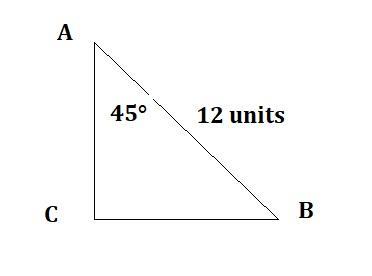
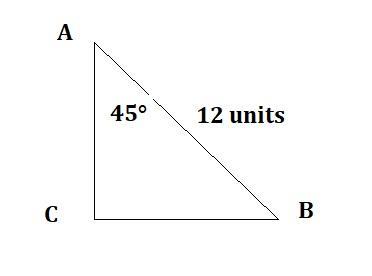
In the right triangle shown, m\angle A=45\degreem∠A=45°m, angle, A, equals, 45, degree and AB = 12AB=12A, B, equals, 12. How lon

g is BC

Mathematics
1 answer:
denis23 [38]2 years ago
4 0

Answer:

BC=6\sqrt{2}\ units

Step-by-step explanation:

In this problem i will assume that the side AB is the hypotenuse

The picture in the attached figure

we know that

In a right triangle, if one angle is 45 degrees, then the other angle complementary is equal to 45 degrees too

so

m\angle B=45^o

In the right triangle ABC

cos(B)=\frac{BC}{AB} ----> by CAH (adjacent side divided by the hypotenuse)

substitute the given values

we have

cos(45^o)=\frac{\sqrt{2}}{2}

AB=12\ units

substitute

BC=cos(B)(AB)

BC=\frac{\sqrt{2}}{2}(12)=6\sqrt{2}\ units

You might be interested in
Which expressions are equivalent to RootIndex 3 StartRoot 128 EndRoot Superscript x? Select three correct answers.
vodka [1.7K]

Answer:

<h3>- 128 Superscript StartFraction 3 Over x EndFraction </h3><h3>- (4RootIndex 3 StartRoot 2 EndRoot)x </h3><h3>- (4 (2 Superscript one-third Baseline) ) Superscript x</h3><h3>Step-by-step explanation:</h3>

Given the indicinal equation (\sqrt[3]{128} )^{x}\\

According to one of the law of indices,

(\sqrt[a]{m} )^{b}\\= (\sqrt{m})^\frac{b}{a}

Applying this law to the question;

(\sqrt[3]{128} )^{x}\\ = {128} ^\frac{x}{3}\\ \\= (\sqrt[3]{64*2})^{x} \\ = (4\sqrt[3]{2})^{x} \\= (4(2^{1/3} )^{x} )

The following are therefore true based on the following calculation

128 Superscript StartFraction 3 Over x EndFraction

(4RootIndex 3 StartRoot 2 EndRoot)x

(4 (2 Superscript one-third Baseline) ) Superscript x

5 0
2 years ago
Read 2 more answers
Find the center, vertices, and foci for the ellipse 25x^2 + 64y^2 = 1600
Alisiya [41]

Answer:

The answer to your question is below

Step-by-step explanation:

Data

Equation               25x² + 64y² = 1600

Process

1.- Divide all the equation by 1600

                             25x²/1600 + 64y²/ 1600 = 1600/1600

-Simplify

                              x²/64 + y²/ 25 = 1

2.- Equation of a horizontal ellipse

                             \frac{x^{2} }{a^{2}} + \frac{y^{2}}{b^{2}} = 1

3.- Find a, b and c

    a² = 64             a = 8

    b² = 25             b = 5

-Calculate c with the Pythagorean theorem

                   a² = b² + c²

-Solve for c

                   c² = a² - b²

-Substitution

                   c² = 8² - 5²

-Simplification

                  c² = 64 - 25

                  c² = 39

-Result

                  c = √13

4.- Find the center

          C = (0, 0)

5.- Find the vertices

          V1 = (-8, 0)     V2 = (8, 0)

6.- Find the foci

          F1 = (-√13, 0)   F2 = (√13, 0)

7 0
2 years ago
Which equation describes this line?
Anettt [7]

The last equation would best describe the line.

y-4=3(x+2)

y-4=3x + 6

y=3x + 10

4 0
2 years ago
Read 2 more answers
Which graph shows a dilation? On a coordinate plane, 2 quadrilaterals are shown. The larger quadrilateral has points (negative 4
gayaneshka [121]

Answer:

On a coordinate plane, 2 quadrilaterals are shown. The larger quadrilateral has points (negative 5, 3), (1, 3), (4, 0), (negative 2, 0). The smaller quadrilateral has points (negative 1, 0), (negative 2, 1), (0, 1), and (1, 0).      

Step-by-step explanation:

<u>Larger quadrilateral</u>

Length of the top and bottom segments are 6 units.

Length of the left and right sides:

d = √[(-5 - (-2))² + (3 - 0)²] = √[3² + 3²] = √(2*3²) = 3√2 units

From point (-5, 3) to point (-2, 0) the slope is:

m = (3 - 0)/(-5 - (-2)) = -1

<u>Smaller quadrilateral</u>

Length of the top and bottom segments are 2 units.

Length of the left and right sides:

d = √[(-2 - (-1))² + (1 - 0)²] = √[1² + 1²] = √2 units

From point (-2, 1) to point (-1, 0) the slope is:

m = (1 - 0)/(-2 - (-1)) = -1

If you dilate the smaller quadrilateral by a factor of 3, you get the larger quadrilateral (they have the same slope, and 3 times length of the smaller quadrilateral is equal to the length of the larger quadrilateral).
5 0
2 years ago
Read 2 more answers
Morena is painting her bedroom and has a triangle of space left over as shown below. What is the area of the space Morena still
aleksandrvk [35]

The answer is Letter c

7 0
2 years ago
Other questions:
  • Naomi went on a 6.5 mile hike. In the morning she hiked 1.75 miles, rested,and then hiked 2.4 more miles. She completed the hike
    14·2 answers
  • Can anyone help me?
    11·2 answers
  • If a student ate 3/4 of their meals away from home, what percent of the total day is spent other than at home?
    10·1 answer
  • Which is a counterexample for the conditional statement shown? If three distinct points lie in a plane, then the points can form
    14·1 answer
  • Jillian needs to cross a stream that is 4 1⁄4 yards wide. She wants to use a nearby log which is 11 feet long. Is the log long e
    12·1 answer
  • The function y = square root sign x is translated using the rule (x, y) → (x – 7, y + 2)to create f(x). What is the domain of f(
    11·2 answers
  • Point L was plotted at (-4, 1), then L was transformed creating point L’ at (-1, -4).Which transformation rule could have been u
    9·1 answer
  • If trapezoid JKLM with vertices) (3, 4), K (6,4), L (8, 1) and M (1,1) is rotated 270 degrees counterclockwise, what are the
    11·1 answer
  • Determine whether each relation is an equivalence relation. Justify your answer. If the relation is an equivalence relation, the
    5·1 answer
  • Construct a line through R that is perpendicular to the line​
    5·1 answer
Add answer
Login
Not registered? Fast signup
Signup
Login Signup
Ask question!
