answer.
Ask question
Login Signup
Ask question
All categories
  • English
  • Mathematics
  • Social Studies
  • Business
  • History
  • Health
  • Geography
  • Biology
  • Physics
  • Chemistry
  • Computers and Technology
  • Arts
  • World Languages
  • Spanish
  • French
  • German
  • Advanced Placement (AP)
  • SAT
  • Medicine
  • Law
  • Engineering
babymother [125]
2 years ago
3

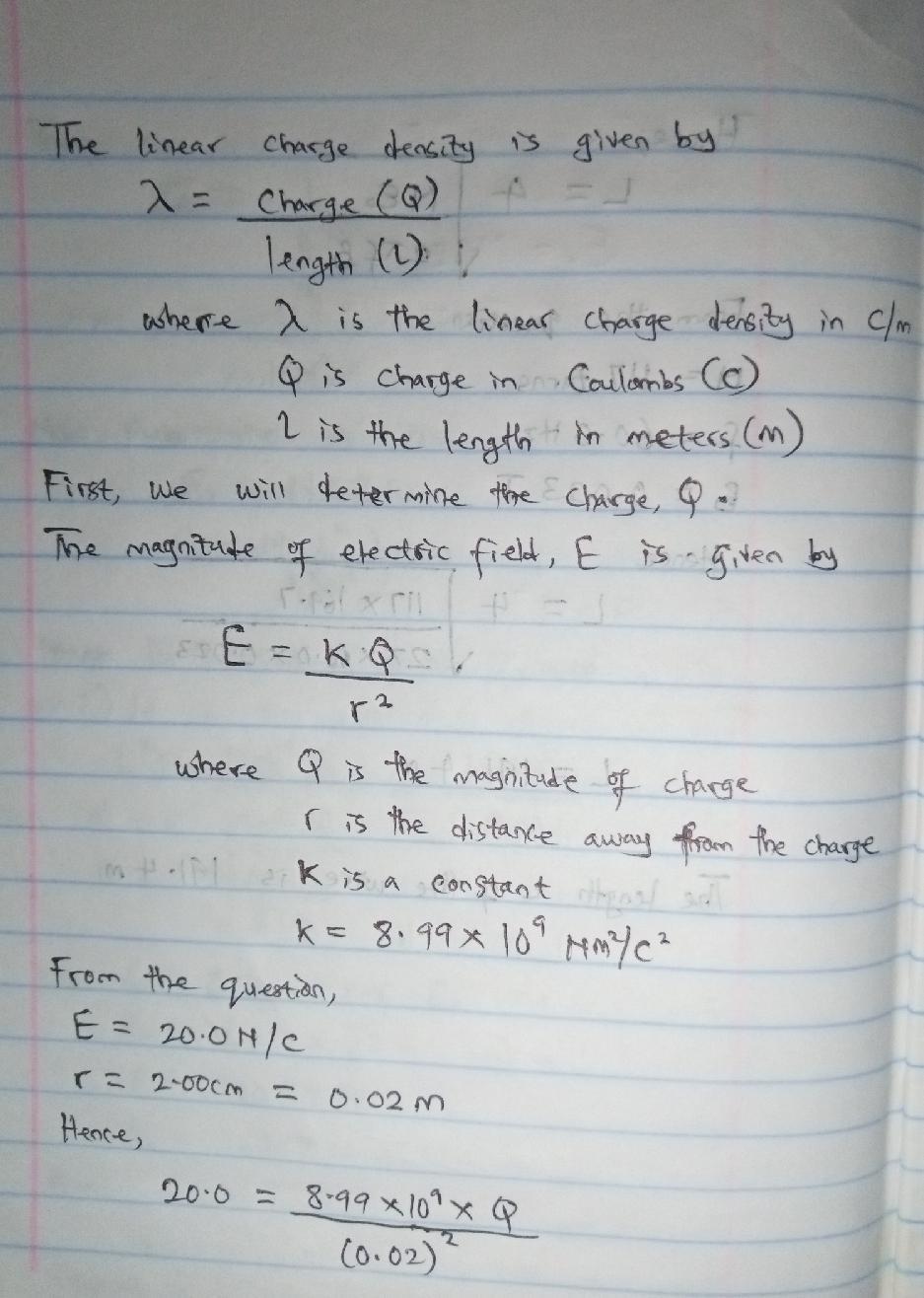
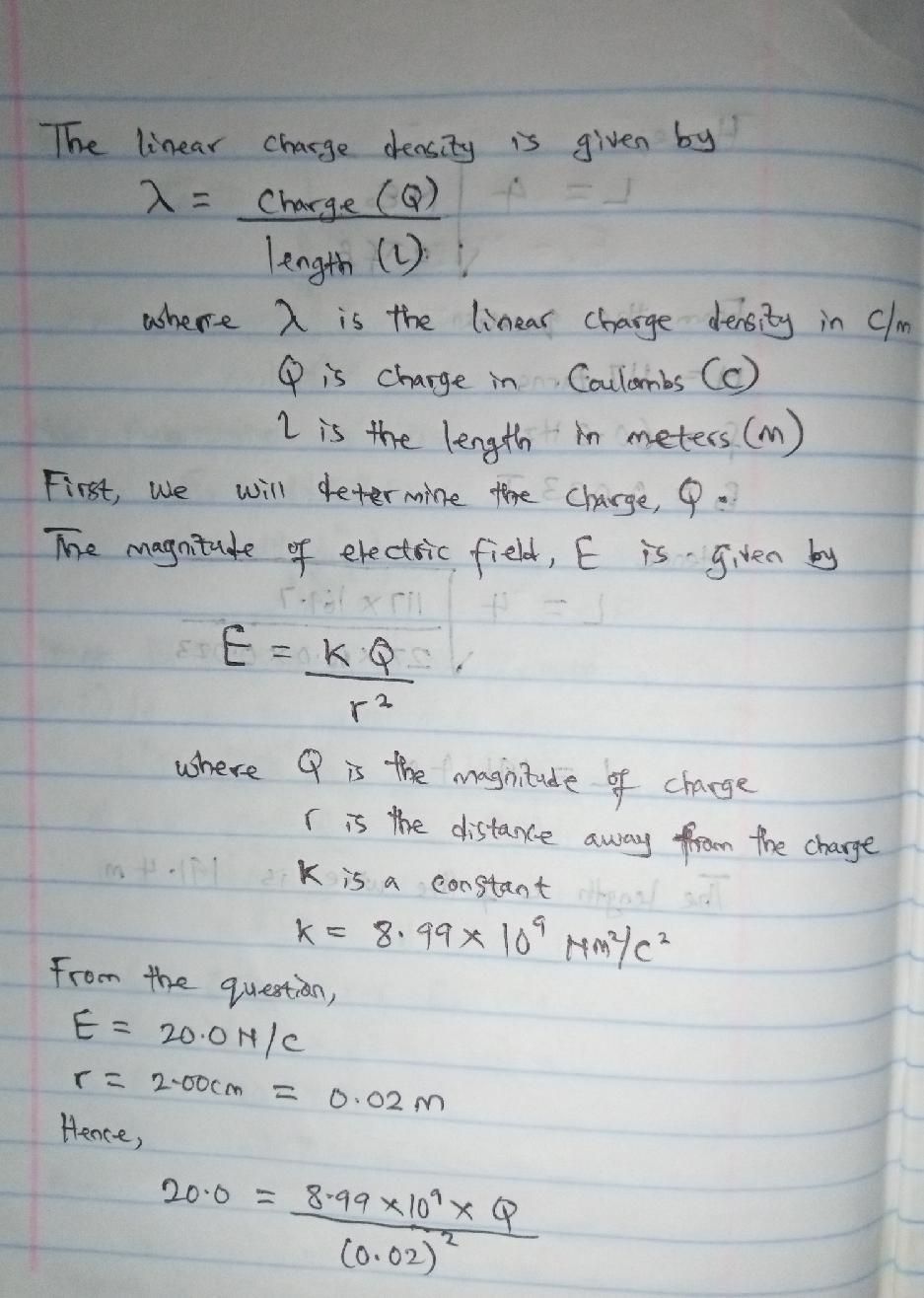
Charge is distributed uniformly along a long straight wire. The electric field 2.00 cm from the wire is 20.0 NC/ directed radial

ly inward towards the axis of symmetry. The linear charge density on the wire is

Physics
1 answer:
aksik [14]2 years ago
7 0

Answer: The linear charge density on the wire is 4.45 × 10^-11 C/m

Explanation: Please see the attachments below

You might be interested in
The Lyman series comprises a set of spectral lines. All of these lines involve a hydrogen atom whose electron undergoes a change
mihalych1998 [28]

Answer:

a) 1.2*10^-7 m

b) 1.0*10^-7 m

c) 9.7*10^-8 m

d) ultraviolet region

Explanation:

To find the different wavelengths you use the following formula:

\frac{1}{\lambda}=R_H(1-\frac{1}{n^2})

RH: Rydberg constant = 1.097 x 10^7 m^−1.

(a) n=2

\frac{1}{\lambda}=(1.097*10^7m^{-1})(1-\frac{1}{(2)^2})=8227500m^{-1}\\\\\lambda=1.2*10^{-7}m

(b)

\frac{1}{\lambda}=(1.097*10^7m^{-1})(1-\frac{1}{(3)^2})=9751111,1m^{-1}\\\\\lambda=1.0*10^{-7}m

(c)

\frac{1}{\lambda}=(1.097*10^7m^{-1})(1-\frac{1}{(4)^2})=10284375m^{-1}\\\\\lambda=9.7*10^{-8}m

(d) The three lines belong to the ultraviolet region.

8 0
2 years ago
A 0.110 kg cube of ice (frozen water) is floating in glycerine. The glycerine is in a tall cylinder that has inside radius 3.70
Sonbull [250]

Answer:

the distance by which the height of the  liquid in the cylinder change after the ice gets melted = 0.528 cm

Explanation:

The change in volume of glycerin when the ice cube is placed on the surface of the glycerin can be represented as:

V = \frac{m}{ \rho}

Given that ;

the mass of the ice cube (m) = 0.11 kg = 0.110 × 10³ g

density of the glycerine (\rho) = 1.260 kg/L = 1.260 g/cm³

Then:

V = \frac{0.110*10^3 \ g}{1.260 \ g/cm^3}

V = 0.0873*10^3 \ cm^3 (\frac{1L}{10^3 cm^3})

V = 0.0873 L

Now;Initially the volume of the glycerin before the ice cube starts to melt is:

V_1 = V_i + V\\\\V_1 = V_i+ 0.0873 \ L

However; the volume of the water produced by the 0.11 kg ice cube = 0.11*10^3 \ cm^3

The expression for change in the volume of glycerin after the ice cube starts to melt is as follows:

V_2 = V_i + V"

replacing V" with 0.11*10^3 \ cm^3 ; we have:

V_2 = V_i (0.11*10^3 \ cm^3 )(\frac{1 \ L }{10^3 \ cm^3})

V_2 = V_i + 0.11 \ L

The overall total change in the volume of the glycerin is illustrated as:

V_f = V_2 - V_1

Now; from the foregoing ; lets replace the respective value of V_2 and V_1 in the above equation ; we have;

V_f = (V_i + 0.11 \ L) - (V_i + \ 00873 \ L)\\ \\V_f = 0.11 L - 0.0873 \ L\\\\V_f = 0.0227 \ L

The formula usually known to be the volume of a cylinder is :

V = \pi r ^2 h

For the question ; we will have:

V_f = \pi r ^2 h

making h the subject of the  formula ; we have:

h = \frac{V_f}{\pi r^2}

replacing 0.0227 L for V_fand the given value of radius which is = 3.70 cm; we have:

h = \frac{0.0227 \ L ( \frac{10^3 \ cm^3}{1\ L})}{\pi * (3.70 cm)^2}

h = \frac{22.7 \ cm^3}{\pi * (3.70 cm)^2}\\\\h = 0.528 \ \ cm

Thus ; the distance by which the height of the  liquid in the cylinder change after the ice gets melted = 0.528 cm
8 0
2 years ago
The length of the side of a cube having a density of 12.6 g/ml and a mass of 7.65 g is __________ cm.
qaws [65]

Density is the characteristic property of a substance.  It is the measure of mass of the substance divided by its volume (density= mass/volume). Manipulate the given formula to come up with the formula for the volume. Therefore, volume is equals to mass of a substance divided by its density (Vol= mass/density). Given 12.6 g/ml as density and 7.65 g mass, volume is equals to 0.60714 ml, since 1 ml = 1cm^3, volume is equals to 0.60714 cm^3 then extract the cube root of the volume to get the length of the cube in cm which is equal to 0.84677 cm.


4 0
2 years ago
A satellite that orbits Earth with a speed of v0 must be in an orbit of radius 8RE to maintain a circular orbit, where RE is the
NISA [10]

Answer:

1.024 × 10⁸ m

Explanation:

The velocity v₀ of the orbit 8RE is v₀ = 8REω where ω = angular speed.

So, ω =  v₀/8RE

For the orbit with radius R for it to maintain a circular orbit and velocity 2v₀, we have

2v₀ = Rω

substituting ω =  v₀/8RE into the equation, we have

2v₀ = v₀R/8RE

dividing both sides by v₀, we have

2v₀/v₀ = R/8RE

2 = R/8RE

So, R = 2 × 8RE

R = 16RE

substituting RE = 6.4 × 10⁶ m

R = 16RE

= 16 × 6.4 × 10⁶ m

= 102.4 × 10⁶ m

= 1.024 × 10⁸ m

8 0
2 years ago
The point on the graph that lies on the y-axis (vertical axis) is called the y-intercept. What does the y-intercept tell you abo
jekas [21]

Answer:

The starting position of the runner.

Explanation:

When you look at the graph, you can see that the first point on the graph is twenty on the y-axis.

The runner starts at twenty, and ends at thirty.

Therefore, the runner starts at twenty on the y-axis, so it's the starting position of the runner.

7 0
2 years ago
Other questions:
  • Which object has the greatest inertia?
    13·2 answers
  • Find the centripetal force needed by a 1275 kg car to make a turn of radius 40.0 m at a speed of 25.0 km/h
    12·2 answers
  • A metal ball with diameter of a half a centimeter and hanging from an insulating thread is charged up with 1010 excess electrons
    10·1 answer
  • A person drives an automobile with a mass of 450 kilograms at a velocity of 26 meters per second. The driver accelerates to a ve
    5·1 answer
  • The diagram shows the electric field around two charged objects. What is the best conclusion about the charges that can be made
    14·2 answers
  • A watermelon is thrown down from a skyscraper with a speed of 7.0\,\dfrac{\text m}{\text s}7.0 s m ​ 7, point, 0, space, start f
    7·2 answers
  • A sleepy student drops a calculator out of a window that's 20.7\text{ m}20.7 m20, point, 7, start text, space, m, end text off t
    10·1 answer
  • A 35-kg girl is standing near and to the left of a 43-kg boy on the frictionless surface of a frozen pond. The boy throws a 0.75
    12·1 answer
  • Charge of uniform density (40 pC/m^2) is distributed on a spherical surface (radius = 1.0 cm), and a second concentric spherical
    14·1 answer
  • a cylinder has a radius of 2.1cm and a length of 8.8cm .total charge 6.1 x 10^-7C is distributed uniformly throughout. the volum
    14·1 answer
Add answer
Login
Not registered? Fast signup
Signup
Login Signup
Ask question!