answer.
Ask question
Login Signup
Ask question
All categories
  • English
  • Mathematics
  • Social Studies
  • Business
  • History
  • Health
  • Geography
  • Biology
  • Physics
  • Chemistry
  • Computers and Technology
  • Arts
  • World Languages
  • Spanish
  • French
  • German
  • Advanced Placement (AP)
  • SAT
  • Medicine
  • Law
  • Engineering
mario62 [17]
2 years ago
12

Consider the cell pt | h2 (1 atm); h+ (? m) || hg2cl2(s); cl− (1 m) | hg 2 h+ + 2 e − → h2 e 0 = 0.00 v hg2cl2 + 2 e − → 2 hg +

2 cl− e 0 = 0.268 v if the measured cell potential for the cell is 0.35 volts, what is the ph of the solution? 1. 1.39 2. less than 1.00 3. 4.74 4. 2.77 5. 5.45 020
Chemistry
2 answers:
tatyana61 [14]2 years ago
5 0

Answer:

pH ˜ 1.39

Explanation:

solution

given the cell equation as follows:

Pt | H2 (1 atm); H+ (? M) || Hg2Cl2(s); Cl- (1 M) | Hg

half of the reactions are

2H+ + 2 e- --> H2 (E0 = 0.00 V )

Hg2Cl2 + 2 e- --> 2Hg + 2Cl- (E0 = 0.268 V)

E0 cell = E0 cathode -E0 anode

= 0.268 V -0.00V ( the more of positive is cathode while the smaller is anode )

= 0.268V

knowing that  Ecell = E0 cell - 0.0592 V/n) log [oxd/red]

0.35 V = 0.268V -(0.0592V/2) log [H+ ]2 /[Cl- ]

0.35V-0.268V =- 0.0296V*2 log [H+ ]/[1.0]

0.082V = -0.0592V log [H+ ]

so 0.082V /0.0592V = - log [H+ ]

1.385 = - log [H+ ]

1.385 = pH (since pH = - log [H+ ] )

In conclusion, pH ˜ 1.39

Dmitry [639]2 years ago
3 0

Answer:

1.39

Explanation:

[Hg2Cl2]= 1M

[H^+] = ????

E°cell= 0.35V

E= 0.268 V

Therefore E for the reaction must -0.082 V

n= 2 moles of electrons

From Nernst Equation:

E= E°cell- 0.0592/n log [Red]/[Ox]

0.0268= 0.35- 0.0592/2 log 1/[Ox]^2

-0.082= -0.0296 log 1/[Ox]^2

log 1/[Ox]^2= 0.082/0.0296

log 1/[Ox]^2= 2.77

1/[Ox]^2=Antilog (2.77)

[Ox]^2=1.698×10^-3

[Ox] = 0.0412 M

But pH= -log [H^+]= -log(0.0412)= 1.385

You might be interested in
How many cycles of the synthesis pathway are needed to produce myristic acid, c13h27cooh?
Alenkasestr [34]
The primary cycle of fatty acid synthesis produces a four-carbon acyl group. Every following cycle adds a three-carbon malonyl group, which stretches off one molecule of CO2 (one carbon atom) in a condensation response. Thus, the net number of carbon atoms additional by each following cycle is two. For the reason that the first cycle makes a four-carbon chain, and each added cycle extends the chain by two carbon atoms, the second cycle fallouts in a six-carbon chain, the third cycle fallouts in an eight-carbon chain, and so on. And so, the synthesis of the 14-carbon myristic acid necessitates six repetitions.
7 0
2 years ago
Carbon tetrachloride contains one carbon and four chlorine atoms. for this compound 11.818 g of chlorine combine with 1.000 g of
Feliz [49]
12000 I iiiiiiiiiiiiiiiiiiiiiiiiiiiiiiiiiiiiiiiiiiiiiiiiiiiiiiiiiiiiiiiiiiiiiiiiiiiiiiiiiiiiiii
5 0
2 years ago
Read 2 more answers
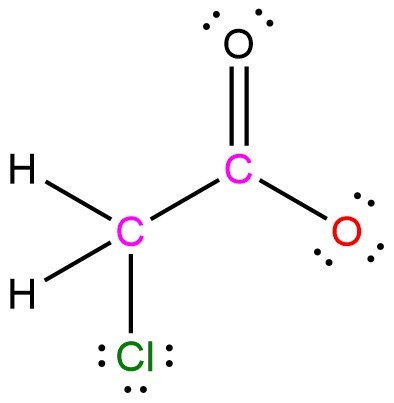
Write the lewis structure for ch2clcoo−. assign a formal charge for any atom with a non-zero formal charge.
Murljashka [212]
The Lewis structure of Chloroacetate (H₂CClCO₂) is given below. In structure it is shown that carbon has a double bond with one oxygen atom and two single bonds with CH₂Cl and O⁻.

Formal Charge;
                        Formal charge is caculated as,

Formal charge  =  # of valence e⁻ - [# of lone pair of e⁻ + 1/2 # of bonded e⁻]

Formal charge on Oxygen (Highlighted Red);

Formal charge  =  6 - [ 6 + 2/2]

Formal charge  =  6 - [6 + 1]

Formal charge  =  6 - [7]

Formal charge  =  -1

8 0
2 years ago
A sample of a compound containing only carbon and oxygen decomposes and produces 24.50g of carbon and 32.59g of oxygen. what is
Fynjy0 [20]
<span>Carbon Monoxide. First, determine the relative number of moles of each element by looking up the atomic weights of carbon and oxygen Atomic weight carbon = 12.0107 Atomic weight oxygen = 15.999 Moles of Carbon = 24.50 g / 12.0107 g/mol = 2.039847802 mol Moles of Oxygen = 32.59 g / 15.999 g/mol = 2.037002313 mol Given that the number of moles of both carbon and oxygen are nearly identical, it wouldn't be unreasonable to think that the empirical formula for the compound is CO which also happens to be the formula for Carbon Monoxide.</span>
3 0
2 years ago
Read 2 more answers
At 50 degree C pK_w = 13.26. What is the pH of pure water at this temperature?
Ksivusya [100]

Answer:

6.63

Explanation:

From the relationship;

pH = pKw/2

Pkw = 13.26

Then it follows that;

pH = 6.63

Hence if. pKw = 13.26, the pH = 6.63

8 0
2 years ago
Other questions:
  • Two well-known complex ions containing ni are [ni(h2o)6]2+, which is green, and [ni(en)3]2+, which is purple. which one of these
    10·1 answer
  • The population of rabbits in a forest is decreasing. Foxes in that region are now competing with each other for the limited numb
    12·2 answers
  • a quantity of 18.68 mL of KOH solution is needed to neutralize 0.4218 g of KHP. What is the concentration (in molarity) of the K
    8·1 answer
  • An average copper penny minted in the 1960s contained about 3.000 g of copper. how much chalcopyrite had be mined to produce 100
    6·2 answers
  • If you have 10cm of snow with a volume of 40mL and a density of 0.5 g/mL how many inches of rain is this?
    5·1 answer
  • Select all the true statements. When an atom gains an electron, it becomes a cation. Anions carry a positive charge. The Cl− and
    14·1 answer
  • A chemist mixes two liquids A and B to form a homogeneous mixture. The densities of the liquids are 2.0514 g/mL for A and 2.6678
    8·1 answer
  • If 0.640 g of beautiful blue crystals of azulene is dissolve in 99 g of benzen, the resulting solutions boils at 80.23 degrees c
    15·1 answer
  • How can a piece of wood floating on water illustrate the condition of lowest potential energy and maximum
    10·1 answer
  • A student buys a rope at the store. The label on the packaging says that the rope is 2.15 meters in length. The student measures
    14·1 answer
Add answer
Login
Not registered? Fast signup
Signup
Login Signup
Ask question!