answer.
Ask question
Login Signup
Ask question
All categories
  • English
  • Mathematics
  • Social Studies
  • Business
  • History
  • Health
  • Geography
  • Biology
  • Physics
  • Chemistry
  • Computers and Technology
  • Arts
  • World Languages
  • Spanish
  • French
  • German
  • Advanced Placement (AP)
  • SAT
  • Medicine
  • Law
  • Engineering
lesantik [10]
2 years ago
8

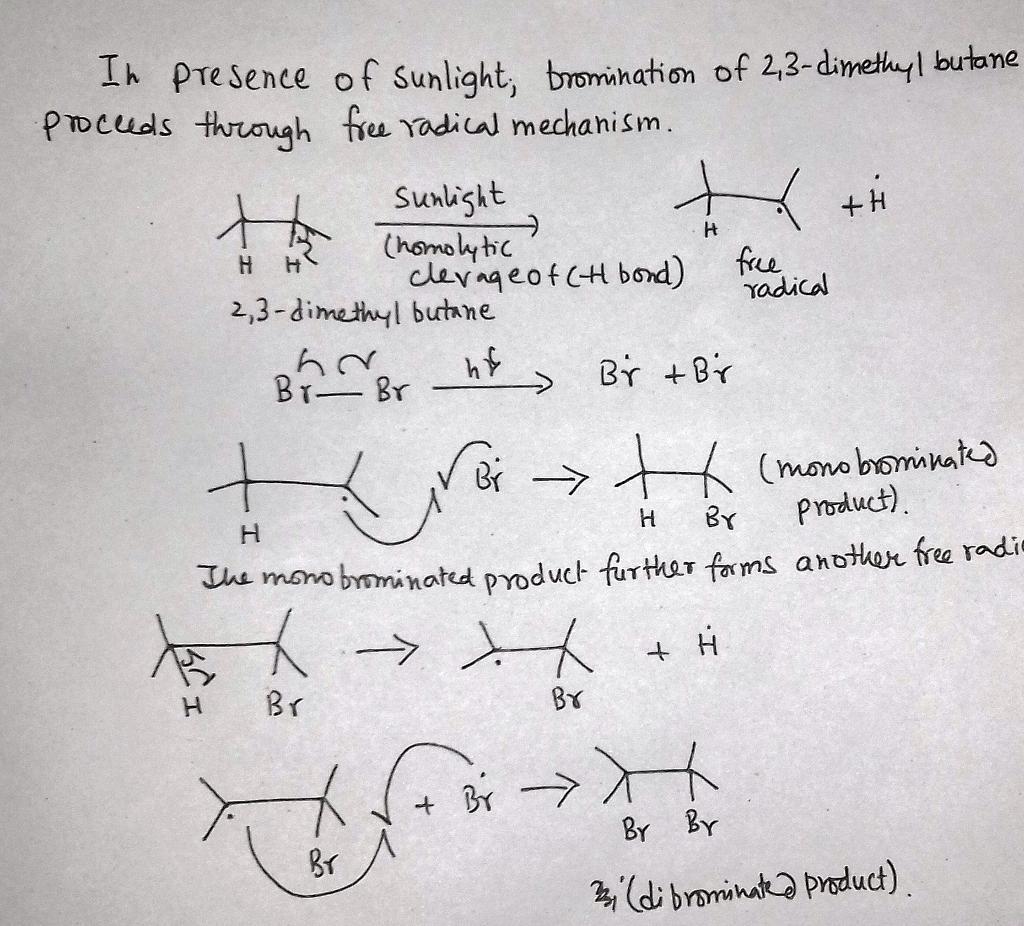
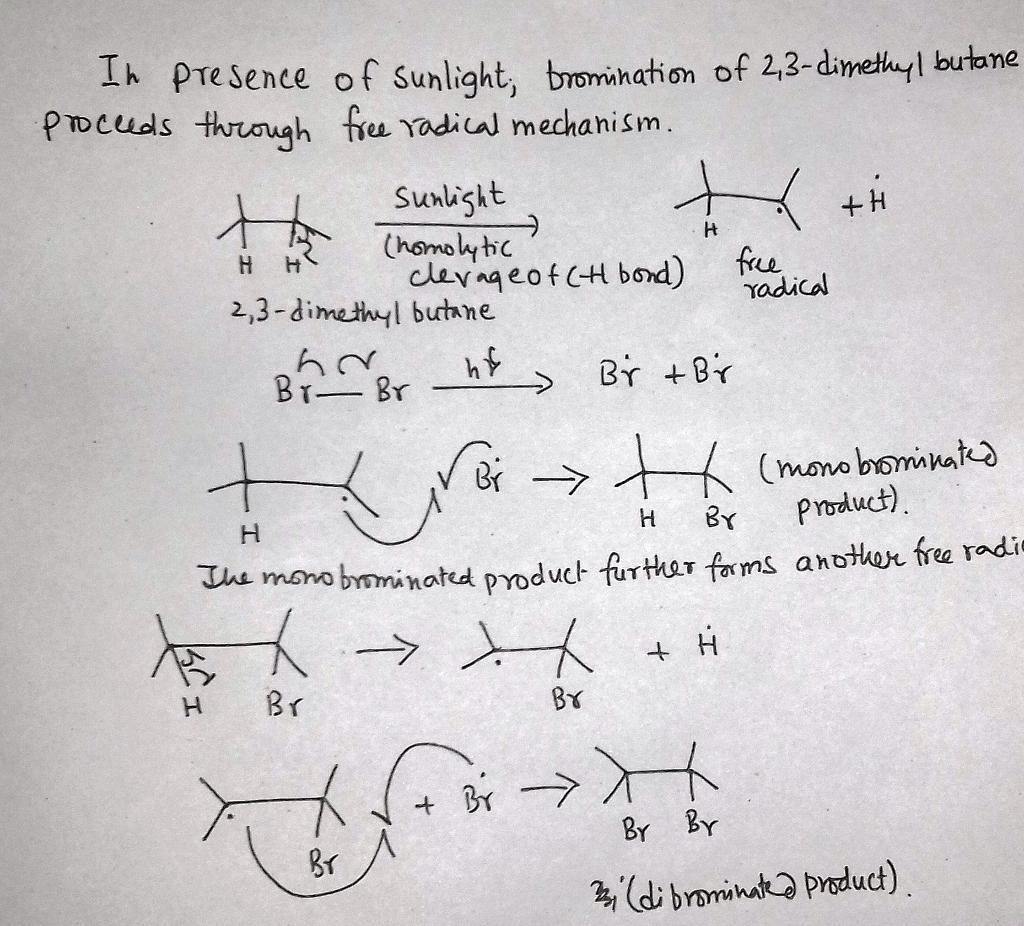
2,3-Dimethylbutane reacts with bromine in the presence of light to give a monobrominated product. Further reaction gives a good

yield of a dibrominated product. Predict the structures of these products, and propose a mechanism for the formation of the monobrominated product.

Chemistry
1 answer:
irga5000 [103]2 years ago
3 0

Answer:

Explanation:

find the solution below

You might be interested in
A thin sheet of iridium metal that is 3.12 cm by 5.21 cm has a mass of 87.2 g and a thickness of 2.360 mm. What is the density o
never [62]

Answer:

Therefore the density of the sheet of iridium is 22.73 g/cm³.

Explanation:

Given, the dimension of the sheet is 3.12 cm by 5.21 cm.

Mass: The mass of an object can't change with respect to position.

The S.I unit of mass is Kg.

Weight of an object is product of mass of the object and the gravity of that place.

Density: The density of an object is the ratio of mass of the object and volume of the object.

Density =\frac{mass}{volume}

            =\frac{Kg}{m^3}                 [S.I unit of mass= Kg and S.I unit of m³]

Therefore the S.I unit of density = Kg/m³

Therefore the C.G.S unit of density=g/cm³

The area of the sheet is = length × breadth

                                        =(3.12×5.21) cm²

                                       =16.2552 cm²

Again given that the thickness of the sheet  is 2.360 mm =0.2360 cm

Therefore the volume of the sheet is =(16.2552 cm²×0.2360 cm)

                                                             =3.8362272 cm³

Given that the mass of the sheet of iridium is 87.2 g.

Density =\frac{87.2 g}{3.8362272 cm^3}

             =22.73 g/cm³

Therefore the density of the sheet of iridium is 22.73 g/cm³.

5 0
2 years ago
What happened to the volume of gas when the syringe was exposed to various temperature conditions? Using the concepts explored i
rewona [7]

Answer:

Thus, when the volume of the gas is exposed to a temperature above -273.15 K, the volume increases linearly with the temperature.

Explanation:

The expression for Charles's Law is shown below:

\frac {V_1}{T_1}=\frac {V_2}{T_2}

This states that the volume of the gas is directly proportional to the absolute temperature keeping the pressure conditions and the moles of the gas constant.

<u>Thus, when the volume of the gas is exposed to a temperature above -273.15 K, the volume increases linearly with the temperature. </u>

<u>For example , if the temperature of the gas is reduced to half, the volume also reduced to half. </u>

<u>At -273.15 K, according to Charles's law, it is possible to make the volume of an ideal gas = 0.</u>

5 0
2 years ago
If you were to perform the reaction KCl (s)→K+ (g)+ Cl−(g), would energy be absorbed or released? Lattice Energies for Some Ioni
lina2011 [118]

Answer:

Energy would be absorbed.

Explanation:

Lattice energy is defined as the energy required to break apart an ionic solid and convert its component atoms into gaseous ions. That is what you're doing in:

KCl (s) → K⁺(g) + Cl⁻(g)

The energy you require to obtain this reaction is 701 kJ/mol. As the value is positive, <em>energy would be absorbed.</em>

<em />

I hope it helps!

6 0
2 years ago
14) The central iodine atom in the ICl4- ion has __________ nonbonded electron pairs and __________ bonded electron pairs in its
masha68 [24]

Answer:

Two non bonded electron pairs and four bonded electron pairs

Explanation:

An image of the compound as obtained from chemlibretext is attached to this answer.

The ion ICl4- ion, is an AX4E2 ion. This implies that there are four bond pairs and two lone pairs of electrons. As expected, the shape of the ion is square planar since the lone pairs are found above and below the plane of the square. This is clear from the image attached.

7 0
2 years ago
Calculate the pH of a polyprotic acid given and sketch the titration curves for the following reaction:
victus00 [196]

Answer: (1). pH = 1.70

(2). pH = 2.3

(3). pH = 3.3

(4). pH = 4.3

(5). pH = 8.41

(6). pH = 10.22

Explanation:

we assume that the formula representation of acid is H₂A

the titration curve has reasonably sharp breaks at both equivalence points, corresponding to the reactions;

H₂A + OH⁻ → HA⁻ + H₂O

HA⁻ + OH⁻ → A²⁻ + H₂O

the volume of NaOH (V₀) at the first equivalent point is,

V₀ = (20.0 mL)(0.100M) / 0.100M = 20.0mL

where volume of NaOH at 1/2 equivalent point is,

V₀/2 = 10.0mL

also Volume of NaOH at the second equivalence (2V₀) point is 40.0mL

the volume of NaOH at 1/2 second equivalent point is,

V₀ + V₀/2 = 30.0mL

Volume of NaOH after second equivalence exceeds 40mL

therefore, at 0 mL NaOH addition;

where the extent of ionization is assumed to be x, we have

                        H₂A   ⇆     HA⁻   +   H⁺

where initial:   0.1 M       -            -

          change:   -x         +x           +x

          Equili:      0.1-x      x             x

Kаl = [HA⁻][H⁺] / [H₂A]

10⁻²³ = (x)(x) / (0.1-x)

x = 0.020

[H⁺] = 0.020 M

pH = -log [H⁺]

pH = -log(0.020)

pH = 1.70

(2). at 10 mL NaOH addition

[H₂A]ini = 0.10 M * 20.0 mL = 2 mmol

[OH⁻] = 0.1 M * 10 mL = 1 mmol

after reaction:

[H₂A] = 1 mmol

[H⁻] = 1 mmol

pH = pKa₁ + log [HA⁻] / [[HA⁻]

pH = 2.3 + log 1mmol / 1mmol

pH = 2.3

(3). pH at the first equivalence point is,

pH = 1/2 (pKa₁ + pKa₂)

pH = 1/2(2.3 + 4.3) = 3.3

pH = 3.3

(4). pH at the second 1/2 equivalence point is

pH = pKa₂ = 4.3

pH = 4.3

(5). pH at the second equivalence point;

all H₂A is converted into A²⁻

[A²⁻] = initial moles of H₂A / total volume = (20.0 mL)(0.10 M) / (20.0 + 40.0) mL = 0.033 M

at equilibrium:

                   A²⁻ + H²O    ⇆   HA⁺ OH⁻

          0.033 - x

from the Kb₁ expression,

Kb₁ = [OH⁻][HA⁻] / [A²]

Kw/Ka₂ = x²/(0.0333 - x)

10⁻¹⁴/10⁻⁴³ = x²/(0.0333 - x)

x = 2.57 * 10⁻⁶

[OH⁻] = 2.57 * 10⁻⁶M

pH = -log Kw/[OH⁻] = 8.41

pH = 8.41

(6). pH after second equivalence point;

assuming the volume of NaOH is 40.10 mL

after second equivalence point OH⁻ in excess

[OH⁻] = 0.10 M * 0.10 mL / (20 + 40.10) mL = 1.66 * 10⁻⁴ M

pH = 0=-log Kw/[OH⁻] = 10.22

pH = 10.22
8 0
2 years ago
Other questions:
  • Which is an example of practical pursuit of alchemy
    14·2 answers
  • When sodium reacts with chlorine, sodium chloride is produced. Andrew represented this reaction with this equation: Na + Cl2 → 2
    6·2 answers
  • What mass of zinc oxide would be produced by the thermal decomposition of 375 grams of zinc carbonate?
    10·1 answer
  • When elemental sodium is added to water, the sodium atoms ionize spontaneously. uncharged na becomes na+. this means that the na
    5·1 answer
  • Describe the sequence of adding ingredients to make the recipe for condensed tomato soup. To mix the ingredients, you have an in
    7·1 answer
  • When a solute molecule is solvated, is energy released or absorbed?
    9·1 answer
  • What is this volume (2.49 × 10⁴ L) in cubic meters?
    6·1 answer
  • The oh concentration in a 1.0 x10 3 m ba oh 2 solution is
    8·2 answers
  • In an experiment, the reaction of 100.0 g of iodine produced 144.9 g of a compound formed from iodine and fluorine.
    14·1 answer
  • The particles of a substances are arranged in a definite geometric pattern and are constantly vibrating. This substances can be
    10·1 answer
Add answer
Login
Not registered? Fast signup
Signup
Login Signup
Ask question!