answer.
Ask question
Login Signup
Ask question
All categories
  • English
  • Mathematics
  • Social Studies
  • Business
  • History
  • Health
  • Geography
  • Biology
  • Physics
  • Chemistry
  • Computers and Technology
  • Arts
  • World Languages
  • Spanish
  • French
  • German
  • Advanced Placement (AP)
  • SAT
  • Medicine
  • Law
  • Engineering
dusya [7]
2 years ago
9

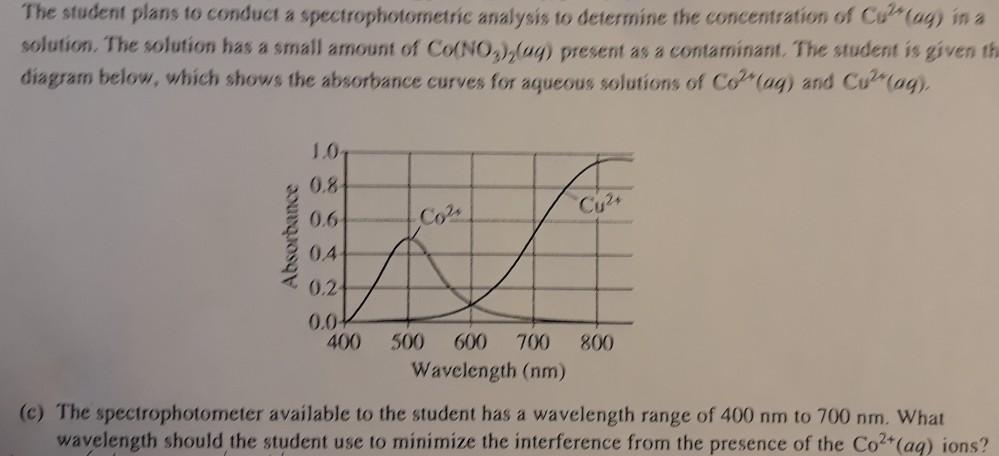
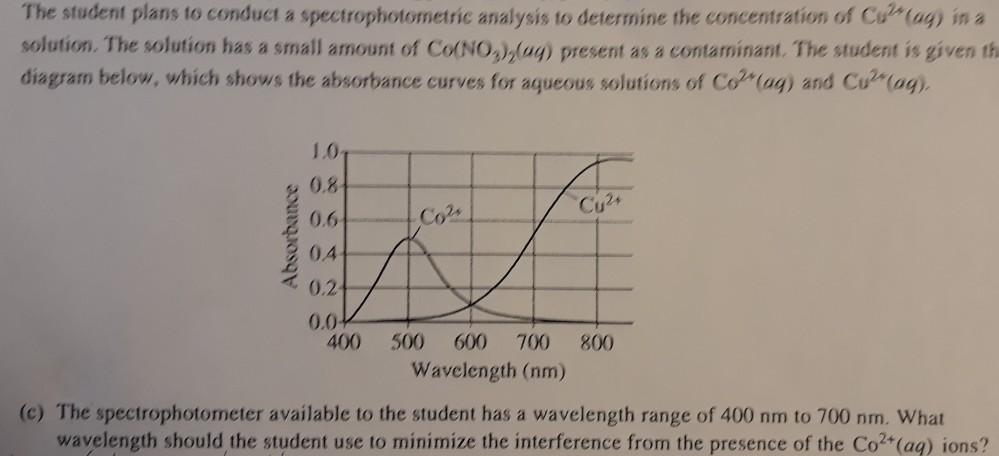
The student plans to conduct a spectrophotometric analysis to determine the concentration of Cu2+(aq) in a solution. The solutio

n has a small amount of Co(NO3)2 (aq) present as a contaminant. The student is given a diagram below, which shows the absorbance curves for aqueous solutions of Co2+ (aq) and Cu2+ (aq)
c. The spectrophotometer available to the student has a wavelength range of 400 nm to 700 nm. What wavelength should the student use to minimize the interference from the presence of the Co2+ (aq)?

Chemistry
1 answer:
Lelechka [254]2 years ago
6 0

Answer:

The wavelength the student should use is 700 nm.

Explanation:

Attached below you can find the diagram I found for this question elsewhere.

Because the idea is to minimize the interference of the Co⁺²(aq) species, we should <u>choose a wavelength in which its absorbance is minimum</u>.

At 400 nm Co⁺²(aq) shows no absorbance, however neither does Cu⁺²(aq). While at 700 nm Co⁺²(aq) shows no absorbance and Cu⁺²(aq) does.

You might be interested in
What is effective nuclear charge of S2- and S? Does the Zeff differs from ions and atoms of the same element.
Elan Coil [88]
<span>Effective nuclear charge is an estimate of the charge experienced by the valence electrons.
</span><span>Sulfur has 6 valence electrons and a charge of 6+.
</span><span>The 3s electrons in sulfur are the 3p electrons, because the former spend more time closer to the nucleus.</span>
<span>Using Slater's Rules, effective nuclear charge of sulfur is +5.5.

2) No!</span><span> The Zeff doesn't differ from ions and atoms of the same element.</span>
7 0
2 years ago
Read 2 more answers
Butane (c4h10) undergoes combustion in excess oxygen to generate gaseous carbon dioxide and water. given δh°f[c4h10(g)] = –124.7
vagabundo [1.1K]

The value of Δ H butane (g) = -124.7 kJ/mol

The value of Δ H CO2 (g) = -393.5 kJ/mol

The value of Δ H H2O (g) = -241.8 kJ/mol

Mass of butane, m = 8.30 gm

Molar mass of butane is 58 gm/mol

Consider the reaction,

C₄H₁₀ + 6.5 O₂ = 4CO₂ + 5H₂O

Calculating the value of Δ H° rxn:

ΔH°rxn = ∑nH° f (products) - ∑nH° f (reactants)

Substituting the values we get,

Δ H° rxn = 4 (-393.5) + 5 (-241.8) - (-124.7)

= -1574 -1209 + 124.7

= -2783 - 124.7

= -2658.3 kJ/mol

Now, calculate the number of moles of butane in 8.30 gm.

Number of moles = mass/molar mass

= 8.30 / 58

= 0.143 moles

Thus, the total energy released in the reaction is,

Q = number of moles × ΔH° rxn

= 0.143 × (2658.3)

= 380.14 kJ

Hence, the total heat released in the reaction is 380.14 kJ.
6 0
2 years ago
Calculate ΔG o for the following reaction at 25°C: 3Mg(s) + 2Al3+(aq) ⇌ 3Mg2+(aq) + 2Al(s) Enter your answer in scientific notat
larisa [96]

Answer:

-3.7771 × 10² kJ/mol

Explanation:

Let's consider the following equation.

3 Mg(s) + 2 Al³⁺(aq) ⇌ 3 Mg²⁺(aq) + 2 Al(s)

We can calculate the standard Gibbs free energy (ΔG°) using the following expression.

ΔG° = ∑np . ΔG°f(p) - ∑nr . ΔG°f(r)

where,

n: moles

ΔG°f(): standard Gibbs free energy of formation

p: products

r: reactants

ΔG° = 3 mol × ΔG°f(Mg²⁺(aq)) + 2 mol × ΔG°f(Al(s)) - 3 mol × ΔG°f(Mg(s)) - 2 mol × ΔG°f(Al³⁺(aq))

ΔG° = 3 mol × (-456.35 kJ/mol) + 2 mol × 0 kJ/mol - 3 mol × 0 kJ/mol - 2 mol × (-495.67 kJ/mol)

ΔG° = -377.71 kJ = -3.7771 × 10² kJ

This is the standard Gibbs free energy per mole of reaction.

5 0
2 years ago
List the number of each type of atom on the left side of the equation C5H12(g)+8O2(g)→5CO2(g)+6H2O(g) C 5 H 12 ( g ) + 8 O 2 ( g
Gala2k [10]

Answer:

Carbon=5, hydrogen=12, oxygen=16

Explanation:

Carbon=5, hydrogen=12, oxygen=16

In order to effectively count the number of atoms, we look at the equation closely and take note of the stoichiometric coefficients of each reactant as this influences the number of atoms of that element present.

For instance, oxygen is diatomic and has a stoichiometric coefficient of 8. This implies the there are sixteen atoms of oxygen altogether.

Note that the left hand side refers to the reactants side.

5 0
2 years ago
Read 2 more answers
12. The most common factors that cause chemical reactions to occur are all the following except
ruslelena [56]
Transfer of electrons
6 0
2 years ago
Other questions:
  • Calculate the maximum concentration (in m) of silver ions (ag+) in a solution that contains 0.025 m of co32-. the ksp of ag2co3
    7·1 answer
  • The lewis structure of pf3 shows that the central phosphorus atom has ________ nonbonding and ________ bonding electron pair(s)
    11·2 answers
  • Six moles of an ideal gas are in a cylinder fitted at one end with a movable piston. the initial temperature of the gas is 27.0c
    7·1 answer
  • Addition of 6 M HCl to which substance will NOT result
    10·2 answers
  • If a 60-g object has a volume of 30 cm3, what is its density? 2 g/cm3 0.5 cm3/g 1800 g * cm3 none of the above
    15·1 answer
  • Determine the volume of hexane that contains 5.33 × 10²² molecules of hexane. The density of hexane is 0.6548 g/ml and its molar
    10·1 answer
  • Suppose you had used carbon tetrachloride, a liquid of density 2.20 g/mL, to determine the actual volume measured by your pipet.
    11·1 answer
  • A student prepared an unknown sample by making a dilute solution of the unknown sample. The dilute sample was prepared by adding
    12·1 answer
  • Methane and chlorine react to form chloromethane, CH3Cl and hydrogen chloride. When 29.8 g of methane and 40.3 g of chlorine gas
    10·2 answers
  • Consider a 0.238 M aqueous solution of sodium hydroxide, NaOH.
    11·1 answer
Add answer
Login
Not registered? Fast signup
Signup
Login Signup
Ask question!