answer.
Ask question
Login Signup
Ask question
All categories
  • English
  • Mathematics
  • Social Studies
  • Business
  • History
  • Health
  • Geography
  • Biology
  • Physics
  • Chemistry
  • Computers and Technology
  • Arts
  • World Languages
  • Spanish
  • French
  • German
  • Advanced Placement (AP)
  • SAT
  • Medicine
  • Law
  • Engineering
ololo11 [35]
2 years ago
10

(b) When a sample of C2H5OH was combusted, the volume of CO2(g) produced was 18.0 L when measured at

Chemistry
1 answer:
myrzilka [38]2 years ago
3 0

Answer:

i) The number of moles of CO₂ (g) produced from the reaction = 0.07663 mole

ii) The volume of C₂H₅OH (l), in mL, that was combusted to produce the volume of CO₂ (g)

collected = 2.234 mL

iii) The amount of heat, in KJ, that was released by the combustion reaction = 52.4 kJ

Explanation:

The balanced chemical reaction when ethanol is combusted is given as

C₂H₅OH (l) + 3O₂ (g) → 2CO₂ (g) + 3H₂O (g)

The volume of CO₂(g) produced was 18.0 L when measured at 21.7°C and 1.03 atm.

i) Number of moles of CO₂ (g) produced by the reaction

With the correct and logical assumption that CO₂ is an ideal gas, the ideal gas equation has the relation

PV = nRT

P = pressure = 1.03 atm = 1.03 × 101325 Pa = 10,435.96 Pa

V = Volume of the gas = 18.0 L = 0.018 m³

n = number of moles = ?

R = molar gas constant = 8.314 J/mol.K

T = absolute temperature in Kelvin = 21.7 + 273.15 = 294.85 K

(10,435.96 × 0.018) = n × 8.314 × 294.85

n = 0.076629106 = 0.07663 mole

ii) The volume of C₂H₅OH (l), in mL, that was combusted to produce the volume of CO₂(g)

collected.

Recall the stoichiometric balance of the reaction

C₂H₅OH (l) + 3O₂ (g) → 2CO₂ (g) + 3H₂O (g)

2 moles of CO₂ is obtained from 1 mole of C₂H₅OH

0.07663 mole of CO₂ will be obtained from (0.07663×1/2) mole of C₂H₅OH; that is, 0.03831 mole of C₂H₅OH.

But we can convert this number of moles used up to mass of C₂H₅OH produced

Mass = (Number of moles) × (Molar Mass)

Molar mass of C₂H₅OH = 46.07 g/mol

Mass of C₂H₅OH combusted from the reaction

= 0.03831 × 46.07 = 1.765 g

But density of C₂H₅OH = 0.79 g/mL

Density = (Mass)/(Volume)

Volume = (Mass)/(Density) = (1.765/0.79)

= 2.234 mL

iii) The amount of heat, in KJ, that was released by the combustion reaction.

The heat of combustion of C₂H₅OH at the temperature of the reaction = -1367.6 kJ/mol. (From literature)

1 mole of C₂H₅OH combusts to give 1367.6 kJ of heat

0.03831 mole of C₂H₅OH will give (0.03831×1367.6) = 52.39 kJ = 52.4 kJ

Hope this Helps!!!!

You might be interested in
What is the difference between calorie and Calorie?
Blababa [14]

What is the difference between calories and kilocalories? The "calorie" we refer to in food is actually kilocalorie. One (1) kilocalorie is the same as one (1) Calorie (upper case C). A kilocalorie is the amount of heat required to raise the temperature of 1 kilogram of water one degree Celsius.

5 0
2 years ago
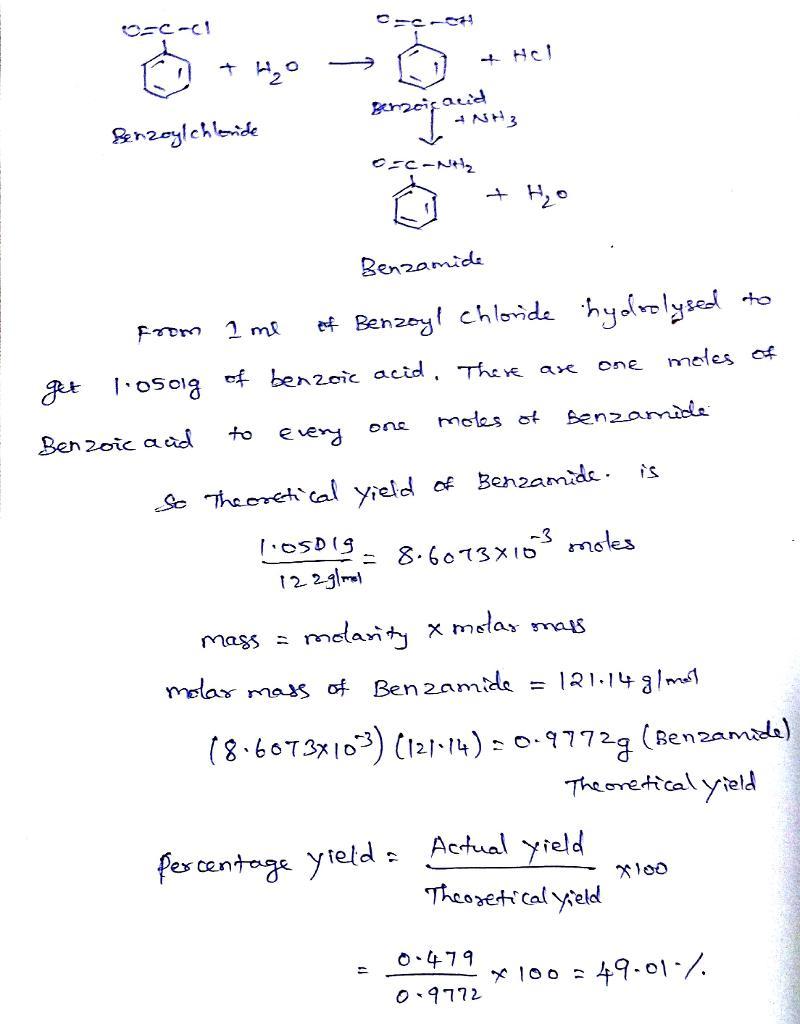
Consider the ammonolysis of benzoyl chloride by adding concentrated ammonium hydroxide to form the final product, benzamide. Rea
gizmo_the_mogwai [7]

Answer:

Explanation: see attachment below

4 0
2 years ago
Which condition can cause excessive pressure on the high side of a self contained active recovery device
murzikaleks [220]

Answer:

What can cause excessive pressure on the high side of an active self-contained recovery device? A closed recovery tank inlet valve or excessive air or other non condensables in the recovery tank (either A or B) Portable refillable tanks or containers used to ship recovered refrigerants must meet what standard(s)?

Explanation:

please mark me as brainliest thank you

5 0
1 year ago
List the number of each type of atom on the left side of the equation C5H12(g)+8O2(g)→5CO2(g)+6H2O(g) C 5 H 12 ( g ) + 8 O 2 ( g
Gala2k [10]

Answer:

Carbon=5, hydrogen=12, oxygen=16

Explanation:

Carbon=5, hydrogen=12, oxygen=16

In order to effectively count the number of atoms, we look at the equation closely and take note of the stoichiometric coefficients of each reactant as this influences the number of atoms of that element present.

For instance, oxygen is diatomic and has a stoichiometric coefficient of 8. This implies the there are sixteen atoms of oxygen altogether.

Note that the left hand side refers to the reactants side.

5 0
2 years ago
Read 2 more answers
Titanium has five common isotopes: 46Ti (8.0%), 47Ti (7.8%), 48Ti (73.4%), 49Ti (5.5%), 50 Ti (5.3%). What is the average atomic
zhannawk [14.2K]
(46x8.0)+(47x7.8)+(48x73.4)+(49x5.5)+(50x5.3) = 4792.3

4792.3/100 = 47.923 this is the average atomic mass of Titanium
6 0
2 years ago
Other questions:
  • If a certain gas occupies a volume of 13 L when the applied pressure is 6.5 atm , find the pressure when the gas occupies a volu
    11·2 answers
  • In the example above, imagine that the sunlight, solar cell, and fan form a closed system and no heat is generated. In this situ
    15·2 answers
  • A pot of water is heated over a fire, and then frozen peas are added to the hot water. What happens to the energy in this situat
    9·2 answers
  • An increase in temperature will effect vapor pressure by:
    6·1 answer
  • What is the minimum pressure in kPa that must be applied at 25 °C to obtain pure water by reverse osmosis from water that is 0.1
    10·1 answer
  • Draw the three structures of the aldehydes with molecular formula C5H10O that contain a branched chain.
    6·1 answer
  • Suppose a group of volunteers is planning to build a park near a local lake. The lake is known to contain low levels of arsenic
    13·1 answer
  • Hydrogen peroxide, H2O2, is common in many households and is used as a bleaching agent. It usually comes in a dark, opaque bottl
    5·1 answer
  • Compute the end-to-end separation (direct distance between molecule ends), in Angstroms, of a coiled PVC molecule with a number-
    13·1 answer
  • 2.92 A 50.0-g silver object and a 50.0-g gold object are both added
    8·1 answer
Add answer
Login
Not registered? Fast signup
Signup
Login Signup
Ask question!