answer.
Ask question
Login Signup
Ask question
All categories
  • English
  • Mathematics
  • Social Studies
  • Business
  • History
  • Health
  • Geography
  • Biology
  • Physics
  • Chemistry
  • Computers and Technology
  • Arts
  • World Languages
  • Spanish
  • French
  • German
  • Advanced Placement (AP)
  • SAT
  • Medicine
  • Law
  • Engineering
uranmaximum [27]
2 years ago
13

In a given rocket engine, a mass flow of propellants equal to 87.6 lbm/s is pumped into the combustion chamber, where the stagna

tion temperature after combustion is 6000°R. The combustion products have mixture values R = 2400 ft·lb/(slug·°R) and γ = 1.21. If the throat area is 0.5 ft2 , calculate the stagnation pressure in the combustion chamber in lb/ft2 . Hint: use your knowledge about choked flow.
Engineering
1 answer:
Ahat [919]2 years ago
4 0

Answer:

15 atm

Explanation:

Solution

Given that:

The first step is to convert mass flow rate unit

m = 87.6 lbm/s = 2.72  slug/sec

Now,

We express the mass flow rate, which is

m = p₀ A* /√T₀√y/R ( 2/ y+1)^(y+1) (y-1)

so,

2.72 = p₀ ^(0.5)/√6000√1.21/2400 (2/2.21)^10.52

Thus,

p₀ =  31736 lb/ft^2

Then,

We convert the pressure in terms of atmosphere

p₀ = 31736/ 2116 = 15 atm

You might be interested in
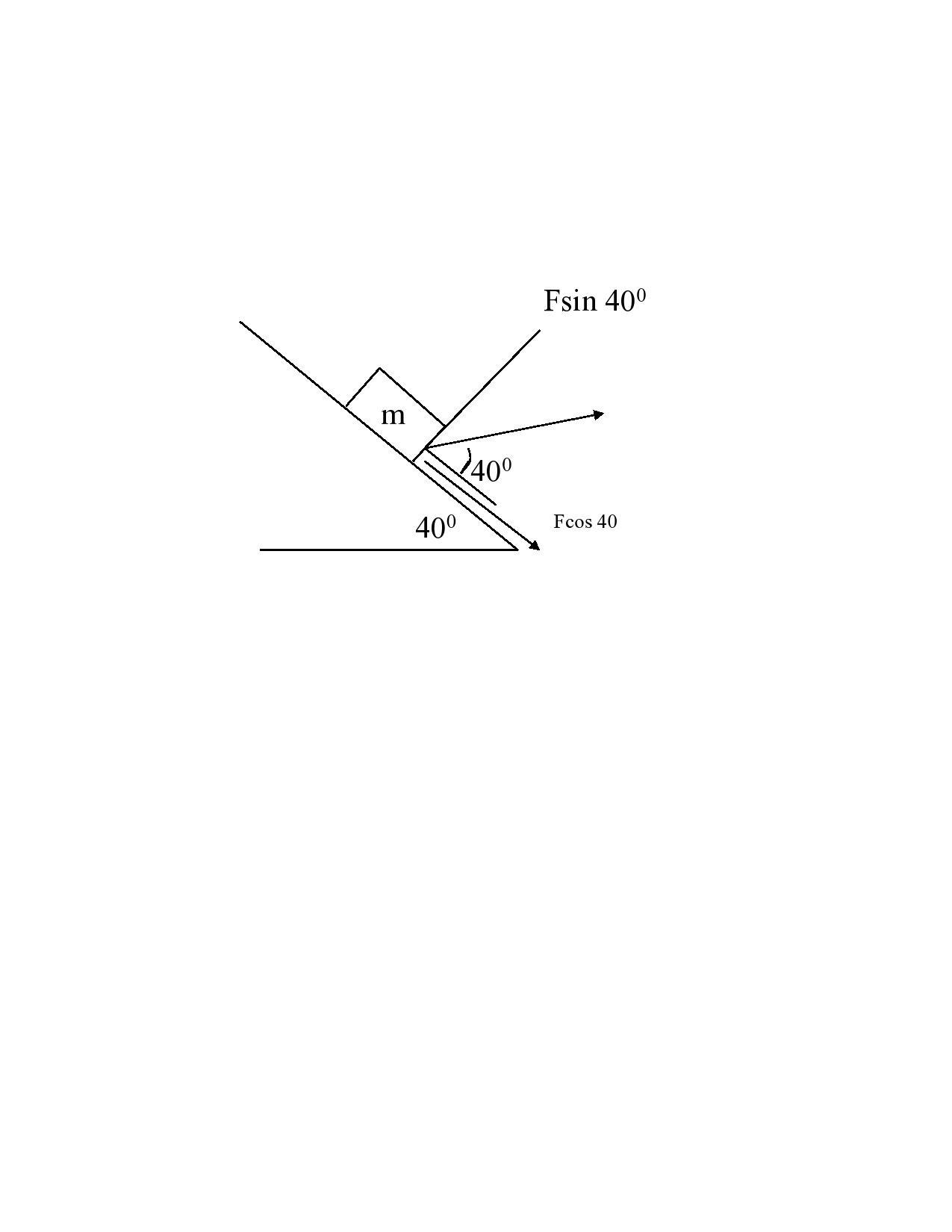
The 10-kg block slides down 2 m on the rough surface with kinetic friction coefficient μk = 0.2. What is the work done by the fr
Rashid [163]

Answer:

153.2 J

Explanation:

Let's first list our given parameters;

mass (m) of the block = 10 kg

which slides down ( i.e displacement) = 2 m

kinetic coefficient of friction (μk) = 0.2

In the diagram shown below;  if we take an integral look at the component of force in the direction of the displacement; we have

F_x= Fcos 40°

F_x= 100 (cos 40°)

F_x= 76.60 N

Workdone by the friction force can now be determined as:

W = F_x × displacement

W = 76.60 × 2

W = 153.2 J

∴  the work done by the friction force = 153.2 J

7 0
2 years ago
Explain why failure of this garden hose occurred near its end and why the tear occurred along its length. Use numerical values t
alukav5142 [94]

Answer:

  • hoop stress
  • longitudinal stress
  • material used

all this could led to the failure of the garden hose and the tear along the length

Explanation:

For the flow of water to occur in any equipment, water has to flow from a high pressure to a low pressure. considering the pipe, water is flowing at a constant pressure of 30 psi inside the pipe which is assumed to be higher than the allowable operating pressure of the pipe. but the greatest change in pressure will occur at the end of the hose because at that point the water is trying to leave the hose into the atmosphere, therefore the great change in pressure along the length of the hose closest to the end of the hose will cause a tear there. also the other factors that might lead to the failure of the garden hose includes :

hoop stress ( which acts along the circumference of the pipe):

αh = \frac{PD}{2T}     EQUATION 1

and Longitudinal stress ( acting along the length of the pipe )

αl = \frac{PD}{4T}       EQUATION 2

where p = water pressure inside the hose

          d = diameter of hose, T = thickness of hose

we can as well attribute the failure of the hose to the material used in making the hose .

assume for a thin cylindrical pipe material used to be

\frac{D}{T} ≥  20

insert this value into equation 1

αh = \frac{20 *30}{2}  = 60/2 = 30 psi

the allowable hoop stress was developed by the material which could have also led to the failure of the garden hose

8 0
2 years ago
Laminar flow normally persists on a smooth flat plate until a critical Reynolds number value is reached. However, the flow can b
grandymaker [24]

Answer:

At L = 0.1 m

h⁻_lam = 11.004K   W/m^1.5

h⁻_turb = 7.8848K   W/m^1.8

At L = 1 m

h⁻_lam = 3.48K   W/m^1.5

h⁻_turb = 4.975K   W/m^1.8

Explanation:

Given that;

h_lam(x)= 1.74 W/m^1.5. Kx^-0.5

h_turb(x)= 3.98 W/m^1.8 Kx^-0.2

conditions for plates of length L = 0.1 m and 1 m

Now

Average heat transfer coefficient is expressed as;

h⁻ = 1/L ₀∫^L hxdx

so for Laminar flow

h_lam(x)= 1.74 . Kx^-0.5  W/m^1.5

from the expression

h⁻_lam = 1/L ₀∫^L 1.74 . Kx^-0.5   dx

= 1.74k / L { [x^(-0.5+1)] / [-0.5 + 1 ]}₀^L

= 1.74k/L = [ (x^0.5)/0.5)]⁰^L

= 1.74K × L^0.5 / L × 0.5

h⁻_lam= 3.48KL^-0.5

For turbulent flow

h_turb(x)= 3.98. Kx^-0.2 W/m^1.8

form the expression

1/L ₀∫^L 3.98 . Kx^-0.2   dx

= 3.98k / L { [x^(-0.2+1)] / [-0.2 + 1 ]}₀^L

= (3.98K/L) × (L^0.8 / 0.8)

h⁻_turb = 4.975KL^-0.2

Now at L = 0.1 m

h⁻_lam = 3.48KL^-0.5  =  3.48K(0.1)^-0.5  W/m^1.5

h⁻_lam = 11.004K   W/m^1.5

h⁻_turb = 4.975KL^-0.2 = 4.975K(0.1)^-0.2

h⁻_turb = 7.8848K   W/m^1.8

At L = 1 m

h⁻_lam = 3.48KL^-0.5  =  3.48K(1)^-0.5  W/m^1.5

h⁻_lam = 3.48K   W/m^1.5

h⁻_turb = 4.975KL^-0.2 = 4.975K(1)^-0.2

h⁻_turb = 4.975K   W/m^1.8

Therefore

At L = 0.1 m

h⁻_lam = 11.004K   W/m^1.5

h⁻_turb = 7.8848K   W/m^1.8

At L = 1 m

h⁻_lam = 3.48K   W/m^1.5

h⁻_turb = 4.975K   W/m^1.8

3 0
2 years ago
A 50-kg iron block and 20-kg copper block, both initially at 80 oC, are dropped into a large lake at 15 oC. Thermal equilibrium
bija089 [108]
I need this answer to please
5 0
2 years ago
A dielectric material, such as Teflon®, is placed between the plates of a parallel-plate capacitor without altering the structur
Lina20 [59]

Answer: The electric field decreases because of the insertion of the Teflon.

Explanation:

If the charge on the capacitor is held fixed, the electric field as a consequence of this charge distribution (directed from the positive charged plate to the negative charged one remains unchanged.

However, as the Teflon is a dielectric material, even though doesn't allow the free movement of the electrons as an answer to an applied electric field, it allows that the electrons be displaced from the equilibrium position, leaving a local negative-charged zone close to the posiitive plate of the capacitor, and an equal but opposite charged layer close to the negative plate.

In this way, a internal electric field is created, that opposes to the external one due to the capacitor, which overall effect is diminishing the total electric field, reducing the voltage between the plates, and  increasing the capacitance proportionally to the dielectric constant of the Teflon.  

8 0
2 years ago
Other questions:
  • A thin metal disk of mass m=2.00 x 10^-3 kg and radius R=2.20cm is attached at its center to a long fiber. When the disk is turn
    11·1 answer
  • What can your employer do to protect you from overhead power lines?
    8·1 answer
  • At a certain college, 30% of the students major in engineering, 20% play club sports, and 10% both major in engineering and play
    14·1 answer
  • The uniform 8–ft board is pushed down into the water so it makes an angle of θ = 30o with the water surface. If the cross sectio
    14·1 answer
  • Consider the following class definitions: class smart class superSmart: public smart { { public: public: void print() const; voi
    6·1 answer
  • Two AISI 304 stainless steel plates 10 mm thick are subjected to a contact pressure of 1 bar under vacuum conditions for which t
    9·1 answer
  • A 5-cm-diameter shaft rotates at 4500 rpm in a 15-cmlong, 8-cm-outer-diameter cast iron bearing (k = 70 W/m·K) with a uniform cl
    10·1 answer
  • Python Homework
    12·1 answer
  • (a) If you needed to fit an acrylic base in a box that is 250mm x 250mm square, and the kerf on the laser cutter is 0.3mm, what
    13·1 answer
  • An equation used to evaluate vacuum filtration is Q = ΔpA2 α(VRw + ARf) , Where Q ≐ L3/T is the filtrate volume flow rate, Δp ≐
    13·1 answer
Add answer
Login
Not registered? Fast signup
Signup
Login Signup
Ask question!