answer.
Ask question
Login Signup
Ask question
All categories
  • English
  • Mathematics
  • Social Studies
  • Business
  • History
  • Health
  • Geography
  • Biology
  • Physics
  • Chemistry
  • Computers and Technology
  • Arts
  • World Languages
  • Spanish
  • French
  • German
  • Advanced Placement (AP)
  • SAT
  • Medicine
  • Law
  • Engineering
BartSMP [9]
2 years ago
5

A six-lane freeway (three lanes in each direction) currently operates at maximum LOS C conditions. The lanes are 11 ft wide, the

right-side shoulder is 4 ft wide, and there are two ramps within three miles upstream of the segment midpoint and one ramp within three miles downstream of the segment midpoint. The highway is on rolling terrain with 10% heavy vehicles, and the peak hour factor is 0.90. Determine the hourly volume for these conditions.
Engineering
1 answer:
Gelneren [198K]2 years ago
7 0

Answer:

4.071 veh/h.

Explanation:

Step one: calculate the estimated free flow speed by using the formula below;

= 75.4 - F(L) - F(C) - 3.22T^ 0.84.

The value of F(L) = 1.9 m/h and F(C) = 0.8 m/h.

Hence,

free flow speed = 75.4 - 1.9 - 0.8 - 3.22(3/6)^0.84.

free flow speed= 75.4 - 1.9 - 0.8 - 1.799

free flow speed= 70.901 mi/h = 70 mi/h.

Step two: determine the adjustment factor by using the formula below;

The adjustment factor = 1/ [1 + Pm (Em - 1) + Pn (En - 1)].

The adjustment factor = 1/[ 1+ 10/100 ( 2.5 - 1) + 0(2.0 - 1] = 0.869.

Step three;

Calculate the hourly volume;

The value corresponding to the LOS C conditions and free flow speed at 70 mi/h is 1735.

Therefore,

hourly volume, V = 1735 × 0.9 × 0.869 × 3.

Hourly volume, V = 4.071 veh/h.

You might be interested in
A certain printer requires that all of the following conditions be satisfied before it will send a HIGH to la microprocessor ack
Elza [17]

Answer:

D) AND gate.

Explanation:

Given that:

A certain printer requires that all of the following conditions be satisfied before it will send a HIGH to la microprocessor acknowledging that it is ready to print

These conditions are:

1. The printer's electronic circuits must be energized.

2. Paper must be loaded and ready to advance.

3. The printer must be "on line" with the microprocessor.

Now; if these conditions are met  the logic gate produces a HIGH output indicating readiness to print.

The objective here is to determine the basic logic gate used in this circuit.

Now;

For NOR gate;

NOR gate gives HIGH only when all the inputs are low. but the question states it that "a HIGH is generated and applied to a 3-input logic gate". This already falsify NOR gate to be the right answer.

For NOT gate.

NOT gate operates with only one input and one output device but here; we are dealing with 3-input logic gate.

Similarly, OR gate gives output as a high if any one of the input signals is high but we need "a HIGH that is generated and applied to a 3-input logic gate".

Finally, AND gate output is HIGH only when all the input signal is HIGH and vice versa, i.e AND gate output is LOW only when all the input signal is LOW. So AND gate satisfies the given criteria that; all the three conditions must be true for the final signal to be HIGH.

3 0
2 years ago
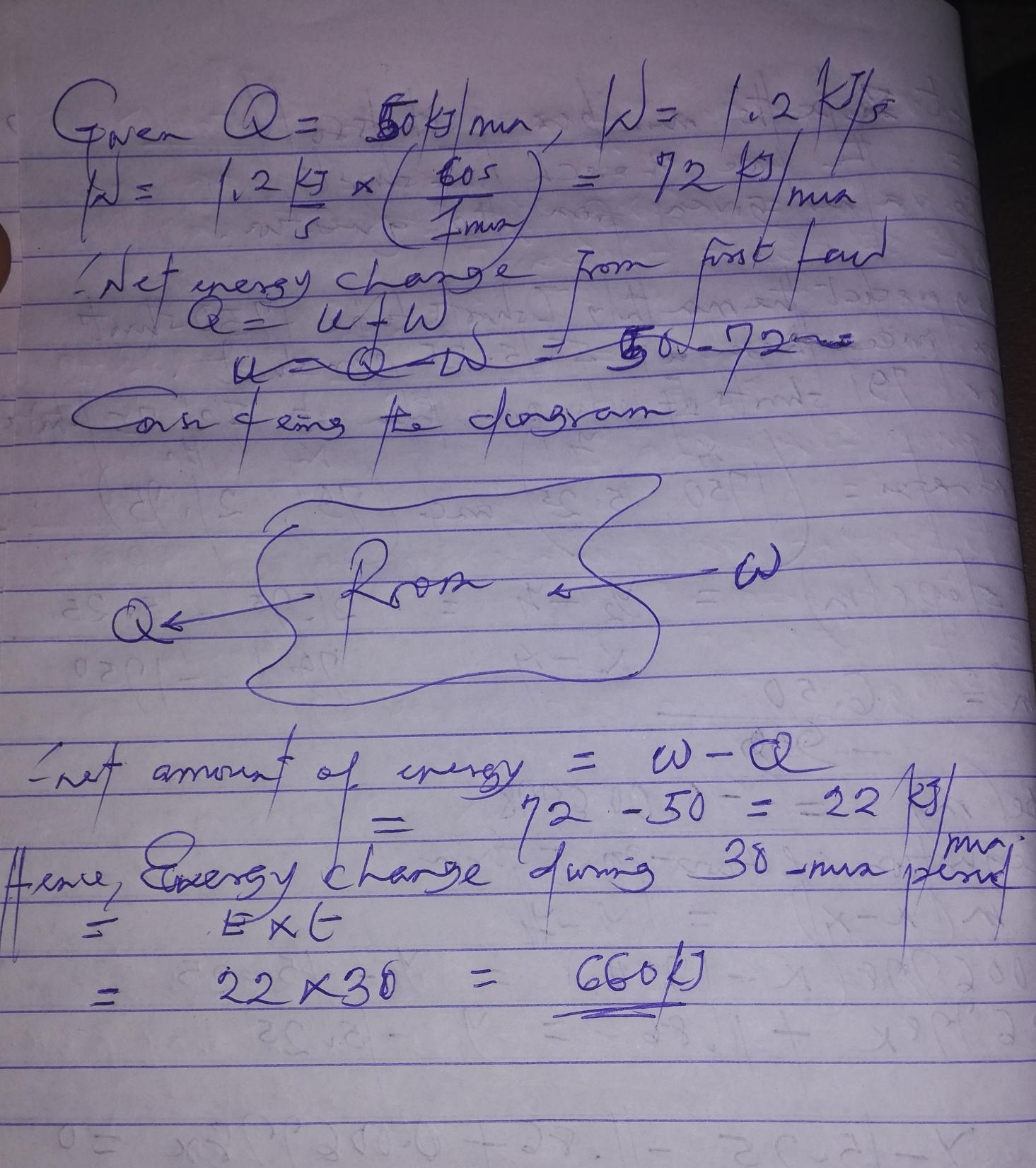
The air contained in a room loses heat to the surroundings at a rate of 50 kJ/min while work is supplied to the room by computer
Artemon [7]

Answer:

net amount of energy change of the air in the room during a 30-min period = 660KJ

Explanation:

The detailed calculation is as shown in the attached file.

4 0
2 years ago
Read 2 more answers
A thermal energy storage unit consists of a large rectangular channel, which is well insulated on its outer surface and encloses
yaroslaw [1]

Answer:

the temperature of the aluminum at this time is 456.25° C

Explanation:

Given that:

width w of the aluminium slab = 0.05 m

the initial temperature T_1 = 25° C

T{\infty} =600^0C

h = 100 W/m²

The properties of Aluminium at temperature of 600° C by considering the conditions for which the storage unit is charged; we have ;

density ρ = 2702 kg/m³

thermal conductivity k = 231 W/m.K

Specific heat c = 1033 J/Kg.K

Let's first find the Biot Number Bi which can be expressed by the equation:

Bi = \dfrac{hL_c}{k} \\ \\ Bi = \dfrac{h \dfrac{w}{2}}{k}

Bi = \dfrac{hL_c}{k} \\ \\ Bi = \dfrac{100 \times \dfrac{0.05}{2}}{231}

Bi = \dfrac{2.5}{231}

Bi = 0.0108

The time constant value \tau_t is :

\tau_t = \dfrac{pL_cc}{h} \\ \\ \tau_t = \dfrac{p \dfrac{w}{2}c}{h}

\tau_t = \dfrac{2702* \dfrac{0.05}{2}*1033}{100}

\tau_t = \dfrac{2702* 0.025*1033}{100}

\tau_t = 697.79

Considering Lumped capacitance analysis since value for Bi is less than 1

Then;

Q= (pVc)\theta_1 [1-e^{\dfrac {-t}{ \tau_1}}]

where;

Q = -\Delta E _{st} which correlates with the change in the internal energy of the solid.

So;

Q= (pVc)\theta_1 [1-e^{\dfrac {-t}{ \tau_1}}]= -\Delta E _{st}

The maximum value for the change in the internal energy of the solid  is :

(pVc)\theta_1 = -\Delta E _{st}max

By equating the two previous equation together ; we have:

\dfrac{-\Delta E _{st}}{\Delta E _{st}{max}}= \dfrac{  (pVc)\theta_1 [1-e^{\dfrac {-t}{ \tau_1}}]} { (pVc)\theta_1}

Similarly; we need to understand that the ratio of the energy storage to the maximum possible energy storage = 0.75

Thus;

0.75=  [1-e^{\dfrac {-t}{ \tau_1}}]}

So;

0.75=  [1-e^{\dfrac {-t}{ 697.79}}]}

1-0.75=  [e^{\dfrac {-t}{ 697.79}}]}

0.25 =  e^{\dfrac {-t}{ 697.79}}

In(0.25) =  {\dfrac {-t}{ 697.79}}

-1.386294361= \dfrac{-t}{697.79}

t = 1.386294361 × 697.79

t = 967.34 s

Finally; the temperature of Aluminium is determined as follows;

\dfrac{T - T _{\infty}}{T_1-T_{\infty}}= e ^ {\dfrac{-t}{\tau_t}}

\dfrac{T - 600}{25-600}= e ^ {\dfrac{-967.34}{697.79}

\dfrac{T - 600}{25-600}= 0.25

\dfrac{T - 600}{-575}= 0.25

T - 600 = -575 × 0.25

T - 600 = -143.75

T = -143.75 + 600

T = 456.25° C

Hence; the temperature of the aluminum at this time is 456.25° C

3 0
2 years ago
Superheated steam at an average temperature 200 C is transported through a steel pipe (k=50 W/mK, D_0=8.0 cm,D_i=6.0 cm,and L=20
Zarrin [17]

The total amount of daily heat transfer is 1382.38 M w.

The temperature on the outside surface of the gypsum plaster insulation is 17.96 ° C.

<u>Explanation:</u>

Given data,

T_{\infty} = 10° C

h_{0} = 250 w/ m^{2} k

Pipe length = 20 m

Inner diameter d_{1} = 6 cm, r_{1} = 3 cm

Outer diameter d_{2} = 8 cm, r_{2} = 4 cm

The thickness of insulation is 4 cm.

r_{3} = r_{2} + 4

= 4+4

r_{3} = 8 cm

h_{0} is the heat transfer coefficient of  convection inside, h_{i} is the heat transfer coefficient of  convection outside.

The heat transfer rate between ambient and steam is

q=\frac{T_{S}-T_{\infty}}{\frac{1}{h_{i}\left(2 \pi r_{1} L\right)}+\frac{\ln \left(r_{2} / r_{1}\right)}{2 \pi K_{1} L}+\frac{\ln \left(r_{3}/ r_{2}\right)}{2 \pi K_{2} L}+\frac{1}{h_{0}\left(2 \pi r_{3} L\right)}} watt

=  \begin{aligned}&\frac{1}{800(2 \pi x \cdot 03 \times 20)}\++\frac{\ln (4 / 3)}{2 \pi \times 50 \times 20}+\frac{\ln (8 / 4)}{2 \pi \times 0.5 \times 20}+\frac{1}{200(2 \pi x \cdot 08 \times 20)}\end{aligned} watt

= \frac{190}{0.0003317+0.0000458+0.0110+0.0004976} watt

q = 15999.86 watt

The total amount of daily heat transfer = 15999.86 × 86400

= 1382.387904 watt

= 1382.38 M w

The total amount of daily heat transfer is 1382.38 M w.

b) The temperature on the outside surface of the gypsum plaster insulation.

q = \frac{T_{3}-T_{\infty}}{\frac{1}{\ln \left(2 \pi \ r_{3} L\right)}}

15999.86   =\frac{\frac{1}{T_3}-10}{\frac{1}{200(2 \pi . 08 \times 20)}}

T_{3} - 10 = 7.96

T_{3} = 17.96 ° C.

4 0
2 years ago
Convert 273.15 mL at 166.0 mm of Hg to its new volume at standard pressure.​
zloy xaker [14]

Answer:

(166.0 mm Hg) (273.15 mL) = (760.0 mm Hg) (x)

4 0
2 years ago
Other questions:
  • Radioactive wastes are temporarily stored in a spherical container, the center of which is buried a distance of 10 m below the e
    13·1 answer
  • How much extra water does a 21.5 ft, 175-lb concrete canoe displace compared to an ultra-lightweight 38-lb Kevlar canoe of the s
    8·1 answer
  • A charge of 2.0 × 10⁻¹⁰ C is to be stored on each plate of a parallel-plate capacitor having an area of 650 mm2 (1.0 in.2 ) and
    14·1 answer
  • Pipe (2) is supported by a pin at bracket C and by tie rod (1). The structure supports a load P at pin B. Tie rod (1) has a diam
    15·1 answer
  • The critical resolved shear stress for iron is 27 MPa (4000 psi). Determine the maximum possible yield strength for a single cry
    12·1 answer
  • A dc shunt generator rated at 85 kW produces a voltage of 280 V. The brush voltage drop is 2.5 V, and the armature and field res
    6·1 answer
  • Which of the following describes boundaries?
    10·1 answer
  • An ideal Stirling cycle filled with air uses a 75 F energy reservoir as a sink. The engine is designed to so that the maximum ai
    8·1 answer
  • The BARO sensor informs the PCM about changes in weather and ____________________.
    14·1 answer
  • Alicia had to get over her fear of heights in order to become comfortable maintaining the generators in wind turbines. professio
    7·1 answer
Add answer
Login
Not registered? Fast signup
Signup
Login Signup
Ask question!