answer.
Ask question
Login Signup
Ask question
All categories
  • English
  • Mathematics
  • Social Studies
  • Business
  • History
  • Health
  • Geography
  • Biology
  • Physics
  • Chemistry
  • Computers and Technology
  • Arts
  • World Languages
  • Spanish
  • French
  • German
  • Advanced Placement (AP)
  • SAT
  • Medicine
  • Law
  • Engineering
babunello [35]
2 years ago
5

An incompressible fluid flows between two infinite stationary parallel plates. The velocity profile is given by u=umaxðAy2 + By+

CÞ, where A, B, and C are constants and y is measured upward from the lower plate. The total gap width is h units. Use appropriate boundary conditions to express the magnitude and units of the constants in terms of h. Develop an expression for volume flow rate per unit depth and evaluate the ratio V=umax
Engineering
1 answer:
nexus9112 [7]2 years ago
5 0

Answer:

the volume flow rate per unit depth is:

\frac{Q}{b} = \frac{2}{3} u_{max} h

the ratio is : \frac{V}{u_{max}}=\frac{2}{3}

Explanation:

From the question; the  equations of the velocities profile in the system are:

u = u_{max}(Ay^2+By+C)   ----- equation (1)

The above boundary condition can now be written as :

At y= 0; u =0           ----- (a)

At y = h; u =0            -----(b)

At y = \frac{h}{2} ; u = u_{max}     ------(c)

where ;

A,B and C are constant

h = distance between two plates

u = velocity

u_{max} = maximum velocity

y = measured distance upward from the lower plate

Replacing the boundary condition in (a) into equation (1) ; we have:

u = u_{max}(Ay^2+By+C) \\ \\ 0 = u_{max}(A*0+B*0+C) \\ \\ 0=u_{max}C \\ \\ C= 0

Replacing the boundary condition (b) in equation (1); we have:

u = u_{max}(Ay^2+By+C) \\ \\ 0 = u_{max}(A*h^2+B*h+C) \\ \\ 0 = Ah^2 +Bh + C \\ \\ 0 = Ah^2 +Bh + 0 \\ \\ Bh = - Ah^2 \\ \\ B = - Ah   \ \ \ \ \   --- (d)

Replacing the boundary condition (c) in equation (1); we have:

u = u_{max}(Ay^2+By+C) \\ \\ u_{max}= u_{max}(A*(\frac{h^2}{2})+B*\frac{h}{2}+C) \\ \\ 1 = \frac{Ah^2}{4} +B \frac{h}{2} + 0 \\ \\ 1 =  \frac{Ah^2}{4} + \frac{h}{2}(-Ah)  \\ \\ 1=  \frac{Ah^2}{4}  - \frac{Ah^2}{2}  \\ \\ 1 = \frac{Ah^2 - Ah^2}{4}  \\ \\ A = -\frac{4}{h^2}

replacing A = -\frac{4}{h^2} for A in (d); we get:

B = - ( -\frac{4}{h^2})hB = \frac{4}{h}

replacing the values of A, B and C into the velocity profile expression; we have:

u = u_{max}(Ay^2+By+C) \\ \\ u = u_{max} (-\frac{4}{h^2}y^2+\frac{4}{h}y)

To determine the volume flow rate; we have:

Q = AV \\ \\ Q= \int\limits^h_0 (u.bdy)

Replacing u_{max} (-\frac{4}{h^2}y^2+\frac{4}{h}y) \ for \ u

\frac{Q}{b} = \int\limits^h_0 u_{max}(-\frac{4}{h^2} y^2+\frac{4}{h}y)dy \\ \\  \frac{Q}{b} = u_{max}  \int\limits^h_0 (-\frac{4}{h^2} y^2+\frac{4}{h}y)dy \\ \\ \frac{Q}{b} = u_{max} (-\frac{-4}{h^2}\frac{y^3}{3} +\frac{4}{h}\frac{y^2}{y})^ ^ h}}__0  }} \\ \\ \frac{Q}{b} =u_{max} (-\frac{-4}{h^2}\frac{h^3}{3} +\frac{4}{h}\frac{h^2}{y})^ ^ h}}__0  }} \\ \\ \frac{Q}{b} = u_{max}(\frac{-4h}{3}+\frac{4h}2} ) \\ \\ \frac{Q}{b} = u_{max}(\frac{-8h+12h}{6}) \\ \\ \frac{Q}{b} =u_{max}(\frac{4h}{6})

\frac{Q}{b} = u_{max}(\frac{2h}{3}) \\ \\ \frac{Q}{b} = \frac{2}{3} u_{max} h

Thus; the volume flow rate per unit depth is:

\frac{Q}{b} = \frac{2}{3} u_{max} h

Consider the discharge ;

Q = VA

where :

A = bh

Q = Vbh

\frac{Q}{b}= Vh

Also;  \frac{Q}{b} = \frac{2}{3} u_{max} h

Then;

\frac{2}{3} u_{max} h = Vh \\ \\ \frac{V}{u_{max}}=\frac{2}{3}

Thus; the ratio is : \frac{V}{u_{max}}=\frac{2}{3}

You might be interested in
Water at 70 kPa and 1008C is compressed isentropically in a closed system to 4 MPa. Determine the final temperature of the water
Nikitich [7]

Answer:

The answer is "909.3928  KJ".

Explanation:

70 \ kPa  \ \ and \ \ 100^{\circ}C \\\\s_i= 7.56162\ \frac{kJ}{kgK}\\\\u_i= 2509.39 \ \frac{kJ}{kg}\\\\

The method is isentropic since the cylinders are shielded.

Calculating the work:

w= u_2-u_i \\\\

   = 3418.7728-2509.38 \\\\=909.3928 \ KJ

3 0
2 years ago
(3) Calculate the heat flux through a sheet of brass 7.5 mm (0.30 in.) thick if the temperatures at the two faces are 150°Cand 5
bezimeni [28]

Answer:

a.) 1.453MW/m2,  b.)  2,477,933.33 BTU/hr  c.) 22,733.33 BTU/hr  d.) 1,238,966.67 BTU/hr

Explanation:

Heat flux is the rate at which thermal (heat) energy is transferred per unit surface area. It is measured in W/m2

Heat transfer(loss or gain) is unit of energy per unit time. It is measured in W or BTU/hr

1W = 3.41 BTU/hr

Given parameters:

thickness, t = 7.5mm = 7.5/1000 = 0.0075m

Temperatures 150 C = 150 + 273 = 423 K

                        50 C = 50 + 273 = 323 K

Temperature difference, T = 423 - 323 = 100 K

We are assuming steady heat flow;

a.) Heat flux, Q" = kT/t

K= thermal conductivity of the material

The thermal conductivity of brass, k = 109.0 W/m.K

Heat flux, Q" = \frac{109 * 100}{0.0075} = 1,453,333.33 W/m^{2} \\ Heat flux, Q" = 1.453MW/m^{2} \\

b.) Area of sheet, A = 0.5m2

Heat loss, Q = kAT/t

Heat loss, Q = \frac{109*0.5*100}{0.0075} = 726,666.667W

Heat loss, Q = 726,666.667 * 3.41 = 2,477,933.33 BTU/hr

c.) Material is now given as soda lime glass.

Thermal conductivity of soda lime glass, k is approximately 1W/m.K

Heat loss, Q=\frac{1*0.5*100}{0.0075} = 6,666.67W

Heat loss, Q = 6,666.67 * 3.41 = 22,733.33 BTU/hr

d.) Thickness, t is given as 15mm = 15/1000 = 0.015m

Heat loss, Q=\frac{109*0.5*100}{0.015} =363,333.33W

Heat loss, Q = 363,333.33 * 3.41 = 1,238,966.67 BTU/hr

5 0
2 years ago
An electrical utility delivers 6.25E10 kWh of power to its customers in a year. What is the average power required during the ye
Sindrei [870]

Answer:

The overall Utility delivered to customers in a year 'U' = 6.25 X 10¹⁰Kwh

However, the average power P, required for a year, t  = ? Kw

Expressing their relationship, we will have

             U = P x t

Given t = 1 year = 24 x 365 hours (assume a year operation is 365 days)

          t = 8760 hours

P = \frac{62500000000}{8760}

P = 7134.7Kw

Hence, the average power required during the year is 7,135Kw

Now to calculate the energy used by the power plant in a year (in quads)?

Recall, Efficiency, η = Power Output/Power Input (100)

so, we have

η = P₀/P₁, given

0.45 = \frac{7134.7Kw}{P₁}

P₁ = 15,855Kw

the total energy E₁ used in a year = 15,855x24x365 = 138.89MJoules

So to convert this to quads, Note;

1 quads of energy = 10¹⁵ Joules

The total energy used is 0.000000139 quads

Now to find the cubic feet of natural gas required to generate this power?

Note: 0.29Kwh of Power generated  = 1 cubic feet of natural gas used

Since, the power plant generated = 62500000000Kwh

The cubic feet of natural gas used = \frac{62500000000}{0.29}

Hence, 2.155x10²⁰cubic feet of N.gas was used to generate this much power.

8 0
2 years ago
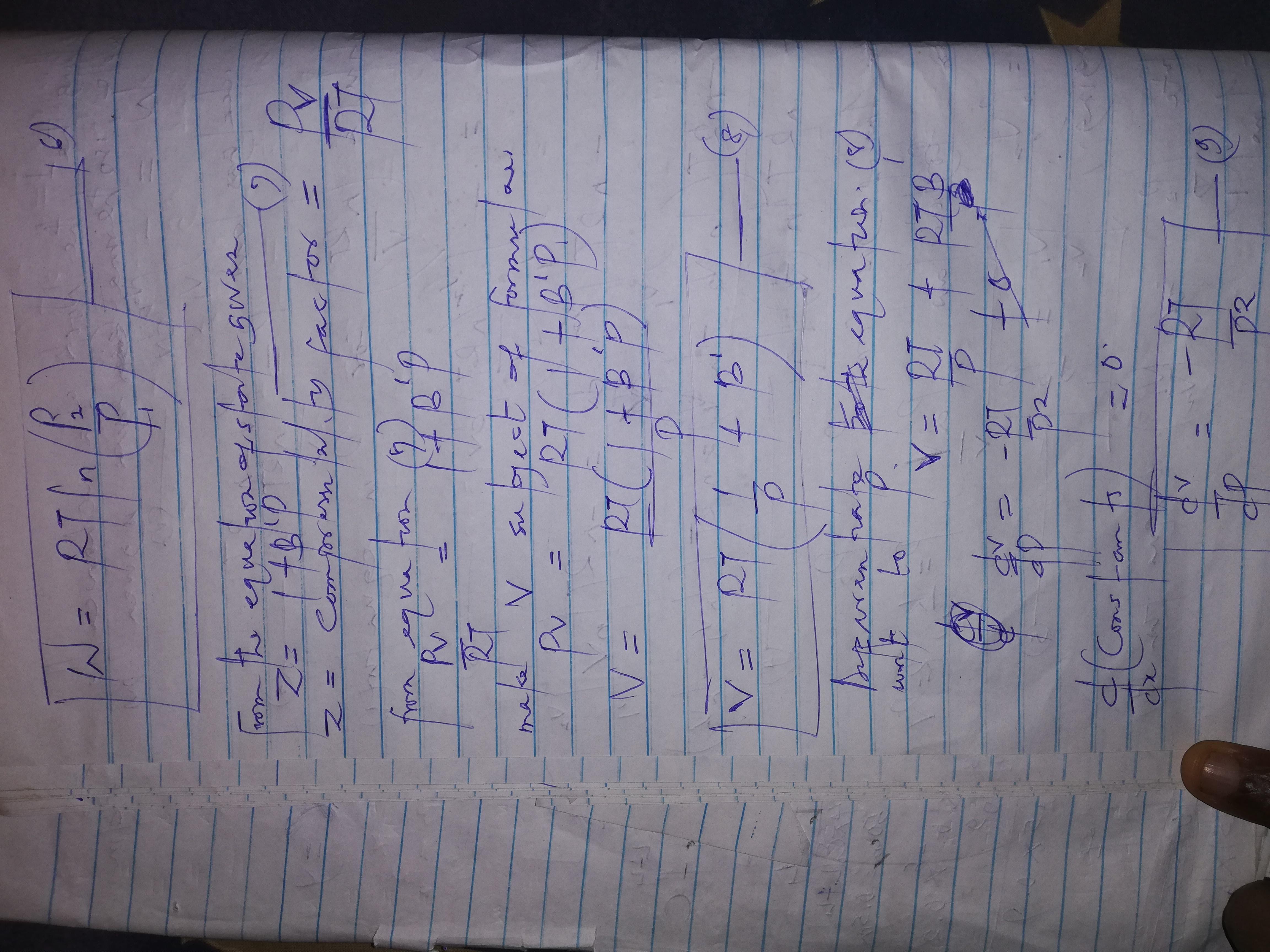
Derive an equation for the work of a mechanically reversible, isothermal compression of 1 mol of a gas from an initial pressure
Lyrx [107]

Answer:

The long derivation for work of a mechanically reversible, isothermal compression was done with detailed steps as shown in the attachment.

Explanation:

what is applied here is a long derivation from Work done in an isobaric process, the expression for the compressibility factor (Z) and the equation of state that was given. The requisite knowledge of Differentiation and Integration was used.

The detailed derivation from firs principle is as shown in the attachment.

5 0
2 years ago
The 8-mm-thick bottom of a 220-mm-diameter pan may be made from aluminum (k = 240 W/m ⋅ K) or copper (k = 390 W/m ⋅ K). When use
Artemon [7]

Answer:

For aluminum 110.53 C

For copper 110.32 C

Explanation:

Heat transmission through a plate (considering it as an infinite plate, as in omitting the effects at the borders) follows this equation:

q = \frac{k * A * (th - tc)}{d}

Where

q: heat transferred

k: conduction coeficient

A: surface area

th: hot temperature

tc: cold temperature

d: thickness of the plate

Rearranging the terms:

d * q = k * A * (th - tc)

\frac{d * q}{k * A} = th - tc

th = \frac{d * q}{k * A} + tc

The surface area is:

A = \frac{\pi * d^2}{4}

A = \frac{\pi * 0.22^2}{4} = 0.038 m^2

If the pan is aluminum:

th = \frac{0.008 * 600}{240 * 0.038} + 110 = 110.53 C

If the pan is copper:

th = \frac{0.008 * 600}{390 * 0.038} + 110 = 110.32 C

7 0
2 years ago
Other questions:
  • Theorems of Pappus and Guldinus are used to find: a. The surface area and volume of a body of rotation b. The surface area and v
    14·1 answer
  • You are working in a lab where RC circuits are used to delay the initiation of a process. One particular experiment involves an
    13·1 answer
  • A closed system consisting of 4 lb of a gas undergoes a process during which the relation between pressure and volume is pVn 5 c
    7·1 answer
  • A rod is 2m long at temperature of 10oC. Find the expansion of the rod, when the temperature is raised to 80oC. If this expansio
    7·1 answer
  • What can your employer do to protect you from overhead power lines?
    8·1 answer
  • If the electric field just outside a thin conducting sheet is equal to 1.5 N/C, determine the surface charge density on the cond
    9·1 answer
  • A well-insulated tank in a vapor power plant operates at steady state. Saturated liquid water enters at inlet 1 at a rate of 125
    8·1 answer
  • Argon contained in a closed, rigid tank, initially at 33.7°C, 2.1 bar, and a volume of 4.2 m3, is heated to a final pressure of
    12·1 answer
  • Benzene vapor at 480°C is cooled and converted to a liquid at 25°C in a continuous condenser. The condensate is drained into 1.7
    15·1 answer
  • 2.24 Carbon dioxide (CO2) gas in a piston-cylinder assembly undergoes three processes in series that begin and end at the same s
    6·1 answer
Add answer
Login
Not registered? Fast signup
Signup
Login Signup
Ask question!