answer.
Ask question
Login Signup
Ask question
All categories
  • English
  • Mathematics
  • Social Studies
  • Business
  • History
  • Health
  • Geography
  • Biology
  • Physics
  • Chemistry
  • Computers and Technology
  • Arts
  • World Languages
  • Spanish
  • French
  • German
  • Advanced Placement (AP)
  • SAT
  • Medicine
  • Law
  • Engineering
arlik [135]
2 years ago
6

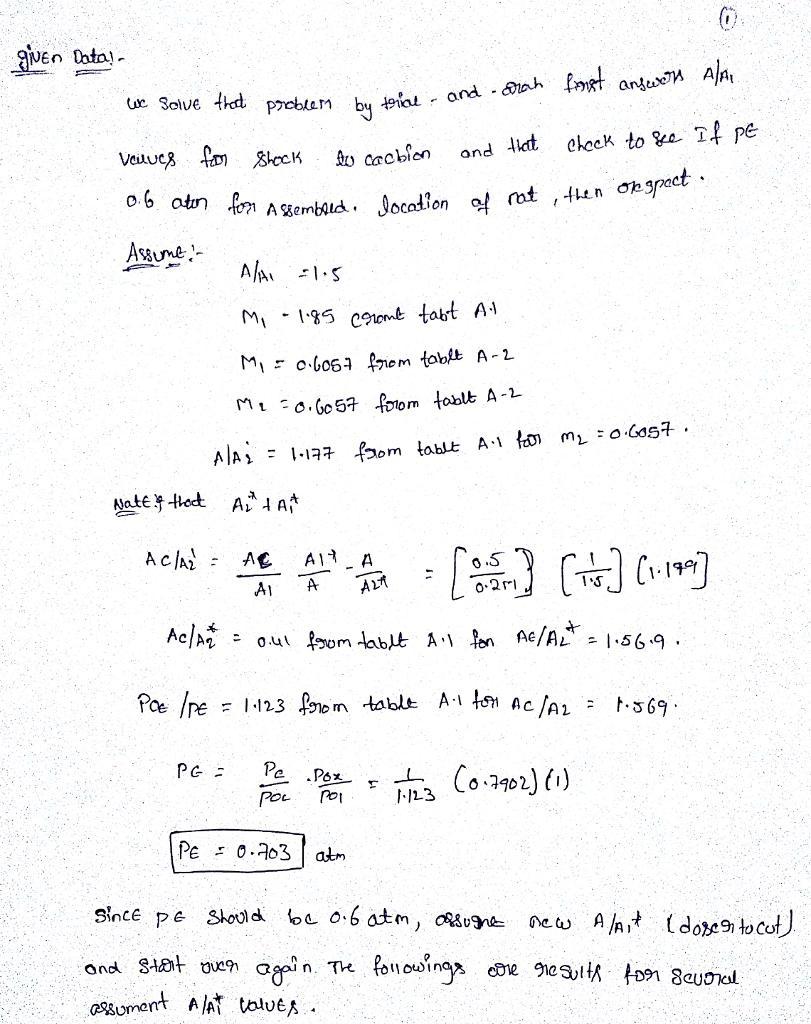
Consider a convergent-divergent duct with exit and throat areas of 0.5 m2 and 0.25 m2, respectively. The inlet reservoir pressur

e is 1 atm and the exit static pressure is 0.6 atm. For this pressure ratio, the flow will be supersonic in a portion of the nozzle, terminating with a normal shock inside of the nozzle. Calculate the local area ratio (A/A*) at which the shock is located inside the nozzle.

Engineering
1 answer:
Bad White [126]2 years ago
4 0

Find the attachments for the complete solution

You might be interested in
A steady tensile load of 5.00kN is applied to a square bar, 12mm on a side and having a length of 1.65m. compute the stress in t
Shtirlitz [24]

Answer:

The stress in the bar is 34.72 MPa.

The design factor (DF) for each case is:

A) DF=0.17

B) DF=0.09

C) DF=0.125

D) DF=0.12

E) DF=0.039

F) DF=1.26

G) DF=5.5

Explanation:

The design factor is the relation between design stress and failure stress. In the case of ductile materials like metals, the failure stress considered is the yield stress. In the case of plastics or ceramics, the failure stress considered is the breaking stress (ultimate stress). If the design factor is less than 1, the structure or bar will endure the applied stress. By the opposite side, when the DF is higher than 1, the structure will collapse or the bar will break.

we will calculate the design stress in this case:

\displaystyle \sigma_{dis}=\frac{T_l}{Sup}=\frac{5.00KN}{(12\cdot10^{-3}m)^2}=34.72MPa

The design factor for metals is:

DF=\displaystyle \frac{\sigma_{dis}}{\sigma_{f}}=\frac{\sigma_{dis}}{\sigma_{y}}

The design factor for plastic and ceramics is:

DF=\displaystyle \frac{\sigma_{dis}}{\sigma_{f}}=\frac{\sigma_{dis}}{\sigma_{u}}

We now need to know the yield stress or the ultimate stress for each material. We use the AISI and ASTM charts for steels, materials charts for non-ferrous materials and plastics safety charts for the plastic materials.

For these cases:

A) The yield stress of AISI 120 hot-rolled steel (actually is AISI 1020) is 205 MPa, therefore:

DF=\displaystyle\frac{34.72MPa}{205MPa}=0.17

B) The yield stress of AISI 8650 OQT 1000 steel is 385 MPa, therefore:

DF=\displaystyle\frac{34.72MPa}{385MPa}=0.09

C) The yield stress of ductile iron A536-84 (60-40-18) is 40Kpsi, this is 275.8 MPa, therefore:

DF=\displaystyle\frac{34.72MPa}{275.8MPa}=0.125

D) The yield stress of aluminum allot 6061-T6 is 290 MPa, therefore:

DF=\displaystyle\frac{34.72MPa}{290MPa}=0.12

E) The yield stress of titanium alloy Ti-6Al-4V annealed (certified by manufacturers) is 880 MPa, therefore:

DF=\displaystyle\frac{34.72MPa}{880MPa}=0.039

F) The ultimate stress of rigid PVC plastic (certified by PVC Pipe Association) is 4Kpsi or 27.58 MPa, therefore:

DF=\displaystyle\frac{34.72MPa}{27.58 MPa}=1.26

In this case, the bar will break.

F) You have to consider that phenolic plastics are used as matrix in composite materials and seldom are used alone with no reinforcement. In this question is not explained if this material is reinforced or not, therefore I will use the ultimate stress of most pure phenolic plastics, in this case, 6.31 MPa:

DF=\displaystyle\frac{34.72MPa}{6.31 MPa}=5.5

This material will break.

3 0
2 years ago
A railcar with an overall mass of 78,000 kg traveling with a speed vi is approaching a barrier equipped with a bumper consisting
sergij07 [2.7K]

Answer:

v₀ = 2,562 m / s  = 9.2 km/h

Explanation:

To solve this problem let's use Newton's second law

              F = m a = m dv / dt = m dv / dx dx / dt = m dv / dx v

              F dx = m v dv

We replace and integrate

            -β ∫ x³ dx = m ∫ v dv

            β x⁴/ 4 = m v² / 2

We evaluate between the lower (initial) integration limits v = v₀, x = 0 and upper limit v = 0 x = x_max

        -β (0- x_max⁴) / 4 = ½ m (v₀²2 - 0)

         x_max⁴ = 2 m /β   v₀²


Let's look for the speed that the train can have for maximum compression

         x_max = 20 cm = 0.20 m


         v₀ =√(β/2m)   x_max²

Let's calculate

          v₀ = √(640 106/2 7.8 104)    0.20²

          v₀ = 64.05  0.04

          v₀ = 2,562 m / s

          v₀ = 2,562 m / s (1lm / 1000m) (3600s / 1h)

          v₀ = 9.2 km / h

5 0
2 years ago
5. Which of these materials in a shop contain metals and toxins and can pollute the environment? A) Antifreeze B) Solvents C) Ba
Elza [17]
As a multiple choice the only correct answer is D
3 0
2 years ago
Read 2 more answers
(3) Calculate the heat flux through a sheet of brass 7.5 mm (0.30 in.) thick if the temperatures at the two faces are 150°Cand 5
bezimeni [28]

Answer:

a.) 1.453MW/m2,  b.)  2,477,933.33 BTU/hr  c.) 22,733.33 BTU/hr  d.) 1,238,966.67 BTU/hr

Explanation:

Heat flux is the rate at which thermal (heat) energy is transferred per unit surface area. It is measured in W/m2

Heat transfer(loss or gain) is unit of energy per unit time. It is measured in W or BTU/hr

1W = 3.41 BTU/hr

Given parameters:

thickness, t = 7.5mm = 7.5/1000 = 0.0075m

Temperatures 150 C = 150 + 273 = 423 K

                        50 C = 50 + 273 = 323 K

Temperature difference, T = 423 - 323 = 100 K

We are assuming steady heat flow;

a.) Heat flux, Q" = kT/t

K= thermal conductivity of the material

The thermal conductivity of brass, k = 109.0 W/m.K

Heat flux, Q" = \frac{109 * 100}{0.0075} = 1,453,333.33 W/m^{2} \\ Heat flux, Q" = 1.453MW/m^{2} \\

b.) Area of sheet, A = 0.5m2

Heat loss, Q = kAT/t

Heat loss, Q = \frac{109*0.5*100}{0.0075} = 726,666.667W

Heat loss, Q = 726,666.667 * 3.41 = 2,477,933.33 BTU/hr

c.) Material is now given as soda lime glass.

Thermal conductivity of soda lime glass, k is approximately 1W/m.K

Heat loss, Q=\frac{1*0.5*100}{0.0075} = 6,666.67W

Heat loss, Q = 6,666.67 * 3.41 = 22,733.33 BTU/hr

d.) Thickness, t is given as 15mm = 15/1000 = 0.015m

Heat loss, Q=\frac{109*0.5*100}{0.015} =363,333.33W

Heat loss, Q = 363,333.33 * 3.41 = 1,238,966.67 BTU/hr

5 0
2 years ago
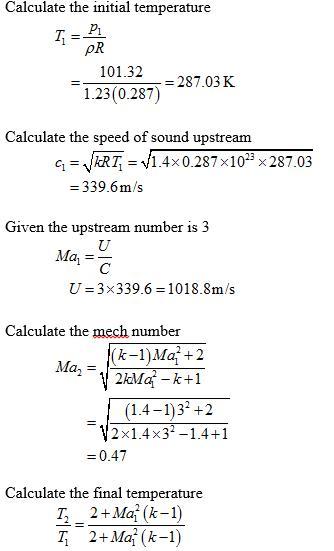
Consider a normal shock wave in air. The upstream conditions are given by M1=3, p1 = 1 atm, and r1 = 1.23 kg/m3. Calculate the d
mart [117]

Answer and Explanation:

The answer is attached below

7 0
2 years ago
Other questions:
  • ) A shaft encoder is to be used with a 50 mm radius tracking wheel to monitor linear displacement. If the encoder produces 256 p
    15·1 answer
  • An aircraft component is fabricated from an aluminum alloy that has a plane-strain fracture toughness of 40 MPa1m (36.4 ksi1in.)
    15·1 answer
  • Use Lagrange multiplier techniques to find the local extreme values of the given function subject to the stated constraint. If a
    15·1 answer
  • The velocity of a particle which moves along the s-axis is given by v = 2-4t+5t^(3/2), where t is in seconds and v is in meters
    11·2 answers
  • Hot combustion gases, modeled as air behaving as an ideal gas, enter a turbine at 10 bar, 1500 K and exit at 1.97 bar and 900 K.
    7·1 answer
  • The in situ moist unit weight of a soil is 17.3 kN/m3 and the moisture content is 16%. The specific gravity of soil solids is 2.
    12·1 answer
  • Solid spherical particles having a diameter of 0.090 mm and a density of 2002 kg/m3 are settling in a solution of water at 26.7C
    8·1 answer
  • the ____ method is the safest turning technique to use as it does not expose your hands to the airbags deployment area
    15·1 answer
  • What is the component called that usually has a dual-voltage selector switch and has cables that connect to the motherboard and
    15·1 answer
  • 140-character statement that completes this sentence: I pledge to not text and drive because...
    12·1 answer
Add answer
Login
Not registered? Fast signup
Signup
Login Signup
Ask question!