answer.
Ask question
Login Signup
Ask question
All categories
  • English
  • Mathematics
  • Social Studies
  • Business
  • History
  • Health
  • Geography
  • Biology
  • Physics
  • Chemistry
  • Computers and Technology
  • Arts
  • World Languages
  • Spanish
  • French
  • German
  • Advanced Placement (AP)
  • SAT
  • Medicine
  • Law
  • Engineering
FinnZ [79.3K]
2 years ago
14

1. A student tried to solve the following problem by selecting the tile as shown. What, if anything, did the student do wrong?

Chemistry
1 answer:
slega [8]2 years ago
6 0

Answer:

B. The student chose the correct tile, but needs to flip the tile to make the units cancel

Explanation:

Based on the reaction:

2AgNO₃(aq) + Cu(s) → 2Ag(s) + Cu(NO₃)₂ (aq)

<em>2 moles of AgNO₃ react per mole of Cu producing 2 moles of Ag and 1 mole of Cu(NO₃)₂</em>

Thus, if you want to produce 6.75moles of Cu(NO₃)₂ you need:

6.75moles of Cu(NO_3)_2  \frac{2 mol AgNO_3 }{1 mol Cu(NO_3)_2} = 13.50 moles of AgNO₃ are needed

Thus, if you analize the tile shown by the student:

<em>B. The student chose the correct tile, but needs to flip the tile to make the units cancel</em>

You might be interested in
Empirical Formula of P3O4H2?
puteri [66]

Answer:

H2 P4 O1. Explanation: In order to calculate the Empirical formula , we will assume that we have started with 10 g of the compound.

Explanation:

3 0
2 years ago
A piston containing 0.120moles of methane gas, CH4, has a volume of 2.12liters. If methane is added until the volume is increase
earnstyle [38]

Answer:

2.83 g

Explanation:

At constant temperature and pressure, Using Avogadro's law

\frac {V_1}{n_1}=\frac {V_2}{n_2}

Given ,  

V₁ = 2.12 L

V₂ = 3.12 L

n₁ = 0.120 moles

n₂ = ?

Using above equation as:

\frac{2.12}{0.120}=\frac{3.12}{n_2}

2.12n_2=0.12\cdot \:3.12

2.12n_2=0.3744

n_2=\frac{0.3744}{2.12}

n_2=0.17660

n₂ = 0.17660 moles

Molar mass of methane gas = 16.05 g/mol

So, Mass = Moles*Molar mass = 0.17660 * 16.05 g = 2.83 g

<u>2.83 g  are in the piston.</u>

8 0
2 years ago
PLEASE HELP!!!!!!
Bas_tet [7]
The reaction that is a double displacement reaction is the final one. Between Pb(NO3)2 and HCl.
6 0
2 years ago
Read 2 more answers
Increased motion in the particles in a liquid allows the particles to
makkiz [27]
Particles in a liquid are more loosely packed there for they have more room to move and can flow around eachother . Hope this helps XD
8 0
2 years ago
Read 2 more answers
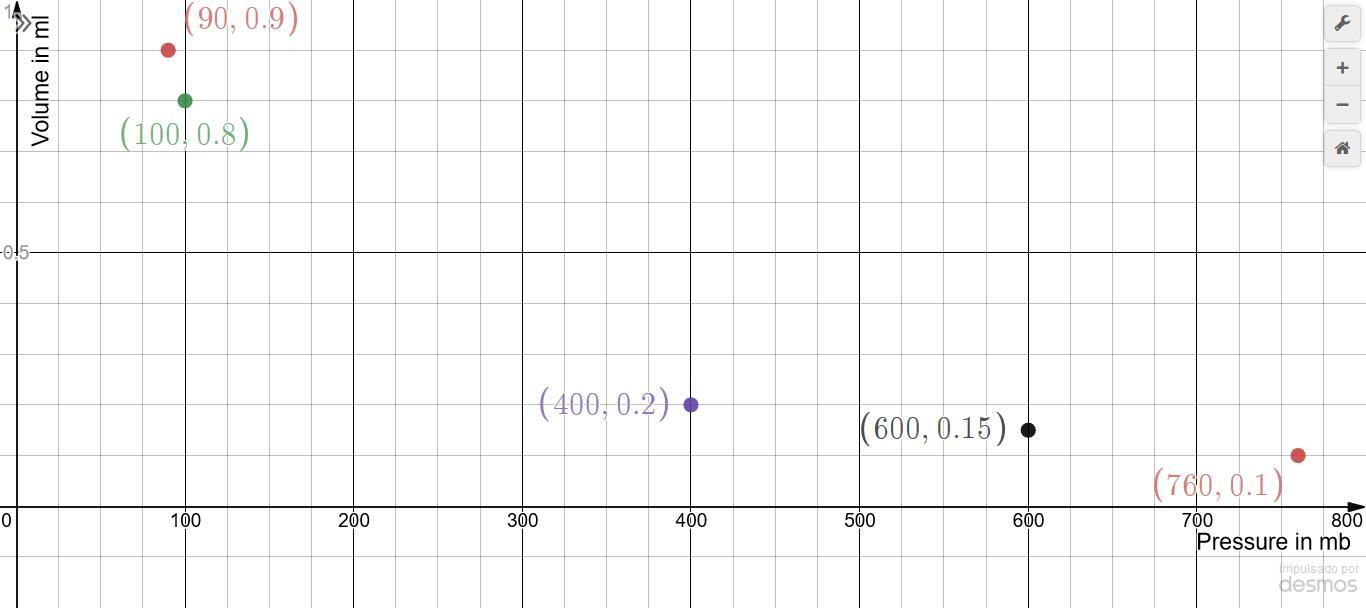
On the axes provided, label pressure on the horizontal axis from O mb to 760 mb and volume on the vertical axis from O to 1 mL.
Delicious77 [7]

Answer:

  • Please, find the graph with the labels and points located on the axes in the picture attached.

Explanation:

This is how you meet all the instructions and some important comments to understand how this kind of graphs word:

<u>1) Label pressure on the horizontal axis from O mb to 760 mb and volume on the vertical axis from O to 1 mL. </u>

The horizontal axis is used to record the independent variable and the vertical axis is used to record the dependent variable. The axes most be properly labeled with the name of the variable and the units.

In this case the origin is the point (0,0) which means that the axes cross each other, perpendicularly, at a pressure of 0 mb and a volume of 0.0 mililiters.

<u>2) Assign values to axes divisions in such a way that you occupy almost all the space on both axes. </u>

A good graph searches to occupy the whole space on both cases; to do that, find the maximum value for each variable, pressure and volume, and choose the values of the marks.

The range of the pressure (horizontal axis) is [90, 760 mb], so you should choose big divisions (marks) of 100 mb, and assign 800 mb to the right most mark on the horizontal axis. Then, you can divide each interval of 100 mb into 10 spaces, with small divisions of 10 mb (my graph uses 4 spcaes, with small divisions of 25 mb, but I recommend you use small divisions of 10 mb).

The range of the volume (vertical axis) is [0.1, 0.8], so you should choose only divisions with value of 0.1 ml.

<u>3) Now locate and label the points: </u>

  • (90, 0.9) ⇒ 90 mb, 0.9 ml
  • (100, 0.8) ⇒ 100 mb, 0.8 ml
  • (400, 0.2) ⇒ 400 mb, 0.2 ml
  • (600, 0.15) ⇒ 600 mb, 0.15 ml
  • (760, 0.1) ⇒ 760 mb, 0.1 ml

The points of the kind (x, y) are called ordered pairs, which means that the order matters, because it has a meaning: the first number represents the independent variable and the second number represents the dependent variable.

So, in the point (90, 0.9), 90 is a pressure of 90 mb and 0.9 is a volume of 0.9 ml.

To locate (600, 0.15), since the horizontal marks have value of 0.1, you must locate the second coordinate of your point between the marks 0.1 and 0.2 ml.

With that you can now locate each point on your graph.

5 0
2 years ago
Read 2 more answers
Other questions:
  • Rank the nonmetals in each set from most reactive (1) to least reactive (3). Neon: Selenium: Fluorine
    5·2 answers
  • After learning about climate change in her science class, Selena wants to make a few changes at home so she can affect climate c
    14·2 answers
  • The empirical formula for a compound is CH2. If n is a whole number, which shows a correct relationship between the molecular fo
    15·2 answers
  • Explain why c6h5ch2ch2br is not formed during the radical bromination of c6h5ch2ch3. select the single best answer.
    8·1 answer
  • An air mass of volume 6.5 x 10 to the fifth L starts at sea level, where the pressure is 775 mm HG. It rises up a mountain where
    12·1 answer
  • Consider isotopes ions protons and electrons. how many of these did dalton not discuss in his atomic theory?
    12·1 answer
  • A pan containing 30 grams of water was allowed to cool from a temperature of 90.0 °C. If the amount of heat released is 1,500 jo
    6·2 answers
  • True or false when an object is placed in water, the water level falls
    8·2 answers
  • he solutions in the arms of a U-tube are separated at the bottom of the tube by a selectively permeable membrane. The membrane i
    10·1 answer
  • In the same condition, what happens to the net force acting on the rope?
    7·1 answer
Add answer
Login
Not registered? Fast signup
Signup
Login Signup
Ask question!