answer.
Ask question
Login Signup
Ask question
All categories
  • English
  • Mathematics
  • Social Studies
  • Business
  • History
  • Health
  • Geography
  • Biology
  • Physics
  • Chemistry
  • Computers and Technology
  • Arts
  • World Languages
  • Spanish
  • French
  • German
  • Advanced Placement (AP)
  • SAT
  • Medicine
  • Law
  • Engineering
suter [353]
2 years ago
13

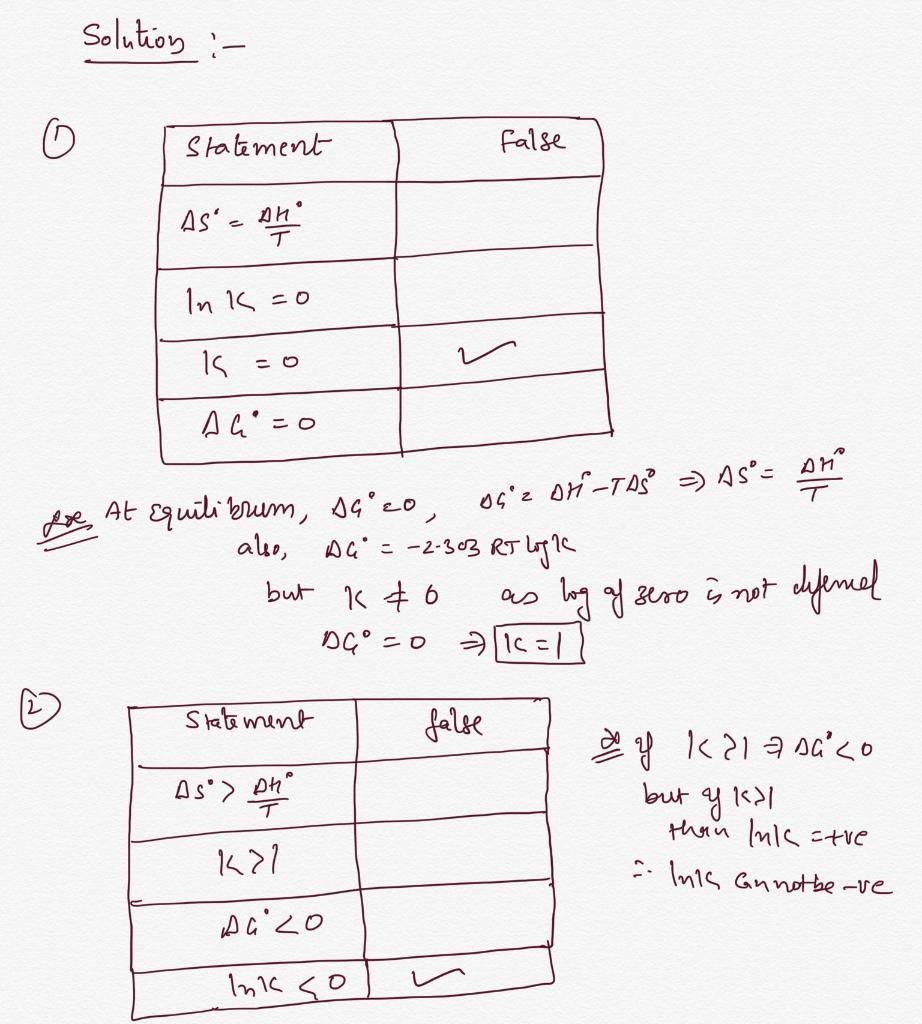
The statements in the tables below are about two different chemical equilibria. The symbols have their usual meaning, for exampl

e AG Gibbs free energy of reaction and stands for the equilibrium constant. stands for the standard In each table, there may be one statement that is false because it contradicts the other three statements. If you find a false statement, check the box next to It. Otherwise, check the "no false statements box under the table. statement false? statement false? Ink>0
AH° R<1
AG'>0
AG'>0
In > AH">TAS
no false statements

Chemistry
1 answer:
Talja [164]2 years ago
4 0

Answer:

see explaination

Explanation:

Please kindly check attachment for the step by step solution of the given problem

You might be interested in
Which statements describe lattice energy?
gtnhenbr [62]
Answer:

It is the energy the ions absorb when they form a crystalline compound.


Explanation:

Lattice energy is the energy released upon the formation of a crystal lattice structure.
5 0
2 years ago
A flexible plastic container contains 0.860g of helium has in a volume of 19.2L if 0.205g of helium is removed at contact pressu
mash [69]

<u>Given:</u>

Initial volume of He, V1 = 19.2 L

Initial mass of He, m1 = 0.0860 g

Mass of He removed = 0.205 g

<u>To determine:</u>

The new volume of He i.e V2

<u>Explanation:</u>

Based on Avogadro's law:

Volume of a gas is directly proportional to the # moles of the gas

Volume (V) α moles (n) -----(1)

Atomic mass of He = 4 g/mol

Initial moles of He, n1 = 0.860 g/4 g.mol-1 = 0.215 moles

Final moles of He, n2 = (0.860-0.205)g/4 g.mol-1 = 0.164 moles

Based on eq(1) we have:

V1/V2 = n1/n2

V2 = V1 n2/n1 = 19.2 L * 0.164 moles/0,215 moles = 14.6 L

Ans: New volume is 14.6 L


6 0
2 years ago
A 0.89% (w/v) sodium chloride solution is referred to as physiological saline solution because it has the same concentration of
maks197457 [2]
1) 0.89% m/v = 0.89 grams of NaCl / 100 ml of solution

=> 8.9 grams of NaCl in 1000 ml of solution = 8.9 grams of NaCl in 1 liter of solution

2) Molarity = M = number of moles of solute / liters of solution

=> calculate the number of moles of 8.9 grams of NaCl

3) molar mass of NaCl = 23.0 g /mol + 35.5 g/mol = 58.5 g / mol

4) number of moles of NaCl = mass / molar mass = 8.9 g / 58.5 g / mol = 0.152 mol

5) M = 0.152 mol NaCl / 1 liter solution = 0.152 M

Answer: 0.152 M
4 0
2 years ago
Dibutyl phthalate is a plasticizer added to make brittle polymers softer and more flexible. Dibutyl phthalate can be prepared by
umka21 [38]

Answer:

Explanation:

find the solution below

4 0
2 years ago
An oxygen atom has a mass of and a glass of water has a mass of . Use this information to answer the question below. Be sure you
MariettaO [177]

Answer:

Number of moles of oxygen atoms having equal mass as  glass of water = 3.12 moles

<em>Note: The given question is missing some figures. Here is a complete similar question below.</em>

<em>An oxygen atom has a mass of 2.66*10^-23 g and a glass of water has a mass of 0.050 kg. What is the mass of 1 mole of oxygen atoms? Round your answer to 3 significant digits. How many moles of oxygen atoms have a mass equal to the mass of a glass of water? Round your answer to 2 significant digits.</em>

Explanation:

A mole of a substance contains the Avogadro number of particles = 6.02 * 10²³

Therefore a mole of oxygen atoms contains 6.02*10²³ atoms.

mass of 1 atom of oxygen = 2.66*10⁻²³ g

Mass of 1 mole of oxygen atoms = mass of 1 atom * number of atoms in 1 mole

Mass of 1 mole of oxygen atoms = 2.66*10⁻²³ g * 6.02*10²³  = 16. 01 g

Mass of a glass of water = 0.050 Kg or 50 g

To determine the number of moles of oxygen atoms that have a mass equal to a glass of water i.e. 50 g, the formula below is used;

<em>number of moles = mass/molar mass</em>

mass of oxygen atoms= 50 g, molar mass or mass of one mole of oxygen atoms = 16.01 g

Therefore, number of moles of oxygen atoms = 50 g / 16.01 g = 3.12 moles

4 0
2 years ago
Other questions:
  • That's just the tip of the iceberg" is a popular expression you may have heard. It means that what you can see is only a small p
    5·2 answers
  • Consider the reaction cacn2 3 h2o → caco3 2 nh3 . how much nh3 is produced if 187 g of caco3 are produced?
    9·1 answer
  • What do you do with unused (excess) chemicals that are taken from reagent bottles?
    13·1 answer
  • The equilibrium constant for the gas-phase isomerization of borneol (c10h17oh) to isoborneol at 503 k is 0.106. a mixture consis
    12·1 answer
  • How much heat is required to increase the temperature of 100.0 grams of iron from 15.0oC to 40.2oC? (The specific heat of iron i
    10·2 answers
  • What is the mass of nickel(ii) nitrate (182.71 g/mol) dissolved in 25.0 ml of 0.100 m ni(no3)2 solution?
    13·2 answers
  • A 10 ft diameter by 15 ft height vertical tank is receiving water (p 62.1 lb/ cu ft) at the rate of 300 gpm and is discharging t
    7·1 answer
  • Calculate the internal energy and enthalpy changes resulting if air changes from an initial |state of 5°C and 10bar, where its m
    11·1 answer
  • 3 Ni2+(aq) + 2 Cr(OH)3(s) + 10 OH− (aq) → 3 Ni(s) + 2 CrO42−(aq) + 8 H2O(l) ΔG∘ = +87 kJ/molGiven the standard reduction potenti
    10·1 answer
  • Select the term that matches each definition:
    5·1 answer
Add answer
Login
Not registered? Fast signup
Signup
Login Signup
Ask question!