answer.
Ask question
Login Signup
Ask question
All categories
  • English
  • Mathematics
  • Social Studies
  • Business
  • History
  • Health
  • Geography
  • Biology
  • Physics
  • Chemistry
  • Computers and Technology
  • Arts
  • World Languages
  • Spanish
  • French
  • German
  • Advanced Placement (AP)
  • SAT
  • Medicine
  • Law
  • Engineering
kobusy [5.1K]
2 years ago
12

An air-standard dual cycle has a compression ratio of 9.1 and displacement of Vd = 2.2 L. At the beginning of compression, p1 =

95 kPa, and T1 = 290 K. The heat addition is 4.25 kJ, with one quarter added at constant volume and the rest added at constant pressure. Determine: a) each of the unknown temperatures at the various states, in K. b) the net work of the cycle, in kJ. c) the power developed at 3000 cycles per minute, in kW. d) the thermal efficiency. e) the mean effective pressure, in kPa.
Engineering
1 answer:
jok3333 [9.3K]2 years ago
3 0

Answer:

a) T₂ is 701.479 K

T₃ is 1226.05 K

T₄ is 2350.34 K

T₅ is 1260.56 K

b) The net work of the cycle in kJ is 2.28 kJ

c) The power developed is 114.2 kW

d) The thermal efficiency, \eta _{dual} is 53.78%

e) The mean effective pressure is 1038.25 kPa

Explanation:

a) Here we have;

\frac{T_{2}}{T_{1}}=\left (\frac{v_{1}}{v_{2}}  \right )^{\gamma -1} = \left (r  \right )^{\gamma -1} = \left (\frac{p_{2}}{p_{1}}  \right )^{\frac{\gamma -1}{\gamma }}

Where:

p₁ = Initial pressure = 95 kPa

p₂ = Final pressure =

T₁ = Initial temperature = 290 K

T₂ = Final temperature

v₁ = Initial volume

v₂ = Final volume

v_d = Displacement volume =

γ = Ratio of specific heats at constant pressure and constant volume cp/cv = 1.4 for air

r = Compression ratio = 9.1

Total heat added = 4.25 kJ

1/4 × Total heat added = c_v \times (T_3 - T_2)

3/4 × Total heat added = c_p \times (T_4 - T_3)

c_v = Specific heat at constant volume = 0.718×2.821× 10⁻³

c_p = Specific heat at constant pressure = 1.005×2.821× 10⁻³

v₁ - v₂ = 2.2 L

\left \frac{v_{1}}{v_{2}}  \right =r  \right = 9.1

v₁ = v₂·9.1

∴ 9.1·v₂ - v₂ = 2.2 L  = 2.2 × 10⁻³ m³

8.1·v₂ = 2.2 × 10⁻³ m³

v₂ = 2.2 × 10⁻³ m³ ÷ 8.1 = 2.72 × 10⁻⁴ m³

v₁ = v₂×9.1 = 2.72 × 10⁻⁴ m³ × 9.1 = 2.47 × 10⁻³ m³

Plugging in the values, we have;

{T_{2}}= T_{1} \times \left (r  \right )^{\gamma -1}  = 290 \times 9.1^{1.4 - 1} = 701.479 \, K

From;

\left (\frac{p_{2}}{p_{1}}  \right )^{\frac{\gamma -1}{\gamma }}= \left (r  \right )^{\gamma -1} we have;

p_{2} = p_{1}} \times \left (r  \right )^{\gamma } = 95 \times \left (9.1  \right )^{1.4} = 2091.13 \ kPa

1/4×4.25 =  0.718 \times 2.821 \times  10^{-3}\times (T_3 - 701.479)

∴ T₃ = 1226.05 K

Also;

3/4 × Total heat added = c_p \times (T_4 - T_3) gives;

3/4 × 4.25 = 1.005 \times 2.821 \times  10^{-3} \times (T_4 - 1226.05) gives;

T₄ = 2350.34 K

\frac{T_{4}}{T_{5}}=\left (\frac{v_{5}}{v_{4}}  \right )^{\gamma -1} = \left (\frac{r}{\rho }  \right )^{\gamma -1}

\rho = \frac{T_4}{T_3} = \frac{2350.34}{1226.04} = 1.92

T_{5} =  \frac{T_{4}}{\left (\frac{r}{\rho }  \right )^{\gamma -1}}= \frac{2350.34 }{\left (\frac{9.1}{1.92 }  \right )^{1.4-1}} =1260.56 \ K

b) Heat rejected =  c_v \times (T_5 - T_1)

Therefore \ heat \ rejected =  0.718 \times 2.821 \times  10^{-3}\times (1260.56 - 290) = 1.966 kJ

The net work done = Heat added - Heat rejected

∴ The net work done = 4.25 - 1.966 = 2.28 kJ

The net work of the cycle in kJ = 2.28 kJ

c) Power = Work done per each cycle × Number of cycles completed each second

Where we have 3000 cycles per minute, we have 3000/60 = 50 cycles per second

Hence, the power developed = 2.28 kJ/cycle × 50 cycle/second = 114.2 kW

d)

Thermal \ efficiency, \, \eta _{dual} =  \frac{Work \ done}{Heat \ supplied} = \frac{2.28}{4.25} \times 100 = 53.74 \%

The thermal efficiency, \eta _{dual} = 53.78%

e) The mean effective pressure, p_m, is found as follows;

p_m = \frac{W}{v_1 - v_2} =\frac{2.28}{2.2 \times 10^{-3}} = 1038.25 \ kPa

The mean effective pressure = 1038.25 kPa.

You might be interested in
The in situ moist unit weight of a soil is 17.3 kN/m3 and the moisture content is 16%. The specific gravity of soil solids is 2.
Temka [501]

Answer:

Explanation:

Given that,

Moist content w = 16%

The in situ moist unit weight of the soil : γ(in situ) = 17.3 kN/m³

Specific gravity of the soil

G(s) = 2.72

Minimum dry unit weight of the soil

γd(compacted) = 18.1 kN/m³

Moist content is same as above

w = 16%

Question

how many cubic meters of soil from the excavation site are needed to produce 2000 m³ of compacted fill?

Let determine the in situ dry unit weight γd(in-situ) using the relation

γd(in-situ) = γ(in-situ) / [1 + (w/100)]

γd(in-situ) = 17.3/ [1 + (18/100)]

γd(in-situ) = 17.3 / ( 1 + 0.18)

γd(in-situ) = 17.3 / 1.18

γd(in-situ) = 14.66 kN/m³

To determine the Volume of the soil to be excavated (Vex)

Let the Volume to be excavated = V

We can use the relation

V=V(fill) × γd(compacted) / γd(in situ)

Given that, V(fill) = 2000m³

V(fill) is the volume of the compacted fill

Therefore,

V=V(fill) × γd(compacted) / γd(in situ)

Vex = 2000 × 18.1 / 14.66

Vex = 2469.13 m³

So, the excavated volume of the soil is 2469.13 m³

3 0
2 years ago
The hot water needs of an office are met by heating tab water by a heat pump from 16 C to 50 C at an average rate of 0.2 kg/min.
Alex777 [14]

Answer:

option B

Explanation:

given,

heating tap water from 16° C to 50° C

at the average rate of 0.2 kg/min

the COP of this heat pump is 2.8

power output = ?

COP = \dfrac{Q_H}{W_{in}}\\W_{in} = \dfrac{Q_H}{COP}\\W_{in} = \dfrac{\dfrac{0.2}{60}\times 4.18\times (50-16)}{2.8}\\W_{in} = 0.169

the required power input is 0.169 kW or 0.17 kW

hence, the correct answer is option B

7 0
2 years ago
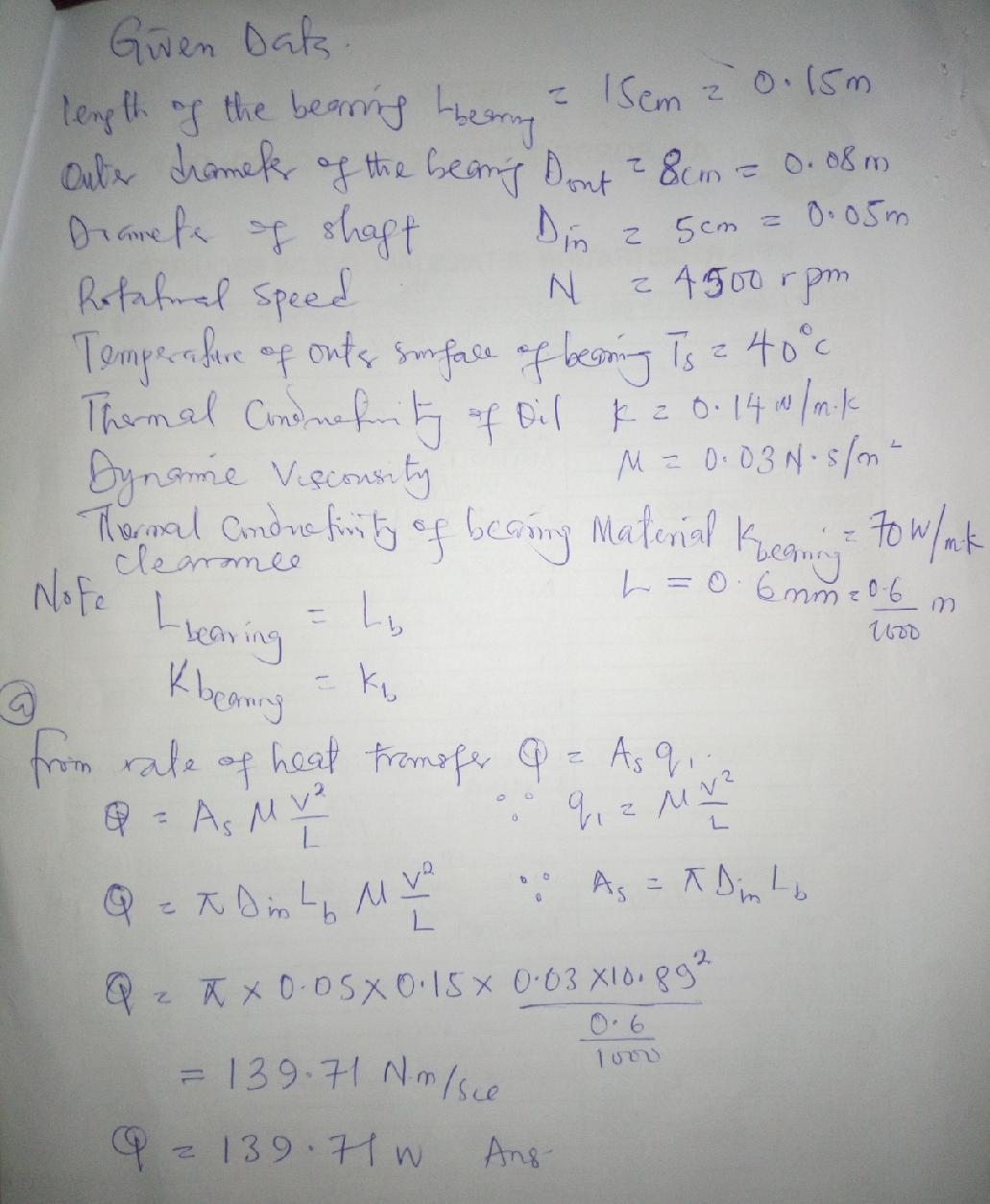
A 5-cm-diameter shaft rotates at 4500 rpm in a 15-cmlong, 8-cm-outer-diameter cast iron bearing (k = 70 W/m·K) with a uniform cl
-BARSIC- [3]

Answer:

(a) the rate of heat transfer to the coolant is Q = 139.71W

(b) the surface temperature of the shaft T = 40.97°C

(c) the mechanical power wasted by the viscous dissipation in oil 22.2kW

Explanation:

See explanation in the attached files

5 0
2 years ago
Evan notices a small fire in his workplace. Since the fire is small and the atmosphere is not smoky he decides to fight the fire
Norma-Jean [14]

Answer:

not calling the firemean

Explanation:

7 0
2 years ago
In a parallel one-dimensional flow in the positive x direction, the velocity varies linearly from zero at y = 0 to 32 m/s at y =
monitta

Answer:

Ψ = 10(y^2) + c

<em><u>y = 1.067m</u></em>

Explanation:

since the flow is one dimensional in positive X direction, the only velocity component is in X, which is denoted by u

while u is a function of y

we find the u in terms of y; u varies linearly wih y

we use similiraty to find the relation

32/1.6 =<em>u/y</em>

<em><u>u = 20y</u></em>

<em><u>Ψ = ∫20ydy</u></em>

<em><u>Ψ = 10(y^2) + c</u></em>

<em><u>(b)</u></em>

<em><u>the flow is half below y = 1.6*(2/3)=1.067 m</u></em>

<em><u>this is because at two third of the height of a triangle lies the centroid of triangle. since the velocity profile forms a right angled triangle , its height is 1.6 m . the flow is halved at y = 1.067m</u></em>

3 0
2 years ago
Other questions:
  • Which of the two materials (brittle vs. ductile) usually obtains the highest ultimate strength and why?
    5·1 answer
  • 3. (20 points) Suppose we wish to search a linked list of length n, where each element contains a key k along with a hash value
    7·1 answer
  • Consider a very long rectangular fin attached to a flat surface such that the temperature at the end of the fin is essentially t
    9·1 answer
  • 4.9 Given that I 4 amps when Vs 40 volts and Is 4 amps and I 1 amp when Vs 20 volts and Is 0, use superposition and linearity to
    5·1 answer
  • Sea water with a density of 1025 kg/m3 flows steadily through a pump at 0.21 m3 /s. The pump inlet is 0.25 m in diameter. At the
    8·1 answer
  • Why is it that dislocations play an important role in controlling the mechanical properties of metallic materials, however, they
    10·1 answer
  • The atomic radii of a divalent cation and a monovalent anion are 0.77 nm and 0.136 nm, respectively.1- Calculate the force of at
    11·1 answer
  • Solid spherical particles having a diameter of 0.090 mm and a density of 2002 kg/m3 are settling in a solution of water at 26.7C
    8·1 answer
  • When encountering low visibility from rain or fog, you should use your ____.
    12·1 answer
  • Mr. Ray deposited $200,000 in the Old and Third National Bank. If the bank pays 8% interest, how much will he have in the accoun
    10·2 answers
Add answer
Login
Not registered? Fast signup
Signup
Login Signup
Ask question!