answer.
Ask question
Login Signup
Ask question
All categories
  • English
  • Mathematics
  • Social Studies
  • Business
  • History
  • Health
  • Geography
  • Biology
  • Physics
  • Chemistry
  • Computers and Technology
  • Arts
  • World Languages
  • Spanish
  • French
  • German
  • Advanced Placement (AP)
  • SAT
  • Medicine
  • Law
  • Engineering
Darya [45]
2 years ago
4

Which best explains why infrared waves are ineffective for treating cancer?

Chemistry
2 answers:
aksik [14]2 years ago
7 0
C.

Infrared waves do not carry enough energy to kill cancerous cells.
LuckyWell [14K]2 years ago
5 0

Answer is: c) They do not transfer enough energy to destroy cancer cells.

Infrared waves (IR) is electromagnetic radiation with longer wavelengths than those of visible light.

IR wavelengths is from the nominal red edge of the visible spectrum at 700 nanometers (frequency 430 THz) to 1 millimeter (300 GHz).

For example, gamma rays contain much more energy (most penetrating) than infrared waves, because they have a greater frequencies.

Gamma rays are the electromagnetic waves with the shortest wavelengths (1 pm), highest frequencies (300 EHz) and highest energy (1,24 MeV).

You might be interested in
An atom of beryllium (m = 8.00 u) splits into two atoms of helium (m = 4.00 u) with the release of 92.2 kev of energy. if the or
galben [10]
The kinetic energy of the products is equal to the energy liberated which is 92.2 keV. But let's convert the unit keV to Joules. keV is kiloelectro volt. The conversion that we need is: 1.602×10⁻¹⁹ <span>joule = 1 eV

Kinetic energy = 92.2 keV*(1,000 eV/1 keV)*(</span>1.602×10⁻¹⁹ joule/1 eV) = 5.76×10²³ Joules

From kinetic energy, we can calculate the velocity of each He atom:
KE = 1/2*mv²
5.76×10²³ Joules = 1/2*(4)(v²)
v = 5.367×10¹¹ m/s
4 0
2 years ago
Read 2 more answers
in a candy factory, the nutty chocolate bars contain 22.0% by mass pecans. If 5.0 kg of pecans were used for candy last Tuesday,
zysi [14]
22.0 is the same as saying that in 100 grams of a chocolate bar, there are 22.0 grams of pecans. or to make it easier because of this problem- 100 Kilograms of a chocolate bar, there is 22.0 Kg of pecans. we can use this as a conversion factor (what is used to convert a value to another value. 

conversion factor---> 22.0 kg of pecan= 100 kg of chocolate bar
Note: remember this, what you are converting from goes in the denominator, what you converting to goes in the numerator. 

5.0 Kg of pecan (100 Kg of chocolate bar/ 22.0 Kg of pecan)= 23 Kg of chocolate bar


7 0
2 years ago
Now explain your diagnosis. Start your argument by writing something like this: "My group believes that Elisa has/does not have
likoan [24]

Answer:

Explanation:I would need more info to understand this question but explaining molecules is pretty easy tho

4 0
1 year ago
What is the reaction energy Q of this reaction? Use c2=931.5MeV/u. Express your answer in millions of electron volts to three si
emmasim [6.3K]

Answer:

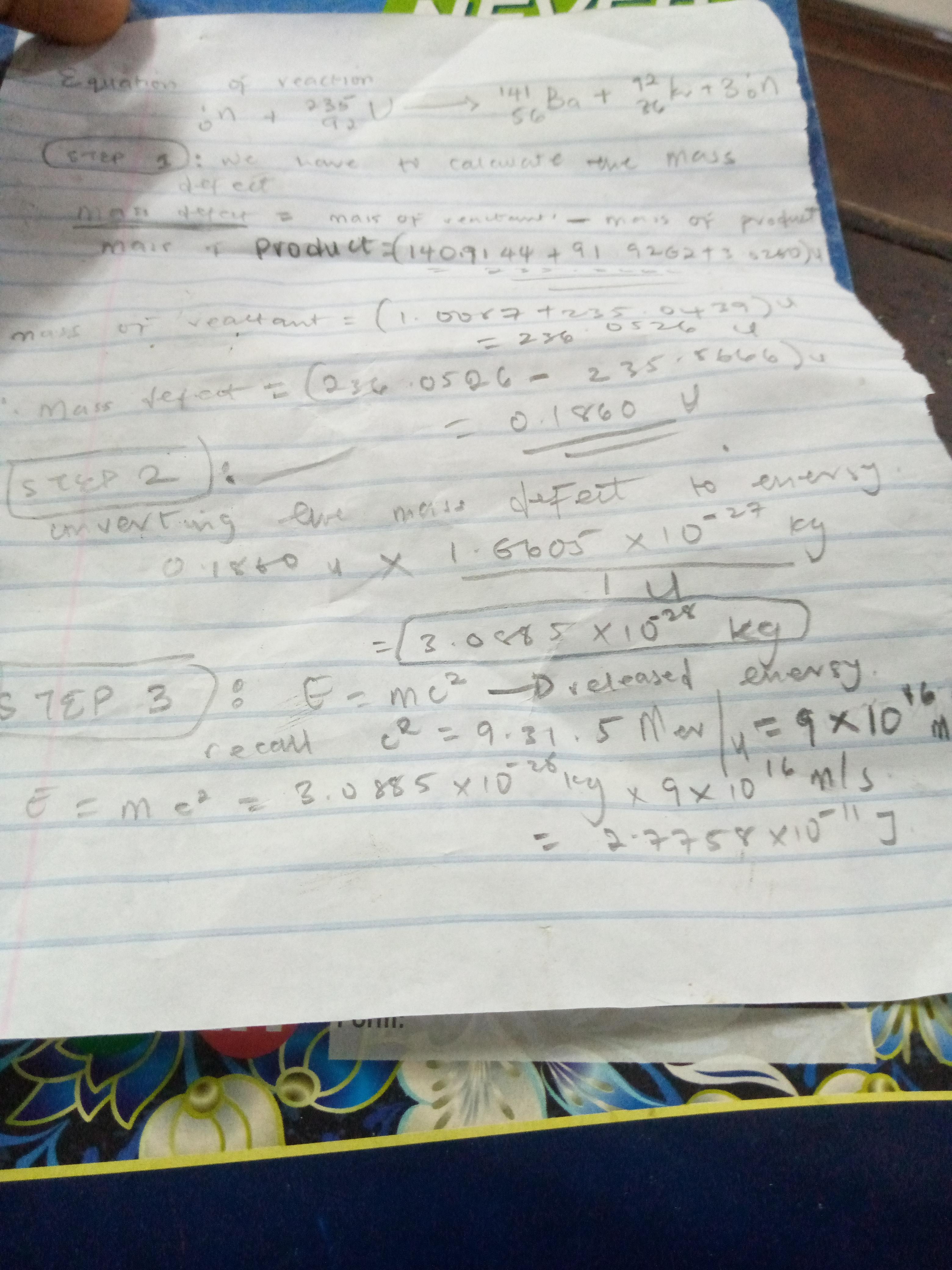
Energy= 2.7758 × 10^-11 J ;

71.112×10^-6 kJ.

Mass defect in Kilogram= 3.0885×10^-28 kg.

That is; 3.1×10^-28 kg(to two significant figure).

Explanation:

(Note: Check equation of reaction in the attached file/picture).

STEP ONE: we have to calculate the Mass defect.

Mass defect= Mass of reactants -- Mass of products.

Mass of the products: (140.9144+91.9262+3.060) u.

= 235.8666 u.

Mass of reactants: (1.0087+235.0439) u= 236.0526 u.

Therefore, the Mass defect= (236.0526 -- 235.8666) u

= 0.1860 u.

STEP TWO: Converting the Mass defect to energy;

0.18860 × 1.6605 × 10^27 kg

= 3.0885× 10^-28 kg

STEP THREE: Calculating energy released . Recall(from the question) c^2= 931.5 Mev/u. This is also equals to 9×10^16 m/s.

E=Mc^2.

Where E= energy released, c= speed of light, M= Mass.

Slotting in the values;

E= 3.0885×10^-28 kg × 9×10^16 m/s.

E=2.7758 × 10^-11 J.

Know that;( 1g of uranium × 1 mol of uranium ÷ 235.0439 g of uranium) × (6.002×10^23 atom of uranium/ 1 mol of uranium) × 2.7758× 10^-11.

=7.1112×10^-10 J

= 71.112×10^6 kJ.

3 0
2 years ago
This is the chemical formula for methyl acetate: CH32CO2. Calculate the mass percent of hydrogen in methyl acetate. Round your a
WITCHER [35]

<u>Answer:</u> The mass percent of hydrogen in methyl acetate is 8 %

<u>Explanation:</u>

The given chemical formula of methyl acetate is CH_3COOCH_3

To calculate the mass percentage of hydrogen in methyl acetate, we use the equation:

\text{Mass percent of hydrogen}=\frac{\text{Mass of hydrogen}}{\text{Mass of methyl acetate}}\times 100

Mass of hydrogen = (6 × 1) = 6 g

Mass of methyl acetate = [(3 × 12) + (6 × 1) + (2 × 16)] = 74 g

Putting values in above equation, we get:

\text{Mass percent of hydrogen}=\frac{6g}{74g}\times 100=8.10\%=8\%

Hence, the mass percent of hydrogen in methyl acetate is 8 %

8 0
2 years ago
Other questions:
  • if 5 moles of P4 reacted with 22 moles Cl2 according to the above reaction, determine:How many moles PCl3 are produced
    14·1 answer
  • recheck Fusion reactions power the in space. Humans currently use fusion in , but researchers are seeking more applications.
    14·1 answer
  • An allergy medicine is usually stored in a cabinet at the room temperature where it’s molecules move around each other. By mista
    12·1 answer
  • Complete the chemical formula for each ionic compound. Consult the periodic table to help you answer the question. beryllium nit
    9·2 answers
  • The solubility of acetanilide is 12.8 g in 100 mL of ethanol at 0 ∘C, and 46.4 g in 100 mL of ethanol at 60 ∘C. What is the maxi
    8·1 answer
  • A reaction produces a gas, which is collected in a glass cylinder. When a glowing splint is placed inside the container, it burn
    15·1 answer
  • Given the initial rate data for the reaction A + B –––&gt; C, determine the rate expression for the reaction.
    15·2 answers
  • To save time you can approximate the initial volume of water to ±1 mL and the initial mass of the solid to ±1 g. For example, if
    14·1 answer
  • Consider the following balanced redox reaction: 2CrO2-(aq) + 2H2O(l) + 6ClO-(aq) LaTeX: \longrightarrow⟶ 2CrO42-(aq) + 3Cl2(g) +
    14·1 answer
  • Write chemical equations and corresponding equilibrium expressions for each of the two ionization steps of carbonic acid. Part A
    11·1 answer
Add answer
Login
Not registered? Fast signup
Signup
Login Signup
Ask question!