answer.
Ask question
Login Signup
Ask question
All categories
  • English
  • Mathematics
  • Social Studies
  • Business
  • History
  • Health
  • Geography
  • Biology
  • Physics
  • Chemistry
  • Computers and Technology
  • Arts
  • World Languages
  • Spanish
  • French
  • German
  • Advanced Placement (AP)
  • SAT
  • Medicine
  • Law
  • Engineering
Yuri [45]
2 years ago
9

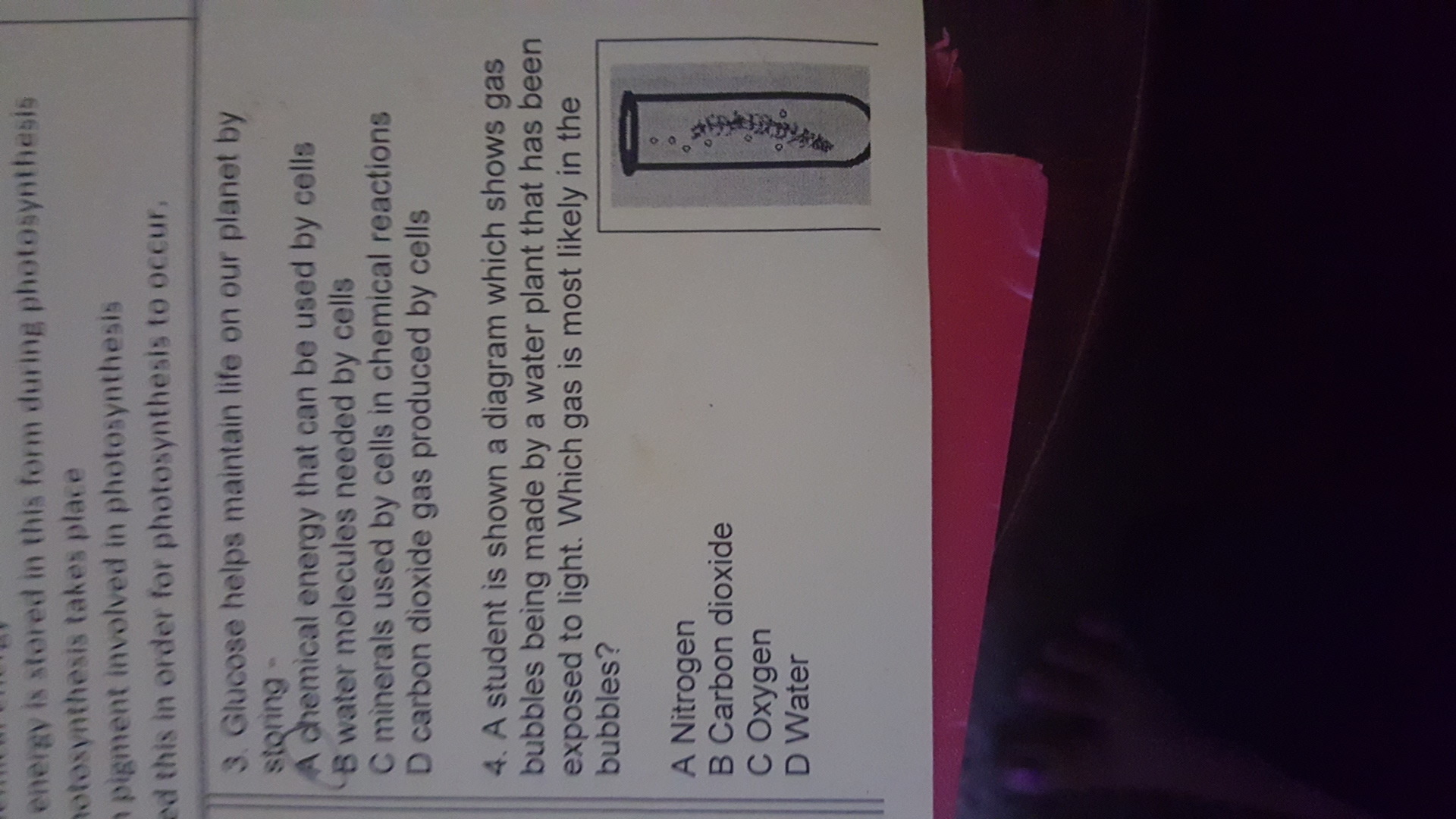
4. a student is shown a Diagram which shows gas bubbles being made by water plant that has been exposed to light. which gas is m

ost likely in the bubbles

Chemistry
1 answer:
lisov135 [29]2 years ago
5 0
Carbon dioxide is in the bubbles
You might be interested in
How many liters of 3.0 M NaOH solution will react with 2.4 mol H2SO4? (Remember to balance the equation.)
timurjin [86]

Answer:

1.6 L is the volume of NaOH that has reacted

Explanation:

The balanced reaction is:

H₂SO₄ + 2NaOH → Na₂SO₄  + 2H₂O

This is a neutralization reaction between a strong acid and a strong base. The products are the correspond salt and water.

We propose this rule of three:

1 mol of sulfuric acid needs 2 mol of NaOH to react to react

Then, 2.4 moles of H₂SO₄  will react with (2.4 . 2) / 1 = 4.8 moles of NaOH

As molarity is 3M, we can determine the volume of our solution

Molarity (M) = mol / volume(L) → Volume(L) = mol / Molarity

Volume(L) = 4.8 mol / 3 M = 1.6 L

3 0
2 years ago
An organelle that is not found in this illustration of a cell would be
zloy xaker [14]

Answer:

The answer is cell wall

Explanation:

Because it is

8 0
2 years ago
Read 2 more answers
If 455-ml of 6.0 M HNO3 is used to make 2.5 L dilution, what is the molarity of the dilution
Anna11 [10]
Hi there

Formula
M1V1=M2V2
(455*6)/2500
Answer
1.092 M
5 0
2 years ago
Using the following standard reduction potentials, Fe3+(aq) + e- → Fe2+(aq) E° = +0.77 V Ni2+(aq) + 2 e- → Ni(s) E° = -0.23 V ca
lina2011 [118]

<u>Answer:</u> The above reaction is non-spontaneous.

<u>Explanation:</u>

For the given chemical reaction:

Ni^{2+}(aq.)+2Fe^{2+}(aq.)\rightarrow 2Fe^{3+}(aq.)+Ni(s)

Here, nickel is getting reduced because it is gaining electrons and iron is getting oxidized because it is loosing electrons.

We know that:

E^o_{(Fe^{3+}/Fe^{2+})}=0.77V\\E^o_{(Ni^{2+}/Ni)}=-0.23V

Substance getting oxidized always act as anode and the one getting reduced always act as cathode.

To calculate the E^o_{cell} of the reaction, we use the equation:

E^o_{cell}=E^o_{cathode}-E^o_{anode}

E^o_{cell}=-0.23-0.77=-1.0V

Relationship between standard Gibbs free energy and standard electrode potential follows:

\Delta G^o=-nFE^o_{cell}

As, the standard electrode potential of the cell is coming out to be negative for the above cell. Thus, the standard Gibbs free energy change of the reaction will become positive making the reaction non-spontaneous.

Hence, the above reaction is non-spontaneous.

3 0
2 years ago
Calculate the wavelength of the photon emitted when an electron makes a transition from n=6 to n=3. You can make use of the foll
Angelina_Jolie [31]

<u>Answer:</u> The wavelength of light is 1.094\times 10^{-6}m

<u>Explanation:</u>

To calculate the wavelength of light, we use Rydberg's Equation:

\frac{1}{\lambda}=R_H\left(\frac{1}{n_f^2}-\frac{1}{n_i^2} \right )

Where,

\lambda = Wavelength of radiation

R_H = Rydberg's Constant  = 1.097\times 10^7m^{-1}

n_f = Final energy level = 3

n_i = Initial energy level = 6

Putting the values in above equation, we get:

\frac{1}{\lambda }=1.097\times 10^7m^{-1}\left(\frac{1}{3^2}-\frac{1}{6^2} \right )\\\\\lambda =\frac{1}{914617m^{-1}}=1.094\times 10^{-6}m

Hence, the wavelength of light is 1.094\times 10^{-6}m

6 0
2 years ago
Other questions:
  • How many grams of Cl are in 38.0 g of each sample of chlorofluorocarbons (CFCs)?
    15·1 answer
  • In which orbital does an electron in a bromine atom experience the greatest effective nuclear charge?
    9·2 answers
  • A fog forms over a lake. What two changes of state must occur to produce the fog? Do the water molecules absorb or release energ
    9·1 answer
  • Which of these is a trace fossil : shrimp burrow, seashell, dinosaur egg, shark tooth
    8·2 answers
  • Percentage of carbon in CCl^4
    7·2 answers
  • An atom of oxygen has an atomic number of 8 and a mass number of 18. How many of each type of subatomic particle does it contain
    12·2 answers
  • Select the correct answer from each drop-down menu.
    11·2 answers
  • The pressure and temperature inside a bike tire is 10 atm and 10k respectively. What will the pressure become in the tire when t
    7·1 answer
  • Crude oil is a mixture of many compounds that can be separated using which process​
    8·1 answer
  • Identify the true statements regarding alpha-1,6 linkages in glycogen.
    11·1 answer
Add answer
Login
Not registered? Fast signup
Signup
Login Signup
Ask question!