answer.
Ask question
Login Signup
Ask question
All categories
  • English
  • Mathematics
  • Social Studies
  • Business
  • History
  • Health
  • Geography
  • Biology
  • Physics
  • Chemistry
  • Computers and Technology
  • Arts
  • World Languages
  • Spanish
  • French
  • German
  • Advanced Placement (AP)
  • SAT
  • Medicine
  • Law
  • Engineering
Fiesta28 [93]
2 years ago
3

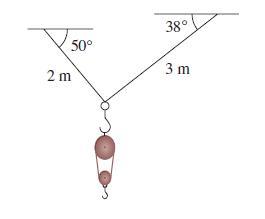
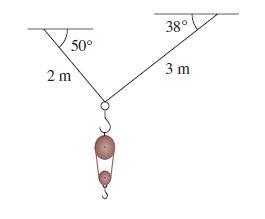
A block-and-tackle pulley hoist is suspended in a warehouse by ropes of lengths 2 m and 3 m. The hoist weighs 350 N. The ropes,

fastened at different heights, make angles of 50° and 38° with the horizontal. Find the tension in each rope and the magnitude of each tension.

Physics
1 answer:
Cerrena [4.2K]2 years ago
5 0

Answer:

276 N and 225 N

Explanation:

Draw a free body diagram.  There are three forces on the hoist:

Weight force 350 N pulling down,

Tension force T₁ pulling up and left 50° from the horizontal,

Tension force T₂ pulling up and right 38° from the horizontal.

Sum of forces in the x direction:

∑F = ma

T₂ cos 38° − T₁ cos 50° = 0

T₂ cos 38° = T₁ cos 50°

T₂ = T₁ cos 50° / cos 38°

Sum of forces in the y direction:

∑F = ma

T₂ sin 38° + T₁ sin 50° − 350 = 0

T₂ sin 38° + T₁ sin 50° = 350

Substitute:

(T₁ cos 50° / cos 38°) sin 38° + T₁ sin 50° = 350

T₁ cos 50° tan 38° + T₁ sin 50° = 350

T₁ (cos 50° tan 38° + sin 50°) = 350

T₁ = 350 / (cos 50° tan 38° + sin 50°)

T₁ = 276 N

T₂ = T₁ cos 50° / cos 38°

T₂ = 225 N
You might be interested in
A ball is thrown horizontally at a height of 2.2 meters at a velocity of 65m/s off a cliff. Assume no air resistance. How long u
slega [8]

The horizontal motion has no effect on the vertical drop.

From a drop, the distance the ball falls in 'T' seconds is

D = 4.9 T^2

so

2.2 = 4.9 T^2

T^2 = 2.2/4.9

T^2 = 0.449 sec^2

T = 0.67 second

8 0
2 years ago
A cyclist moving towards right with an acceleration of 4m/s² at t = 0 he has travelled 5 m moving towards the right at 15 m/s wh
ira [324]

Answer:

x=2t^2+15t+5

Explanation:

x=\frac{1}{2}at^2+v_0t+x_0

4 0
2 years ago
A mouse runs along a baseboard in your house. The mouse's position as a function of time is given by x(t)=pt2+qt, with p = 0.36
AlexFokin [52]

Answer:

0.60 m/s

Explanation:

The average velocity from t = a to t = b is:

v_avg = (x(b) − x(a)) / (b − a)

Given that x(t) = 0.36t² − 1.20t, and the time is from 1.0 to 4.0:

v_avg = (x(4.0) − x(1.0)) / (4.0 − 1.0)

v_avg = [(0.36(4.0)² − 1.20(4.0)) − (0.36(1.0)² − 1.20(1.0))] / 3.0

v_avg = [(5.76 − 4.8) − (0.36 − 1.20)] / 3.0

v_avg = [0.96 − (-0.84)] / 3.0

v_avg = 0.60

The average speed is 0.60 m/s.

5 0
2 years ago
A 150 g particle at x = 0 is moving at 8.00 m/s in the +x-direction. As it moves, it experiences a force given by Fx=(0.850N)sin
krok68 [10]

Answer:

9.98 m/s

Explanation:

The force acting on the particle is defined by the equation:

F=(0.850) sin (\frac{x}{2.00}) [N]

where x is the position in metres.

The acceleration can be found by using Newton's second law:

a=\frac{F}{m}

where

m = 150 g = 0.150 kg is the mass of the particle. Substituting into the equation,

a=\frac{0.850}{0.150}sin (\frac{x}{2.00})=5.67 sin(\frac{x}{2.00}) [m/s^2]

When x = 3.14 m, the acceleration is:

a=5.67 sin(\frac{3.14}{2.00})=5.67 m/s^2

Now we can find the final speed of the particle by using the suvat equation:

v^2-u^2=2ax

where

u = 8.00 m/s is the initial velocity

v is the final velocity

a=5.67 m/s^2

x = 3.14 m is the displacement

Solving for v,

v=\sqrt{u^2+2ax}=\sqrt{8.00^2+2(5.67)(3.14)}=9.98 m/s

And the speed is just the magnitude of the velocity, so 9.98 m/s.

4 0
2 years ago
A 7.5 nC point charge and a - 2.9 nC point charge are 3.2 cm apart. What is the electric field strength at the midpoint between
Oduvanchick [21]

Answer:

Net electric field, E_{net}=91406.24\ N/C

Explanation:

Given that,

Charge 1, q_1=7.5\ nC=7.5\times 10^{-9}\ C

Charge 2, q_2=-2.9\ nC=-2.9\times 10^{-9}\ C

distance, d = 3.2 cm = 0.032 m

Electric field due to charge 1 is given by :

E_1=\dfrac{kq_1}{r^2}

E_1=\dfrac{9\times 10^9\times 7.5\times 10^{-9}}{(0.032)^2}

E_1=65917.96\ N/C

Electric field due to charge 2 is given by :

E_2=\dfrac{kq_2}{r^2}

E_2=\dfrac{9\times 10^9\times 2.9\times 10^{-9}}{(0.032)^2}

E_2=25488.28\ N/C

The point charges have opposite charge. So, the net electric field is given by the sum of electric field due to both charges as :

E_{net}=E_1+E_2

E_{net}=65917.96+25488.28

E_{net}=91406.24\ N/C

So, the electric field strength at the midpoint between the two charges is 91406.24 N/C. Hence, this is the required solution.

3 0
2 years ago
Other questions:
  • You throw a beanbag in the air and catch it 2.2 s later at the same place at which you threw it. How high did it go? What was th
    9·1 answer
  • What is needed to give a large boulder a large acceleration?
    14·2 answers
  • Darryl throws a basketball at the gym floor.The ball bounces once on the floor comes to rest in his coach's hands.At which point
    12·2 answers
  • What voltage is delivered to a 120-volt/5,000-watt load that is fed with #10 awg wire (1.24 ohms/1,000 feet) and located 750 fee
    8·1 answer
  • A 55-kg box is being pushed a distance of 7.0 m across the floor by a force whose magnitude is 160 N. The force is parallel to t
    9·1 answer
  • In a cyclotron, the orbital radius of protons with energy 300 keV is 16.0 cm . You are redesigning the cyclotron to be used inst
    15·2 answers
  • A box sliding on a horizontal frictionless surface encounters a spring attached to a rigid wall and compresses the spring by a c
    9·1 answer
  • Two trucks with equal mass are attracted to each other with a gravitational force of 5.3 x 10 -4 N. The trucks are separated by
    12·1 answer
  • During a game the same batter swings at a ball thrown by the pitcher and hits a line drive. Just before the ball is hit it is tr
    7·1 answer
  • An electric motor consumes 10.8 kJ of electrical energy in 1.00 min . Part A If one-third of this energy goes into heat and othe
    8·1 answer
Add answer
Login
Not registered? Fast signup
Signup
Login Signup
Ask question!