answer.
Ask question
Login Signup
Ask question
All categories
  • English
  • Mathematics
  • Social Studies
  • Business
  • History
  • Health
  • Geography
  • Biology
  • Physics
  • Chemistry
  • Computers and Technology
  • Arts
  • World Languages
  • Spanish
  • French
  • German
  • Advanced Placement (AP)
  • SAT
  • Medicine
  • Law
  • Engineering
kvv77 [185]
2 years ago
11

An electron is traveling with initial kinetic energy K in a uniform electric field. The electron comes to rest momentarily after

traveling a distance d.
a. What is the magnitude of the electric field?
b. What is the direction of the electric field?

1. In the direction of the electron's motion.
2. Opposite to the direction of the electron's motion.
3. Perpendicular to the direction of the electron's motion

c. What If? Fluoride ions (which have the same charge as an electron) are initially moving with the same speed as the electrons from part (a) through a different uniform electric field. The ions come to a stop in the same distance d. Let the mass of an ion be M and the mass of an electron be m. Find the ratio of the magnitude of electric field the ions travel through to the magnitude of the electric field found in part (a). (Use the following as necessary: d, K, m, M, and e for the charge of the electron.)
Engineering
1 answer:
JulsSmile [24]2 years ago
8 0

Answer:

a. The magnitude of the electric field is E = -\dfrac{K}{e \cdot S}

b. 1. In the direction of the electron's motion

c. The ratio of the magnitude of the electric field the ions travel through to the magnitude of electric field for the electrons is M:m or 34634.6:1

Explanation:

The change in kinetic energy of electron = \dfrac{1}{2} \cdot m \cdot  v^2_f -  \dfrac{1}{2} \cdot m \cdot  v^2_i

Given that the work done, W = the change in kinetic energy of electron, we have;

W = \dfrac{1}{2} \cdot m \cdot  v^2_f -  \dfrac{1}{2} \cdot m \cdot  v^2_i

Given that the final velocity is 0, we have;

W =-  \dfrac{1}{2} \cdot m \cdot  v^2_i = -K

However, we have;

W = E·q·S

Where:

q = Particle charge = Electron charge = e

S = Particle displacement

E = Electric field strength

Therefore;

W = -K = E·q·S

Which gives;

E = -\dfrac{K}{e \cdot S}

b. The direction of the electric field is the direction of the force exerted by the electric field on a positive charge

Given that the particle is an electron, its direction is opposite to that of a positive charge, however whereby the electron is brought to rest the direction of the field is in the same direction of as that of the electron's motion

The correct option is therefore, 1. In the direction of the electron's motion

c. Given that the mass of fluoride ion, Fe⁻, M = 3.155×10⁻²⁶ kg

The mass of an electron, m = 9.1094×10⁻³¹ kg

We have;

x × 0.5 × m × v² = 0.5×M×v²

∴ x = M/m

Therefore. the kinetic energy of the fluoride ion is M/m multiplied by the kinetic energy of the electron

x × 0.5 × 9.1094×10⁻³¹ × v² = 0.5×3.155×10⁻²⁶×v²

Therefore, x = (3.155×10⁻²⁶)÷(9.1094×10⁻³¹) = 34634.6

Therefore, the kinetic energy of the Fluoride ion is 34634.6 times that of the kinetic energy of the electron

Whereby the electric field strength is directly proportional to the kinetic energy, we have;

E_{(electron)} = -\dfrac{K_{(electron)}}{e \cdot S}

E_{(fluoride \ ion)} = -\dfrac{K_{(fluoride \ ion)}}{e \cdot S}

Which gives;

\dfrac{E_{(fluoride \ ion)} }{E_{(electron)}} = \dfrac{-\dfrac{K_{(fluoride \ ion)}}{e \cdot S}}{ -\dfrac{K_{(electron)}}{e \cdot S}}  =  \dfrac{{K_{(fluoride \ ion)}}}{ {K_{(electron)}}}

\dfrac{E_{(fluoride \ ion)} }{E_{(electron)}}  =  \dfrac{\dfrac{M}{m} \times {K_{(electron)}}}{ {K_{(electron)}}} = \dfrac{M}{m}

\dfrac{E_{(fluoride \ ion)} }{E_{(electron)}}  =  \dfrac{34634.6  \times {K_{(electron)}}}{ {K_{(electron)}}} = 34634.6

The magnitude of the uniform electric field in the fluoride ion path is 34634.6 times that of the magnitude of the electric field in the electron path.

The ratio of the magnitude of the electric field the ions travel through to the magnitude of electric field for the electrons is M:m or 34634.6:1

You might be interested in
A thin-walled tube with a diameter of 6 mm and length of 20 m is used to carry exhaust gas from a smoke stack to the laboratory
Molodets [167]

Answer:

Explanation:

Mean temperature is given by

T_mean = \frac{T_i + T_ \infinity}{2}\\\\T_mean = \frac{200 + 15}{2}

Tmean = (Ti + T∞)/2

T_mean = 107.5^{0}

Tmean = 107.5⁰C

Tmean = 107.5 + 273 = 380.5K

Properties of air at mean temperature

v = 24.2689 × 10⁻⁶m²/s

α = 35.024 × 10⁻⁶m²/s

\mu = 221.6 × 10⁻⁷N.s/m²

\kappa = 0.0323 W/m.K

Cp = 1012 J/kg.K

Pr = v/α  = 24.2689 × 10⁻⁶/35.024 × 10⁻⁶

              = 0.693

Reynold's number, Re

Pv = 4m/πD²

where Re = (Pv * D)/\mu

Substituting for Pv

Re = 4m/(πD\mu)

     = (4 x 0.003)/( π × 6 ×10⁻³ × 221.6 × 10⁻⁷)

     = 28728.3

Since Re > 2000, the flow is turbulent

For turbulent flows, Use

Dittus - Doeltr correlation with n = 0.03

Nu = 0.023Re⁰⁸Pr⁰³ = (h₁D)/k

(h₁ × 0.006)/0.0323 = 0.023(28728.3)⁰⁸(0.693)⁰³

(h₁ × 0.006)/0.0323 = 75.962

h₁ = (75.962 × 0.0323)/0.006

h₁ = 408.93 W/m².K

4 0
2 years ago
A commercial refrigerator with refrigerant-134a as the working fluid is used to keep the refrigerated space at -30C by rejecting
chubhunter [2.5K]

Answer:

a) x = 0.4795

b) QL = 5.85 KW

c) COP = 2.33

d) QL_max = 12.72 KW

Explanation:

Solution:-

- Assuming the steady state flow conditions for both fluids R-134a and water.

- The thermodynamic properties remain constant for respective independent intensive properties.

- We will first evaluate the state properties of the R-134a and water.

- Compressor Inlet, ( Saturated Vapor ) - Ideal R-134a vapor cycle

              P1 = 60 KPa, Tsat = -36.5°C  

              T1 = -34°C , h1 = hg = 230.03 KJ/kg

              Qin = 450 W - surrounding heat  

- Condenser Inlet, ( Super-heated R-134a vapor ):

              P2 = 1.2 MPa , Tsat = 46.32°C  

              T2 = 65°C   , h2 = 295.16 KJ/kg

- Condenser Outlet, ( Saturation R-134a point ):

             P3 = P2 = 1.2 MPa , Tsat = 46.32°C

             T3 = 42°C   , h3 = hf = 111.23 KJ/kg

- R-134a is throttled to the pressure of P4 = compressor pressure = P1 = 60 KPa by an "isenthalpic - constant enthalpy pressure reduction" expansion valve.

- Inlet of Evaporator - ( liquid-vapor state )

             P4 = P1 = 60 KPa, hf = 3.9 KJ/kg , hfg = 223.9 KJ/kg

             h4 = h3 = 111.23 KJ/kg

- The quality ( x ) of the liquid-vapor R-134a at evaporator inlet can be determined:

             x4 = ( h4 - hf ) / hfg

             x4 = ( 111.23 - 3.9 ) / 223.9

             x4 = 0.4795      Answer ( a )        

- Water stream at a flow rate flow ( mw ) = 0.25 kg/s is used to take away heat from the R-134a.

- Condenser Inlet, ( Saturated liquid water ):

             Ti = 18°C , h = hf = 75.47 KJ/kg  

- Condenser Outlet, ( Saturated liquid water ):

             To = 26°C , h = hf = 108.94 KJ/kg

- Since the heat of R-134a was exchanged with water in the condenser. The amount of heat added to water (Qh) is equal to amount of heat lost from refrigerant R-134a.

- Apply thermodynamic balance on the R-134a refrigerant in the condenser:

             Qh = flow (mr) * [ h2 - h3 ]

Where,

flow ( mr ) : The flow rate of R-134a gas in the refrigeration cycle

             flow ( mr ) = Qh / [ h2 - h3 ]

             flow ( mr ) = 8.3675 / [ 295.16 - 111.23 ]

             flow ( mr ) = 0.0455 kg/s

- The cooling load of the refrigeration cycle ( QL ) is determined from energy balance of the cycle net work input ( Compressor work input ) - "Win" and the amount of heat lost from R-134a in condenser ( Qh ).

- Apply the thermodynamic balance for the compressor:


            Win = flow ( mr )*[ h2 - h1 ] - Qin

            Win = 0.0455*[ 295.16 - 230.03] KW - 0.45 KW

            Win = 2.513 KW

- The cooling load ( QL ) for the refrigeration cycle can now be calculated. Apply thermodynamic balance for the refrigeration cycle:

            QL = Qh - Win

            QL = 8.3675 - 2.513

            QL= 5.85 KW  .... Refrigeration Load, Answer ( b )

- The COP of the refrigeration cycle is calculated as the ratio of useful work and total work input required:


             COP = QL / Win

             COP = 5.85 / 2.513

             COP =  2.33      Answer ( c )            

- For a compressor to be working at 100% efficiency or ideal then the maximum COP for the refrigeration cycle would be:


             COP_max = [ TL ] / [ Th - TL ]

Where,

            TL : The absolute temperature of heat sink, refrigerated space

            TH : The absolute temperature of heat source, water inlet


            COP_max = [ -30+273 ] / [ (18+273) - (-30+273) ]          

            COP_max = 5.063

- The theoretical ideal refrigeration load ( QL max ) would be:


           COP_max = QL_max / Win

           QL_max = Win*COP_max

           QL_max = 2.513*5.063

           QL_max = 12.72 KW     Answer ( d )

5 0
2 years ago
The in situ moist unit weight of a soil is 17.3 kN/m3 and the moisture content is 16%. The specific gravity of soil solids is 2.
Temka [501]

Answer:

Explanation:

Given that,

Moist content w = 16%

The in situ moist unit weight of the soil : γ(in situ) = 17.3 kN/m³

Specific gravity of the soil

G(s) = 2.72

Minimum dry unit weight of the soil

γd(compacted) = 18.1 kN/m³

Moist content is same as above

w = 16%

Question

how many cubic meters of soil from the excavation site are needed to produce 2000 m³ of compacted fill?

Let determine the in situ dry unit weight γd(in-situ) using the relation

γd(in-situ) = γ(in-situ) / [1 + (w/100)]

γd(in-situ) = 17.3/ [1 + (18/100)]

γd(in-situ) = 17.3 / ( 1 + 0.18)

γd(in-situ) = 17.3 / 1.18

γd(in-situ) = 14.66 kN/m³

To determine the Volume of the soil to be excavated (Vex)

Let the Volume to be excavated = V

We can use the relation

V=V(fill) × γd(compacted) / γd(in situ)

Given that, V(fill) = 2000m³

V(fill) is the volume of the compacted fill

Therefore,

V=V(fill) × γd(compacted) / γd(in situ)

Vex = 2000 × 18.1 / 14.66

Vex = 2469.13 m³

So, the excavated volume of the soil is 2469.13 m³

3 0
2 years ago
A joining process in which a filler metal is melted and distributed by capillary action between faying surfaces, the base metals
PolarNik [594]

Answer:

A soldering process

Explanation:

Given that ,The filler metal's melting point temperature is less than 450 ° C.

Usually, the brazing material has the liquid temperature of the melting point, the full melting point of the filler material approaching 450 degrees centigrade, while the filler material is less than 450 degrees centigrade in the case of soldering.

Therefore the answer is "A soldering process".

4 0
2 years ago
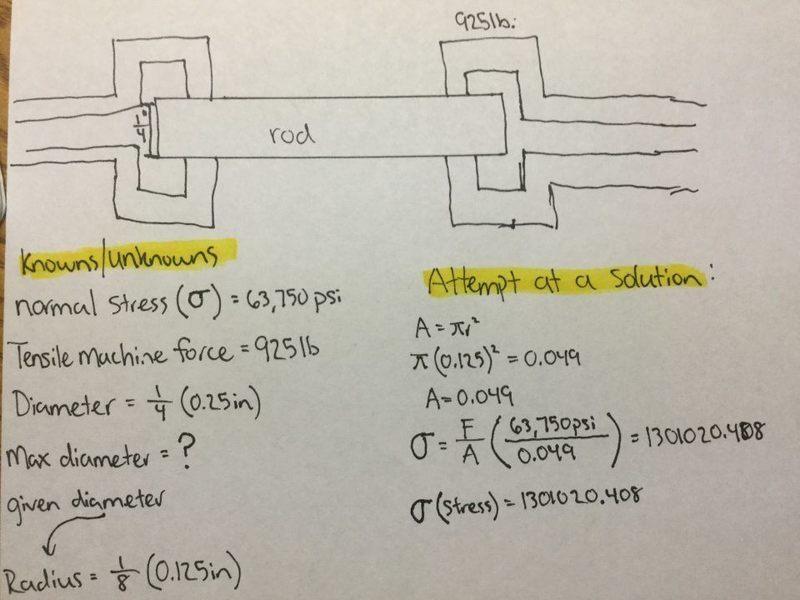
2. A ¼ in. diameter rod must be machined on a lathe to a smaller diameter for use as a specimen in a tension test. The rod mater
gladu [14]

Answer:

we use

sigma=force /area\\A=\pi r^2\\D=2*r

5 0
2 years ago
Other questions:
  • a. Replacing standard incandescent lightbulbs with energy-efficient compact fluorescent lightbulbs can save a lot of energy. Cal
    9·1 answer
  • Determine the amount of gamma and alpha phases in a 10-kg, 1060 steel casting as it is being cooled to the following temperature
    6·1 answer
  • 3. (20 points) Suppose we wish to search a linked list of length n, where each element contains a key k along with a hash value
    7·1 answer
  • A driver traveling at 65 mi/h rounds a curve on a level grade to see a truck overturned across the roadway at a distance of 350
    13·1 answer
  • 4.9 Given that I 4 amps when Vs 40 volts and Is 4 amps and I 1 amp when Vs 20 volts and Is 0, use superposition and linearity to
    5·1 answer
  • "It is necessary to select a metal alloy for an application that requires a yield strength of at least 345 MPa (50,000 psi) whil
    10·1 answer
  • Reconsider Couette flow between two parallel plates as derived in class, but with the top plate moving with a known velocity +i
    13·1 answer
  • Consider the time domain waveforms below on the left. Match waveforms (a) - (e) to their respective frequency spectrum represent
    11·1 answer
  • What are some goals of NYFEA? Select three options.
    9·2 answers
  • The BARO sensor informs the PCM about changes in weather and ____________________.
    14·1 answer
Add answer
Login
Not registered? Fast signup
Signup
Login Signup
Ask question!