answer.
Ask question
Login Signup
Ask question
All categories
  • English
  • Mathematics
  • Social Studies
  • Business
  • History
  • Health
  • Geography
  • Biology
  • Physics
  • Chemistry
  • Computers and Technology
  • Arts
  • World Languages
  • Spanish
  • French
  • German
  • Advanced Placement (AP)
  • SAT
  • Medicine
  • Law
  • Engineering
saw5 [17]
2 years ago
6

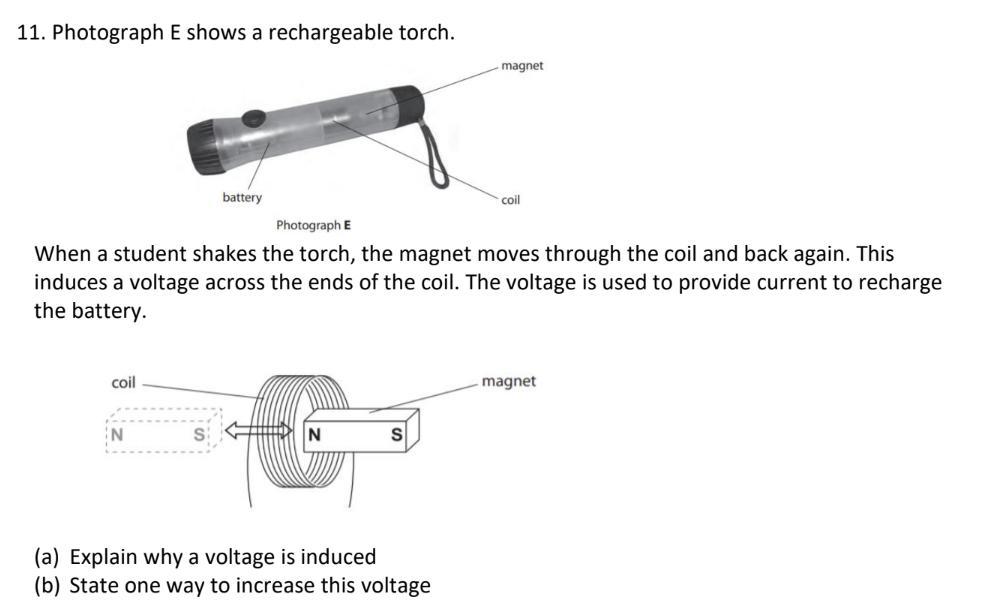
Photograph E shows a rechargeable torch. When a student shakes the torch, the magnet moves through the coil and back again. This

induces a voltage across the ends of the coil. The voltage is used to provide current to recharge the battery. (a) Explain why a voltage is induced (b) State one way to increase this voltage

Physics
2 answers:
Valentin [98]2 years ago
7 0
Sorry no idea what the answer is
Brums [2.3K]2 years ago
6 0

Answer:

a) according to Faraday's law , b) creating a faster movement, placing more turns on coil

Explanation:

a) The voltage is induced in the coil by the relative movement between it and the magnet, therefore according to Faraday's law

           E = - d (B A) / dt

In this case, the magnet is involved, so the value of the magnetic field varies with time, since the number of lines that pass through the loop changes with movement.

This voltage creates a current that charges the battery

b) There are several ways to increase the voltage

* creating a faster movement, can be done by the user

* placing more turns on the coil, must be done by the manufacturer

You might be interested in
The electric field at a point 2.8 cm from a small object points toward the object with a strength of 180,000 N/C. What is the ob
givi [52]

Answer:

Charge, Q=1.56\times 10^{-8}\ C

Explanation:

It is given that,

Electric field strength, E = 180000 N/C

Distance from a small object, r = 2.8 cm = 0.028 m

Electric field at a point is given by :

E=\dfrac{kQ}{r^2}

Q is the charge on an object

Q=\dfrac{Er^2}{k}

Q=\dfrac{180000\ N/C\times (0.028\ m)^2}{9\times 10^9\ Nm^2/C^2}

Q=1.56\times 10^{-8}\ C

So, the charge on the object is 1.56\times 10^{-8}\ C. Hence, this is the required solution.

7 0
2 years ago
Voices of swimmers at a pool travel 400 m/s through the air and 1,600 m/s underwater. The wavelength changes from 2 m in the air
Nata [24]

The frequency of a sound is whatever frequency leaves the source. It doesn't change.

Voiced of swimmers at the pool don't change frequency in or out of the water. Only their speed and wavelength change.

5 0
2 years ago
Read 2 more answers
In an attempt to impress its friends, an acrobatic beetle runs and jumps off the bottom step of a flight of stairs. The step is
Aleks04 [339]

Answer:

0.3677181864 m

Explanation:

u = Velocity = 1.5 m/s

\theta = Angle = 20°

y = -20 cm

Velocity components

u_x=ucos\theta\\\Rightarrow u_x=1.5cos20\\\Rightarrow u_x=1.40953\ m/s

u_y=usin\theta\\\Rightarrow u_y=1.5sin20\\\Rightarrow u_y=0.51303\ m/s

Acceleration components

a_x=0

a_y=-9.81\ m/s^2

y=u_yt+\dfrac{1}{2}a_yt^2\\\Rightarrow -0.2=0.51303\times t+\dfrac{1}{2}\times -9.81t^2\\\Rightarrow 4.905t^2-0.51303t-0.2=0

t=\frac{-\left(-0.51303\right)+\sqrt{\left(-0.51303\right)^2-4\cdot \:4.905\left(-0.2\right)}}{2\cdot \:4.905}, \frac{-\left(-0.51303\right)-\sqrt{\left(-0.51303\right)^2-4\cdot \:4.905\left(-0.2\right)}}{2\cdot \:4.905}\\\Rightarrow t=0.26088, -0.15629

Time taken is 0.26088 seconds

x=u_xt+\dfrac{1}{2}a_xt^2\\\Rightarrow x=1.40953\times 0.26088\\\Rightarrow x=0.3677181864\ m

The distance the beetle travels on the ground is 0.3677181864 m

6 0
2 years ago
What is the tangential velocity at the edge of a disk of radius 10cm when it spins with a frequency of 10Hz? Give your answer wi
Nina [5.8K]

Answer:

630cm/s

Explanation:

In simple harmonic motion, the tangential velocity is expressed mathematically as v = ὦr

ὦ is the angular velocity = 2πf

r is the radius of the disk

f is the frequency

Given the radius of disk = 10cm

frequency = 10Hz

v = 2πfr

v = 2π×10×10

v = 200π

v = 628.32 cm/s

The tangential velocity = 630cm/s ( to 2 significant figures)

8 0
2 years ago
A battleship launches a shell horizontally at 100 m/s from the ship’s deck that’s 50 m above the water. The shell is intended to
Annette [7]

Answer:

The shell will land 10.18m away from the buoy.

Explanation:

In order to solve this problem, we must first do a sketch of what the problem looks like (see attached picture).

Now, there are two cases, one with the tailwind and another with the tailwind. In both cases the shell would have the same vertical initial velocity and acceleration, therefore the shell would hit the water in the same amount of time. So we need to first find the time it takes the shell to hit the water.

In order to do so we can use the following equation:

y_{f}=y_{0}+V_{0}t+\frac{1}{2}at^{2}

now, we know that the final height and the initial velocity are to be zero, so we can simplify the equation like this:

0=y_{0}+\frac{1}{2}at^{2}

and solve for t:

t=\sqrt{\frac{-2y_0}{a}}

now we can substitute the values:

t=\sqrt{\frac{-2(50m)}{-9.81m/t^2}}

t=3.19s

Since it takes 3.19s for the shell to hit the water, that's the amount of time it spends flying horizontally.

So we can consider the shell to move at a constant speed if there was no tailwind, so we can find the  distance from the ship to point A to be:

x_{A}=V_{x}t

x_{A}=(100m/s)(3.19)

x_{A}=319m

We can now find the distance between the ship to point B, which is the point the ball falls due to the tailwind. Since the movement will be accelerated in this scenario, we can find the distance by using the following formula:

x_{f}=V_{x0}t+\frac{1}{2}a_{x}t^{2}

So we can substitute the given values:

x_{f}=(100m/s)(3.19s)+\frac{1}{2}(2m/s^{2})(3.19s)^{2}

Which yields:

x_{f}=329.18m

so now we can use the A and B points to find by how far the shell missed the buoy:

Distance=329.18m-319m=10.18m

So the shell missed the buoy by 10.18m.
8 0
2 years ago
Other questions:
  • A worker pushes a 1.50 x 10^3 N crate with a horizontal force of 345 N a distance of 24.0 m. Assume the coefficient of kinetic f
    9·2 answers
  • Consider a box sitting in the back of a pickup. The pickup accelerates to the right, and because the bed of the pickup is sticky
    8·2 answers
  • An 8.0-kg history textbook is placed on a 1.25-m high desk. How large is the gravitational potential energy of the textbook-Eart
    11·2 answers
  • What makes the subject of star formation so difficult and complex? Star formation is too expensive to study in detail. Stars liv
    12·1 answer
  • A hot air balloon must be designed to support a basket, cords, and one person for a total payload weight of 1300 N plus the addi
    9·1 answer
  • Technician A says that some ABS wheel speed sensors are used as part of the tire pressure monitoring system (TPMS) . Technician
    13·2 answers
  • A light bulb in a battery powered desk lamp has a current of 0.042 A and is connected to a 9.2 V battery. What is the resistance
    9·2 answers
  • Henrietta is going off to her physics class, jogging down the sidewalk at a speed of 4.15 m/s . Her husband Bruce suddenly reali
    6·1 answer
  • Suppose we have a radar dish that generates a strong signal that travels out to hit an asteroid 10^9 kilometres away.
    14·1 answer
  • . A little car has a maximum acceleration of 2.57 m/s2. What is the new maximum acceleration of the little car if it tows anothe
    12·1 answer
Add answer
Login
Not registered? Fast signup
Signup
Login Signup
Ask question!
