answer.
Ask question
Login Signup
Ask question
All categories
  • English
  • Mathematics
  • Social Studies
  • Business
  • History
  • Health
  • Geography
  • Biology
  • Physics
  • Chemistry
  • Computers and Technology
  • Arts
  • World Languages
  • Spanish
  • French
  • German
  • Advanced Placement (AP)
  • SAT
  • Medicine
  • Law
  • Engineering
Anastaziya [24]
2 years ago
15

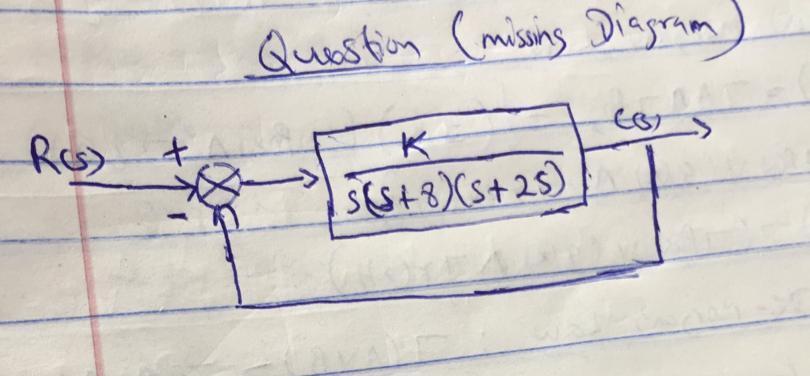
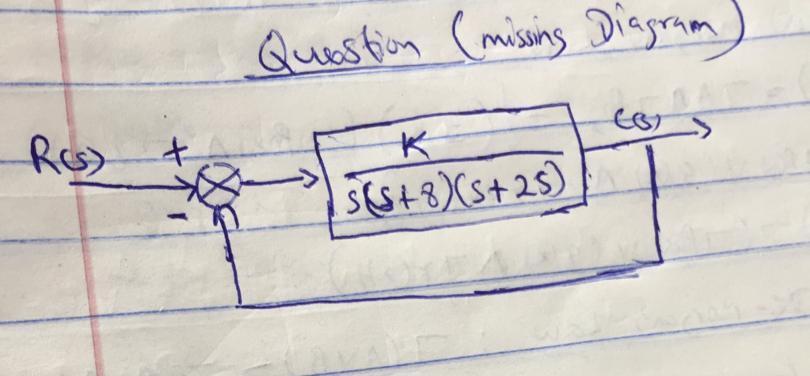
Design a PD compensator for the following system to reduce the settling time by a factor of 4 while continuing to operate the sy

stem with a 20.5% overshoot. State your final compensator and gain. What can you say about a 2nd order approximation. Simulate the uncompensated and compensated step response:

Engineering
1 answer:
Helen [10]2 years ago
5 0

Answer:

Hello your question lacks the required diagram attached below is the missing diagram

final compensator = k ( s + 9.3731 )

gain = 695.4275

Explanation:

attached below is the remaining part of the detailed solution of the question

C(s) = \frac{k}{s(s+8)(s+25) }   The dominant poles fn 20.5% are at Sd = -2.91 + 5.77 J

uncompensated system setting time (ts) = 4/2.91 = 1.3746

You might be interested in
A three-phase line has an impedance of 0.4 j2.7 ohms per phase. The line feeds two balanced three-phase loads that are connected
Viktor [21]

Answer:

a. The magnitude of the line source voltage is

Vs = 4160 V

b. Total real and reactive power loss in the line is

Ploss = 12 kW

Qloss = j81 kvar

Sloss = 12 + j81 kVA

c. Real power and reactive power supplied at the sending end of the line

Ss = 540.046 + j476.95 kVA

Ps = 540.046 kW

Qs = j476.95 kvar

Explanation:

a. The magnitude of the line voltage at the source end of the line.

The voltage at the source end of the line is given by

Vs = Vload + (Total current×Zline)

Complex power of first load:

S₁ = 560.1 < cos⁻¹(0.707)

S₁ = 560.1 < 45° kVA

Complex power of second load:

S₂ = P₂×1 (unity power factor)

S₂ = 132×1

S₂ = 132 kVA

S₂ = 132 < cos⁻¹(1)

S₂ = 132 < 0° kVA

Total Complex power of load is

S = S₁ + S₂

S = 560.1 < 45° + 132 < 0°

S = 660 < 36.87° kVA

Total current is

I = S*/(3×Vload)   ( * represents conjugate)

The phase voltage of load is

Vload = 3810.5/√3

Vload = 2200 V

I = 660 < -36.87°/(3×2200)

I = 100 < -36.87° A

The phase source voltage is

Vs = Vload + (Total current×Zline)

Vs = 2200 + (100 < -36.87°)×(0.4 + j2.7)

Vs = 2401.7 < 4.58° V

The magnitude of the line source voltage is

Vs = 2401.7×√3

Vs = 4160 V

b. Total real and reactive power loss in the line.

The 3-phase real power loss is given by

Ploss = 3×R×I²

Where R is the resistance of the line.

Ploss = 3×0.4×100²

Ploss = 12000 W

Ploss = 12 kW

The 3-phase reactive power loss is given by

Qloss = 3×X×I²

Where X is the reactance of the line.

Qloss = 3×j2.7×100²

Qloss = j81000 var

Qloss = j81 kvar

Sloss = Ploss + Qloss

Sloss = 12 + j81 kVA

c. Real power and reactive power supplied at the sending end of the line

The complex power at sending end of the line is

Ss = 3×Vs×I*

Ss = 3×(2401.7 < 4.58)×(100 < 36.87°)

Ss = 540.046 + j476.95 kVA

So the sending end real power is

Ps = 540.046 kW

So the sending end reactive power is

Qs = j476.95 kvar

7 0
2 years ago
A six- lane freeway ( three lanes in each direction) in a scenic area has a measured free- flow speed of 55 mi/ h. The peak- hou
Novosadov [1.4K]

Answer:

0.867

Explanation:

The driver population factor (f_{p})can be estimated using the equation below:

f_{p} = \frac{V}{PHF*N*f_{HV}*v_{p}}

The value of the heavy vehicle factor (f_{HV}) is determined below:

The values of the E_{T} = 2 and E_{R} = 3 are gotten from the tables for the RVs, trucks and buses upgrades for passenger-car equivalents. Therefore:

f_{HV} = 1/[1+0.08(2-1)+0.06(3-1)] = 1/[1+0.08+0.12] = 1/1.2 = 0.833

Furthermore, the vp is taken as 2250 pc/(h*In) from the table of LOS criteria for lane freeway using the 15 minutes flow rate. Therefore:

f_{p} = 3900/[0.8*3*0.833*2250] = 3900/4498.2 = 0.867

6 0
2 years ago
A horizontal, cylindrical, tank, with hemispherical ends, is used to store liquid chlorine at 10 bar. The vessel is 4 m internal
sp2606 [1]

Answer: 0.021818m =2.18x10^-²m

Explanation: Using Laplace principle

Design pressure is =12 bar= 1200000N/m²

T = Wall thickness

Design stress=110Mn/m²= 110,000,000N/m²

Radius= diameter/2 =4/2=2m

Design stress=Hoop stress =Pr/t where p=internal pressure or internal pressure, r=radius and t= wall thickness.

As Laplace equation stated.

110,000,000= 1,2000,00 x 2/t

t= 2,400,000/110,000,000.

t= 0.021818m

t=2.18x10^-2m.

3 0
2 years ago
A thermal energy storage unit consists of a large rectangular channel, which is well insulated on its outer surface and encloses
yaroslaw [1]

Answer:

the temperature of the aluminum at this time is 456.25° C

Explanation:

Given that:

width w of the aluminium slab = 0.05 m

the initial temperature T_1 = 25° C

T{\infty} =600^0C

h = 100 W/m²

The properties of Aluminium at temperature of 600° C by considering the conditions for which the storage unit is charged; we have ;

density ρ = 2702 kg/m³

thermal conductivity k = 231 W/m.K

Specific heat c = 1033 J/Kg.K

Let's first find the Biot Number Bi which can be expressed by the equation:

Bi = \dfrac{hL_c}{k} \\ \\ Bi = \dfrac{h \dfrac{w}{2}}{k}

Bi = \dfrac{hL_c}{k} \\ \\ Bi = \dfrac{100 \times \dfrac{0.05}{2}}{231}

Bi = \dfrac{2.5}{231}

Bi = 0.0108

The time constant value \tau_t is :

\tau_t = \dfrac{pL_cc}{h} \\ \\ \tau_t = \dfrac{p \dfrac{w}{2}c}{h}

\tau_t = \dfrac{2702* \dfrac{0.05}{2}*1033}{100}

\tau_t = \dfrac{2702* 0.025*1033}{100}

\tau_t = 697.79

Considering Lumped capacitance analysis since value for Bi is less than 1

Then;

Q= (pVc)\theta_1 [1-e^{\dfrac {-t}{ \tau_1}}]

where;

Q = -\Delta E _{st} which correlates with the change in the internal energy of the solid.

So;

Q= (pVc)\theta_1 [1-e^{\dfrac {-t}{ \tau_1}}]= -\Delta E _{st}

The maximum value for the change in the internal energy of the solid  is :

(pVc)\theta_1 = -\Delta E _{st}max

By equating the two previous equation together ; we have:

\dfrac{-\Delta E _{st}}{\Delta E _{st}{max}}= \dfrac{  (pVc)\theta_1 [1-e^{\dfrac {-t}{ \tau_1}}]} { (pVc)\theta_1}

Similarly; we need to understand that the ratio of the energy storage to the maximum possible energy storage = 0.75

Thus;

0.75=  [1-e^{\dfrac {-t}{ \tau_1}}]}

So;

0.75=  [1-e^{\dfrac {-t}{ 697.79}}]}

1-0.75=  [e^{\dfrac {-t}{ 697.79}}]}

0.25 =  e^{\dfrac {-t}{ 697.79}}

In(0.25) =  {\dfrac {-t}{ 697.79}}

-1.386294361= \dfrac{-t}{697.79}

t = 1.386294361 × 697.79

t = 967.34 s

Finally; the temperature of Aluminium is determined as follows;

\dfrac{T - T _{\infty}}{T_1-T_{\infty}}= e ^ {\dfrac{-t}{\tau_t}}

\dfrac{T - 600}{25-600}= e ^ {\dfrac{-967.34}{697.79}

\dfrac{T - 600}{25-600}= 0.25

\dfrac{T - 600}{-575}= 0.25

T - 600 = -575 × 0.25

T - 600 = -143.75

T = -143.75 + 600

T = 456.25° C

Hence; the temperature of the aluminum at this time is 456.25° C

3 0
2 years ago
Same rule: If both players spend the same number of coins, player 2 gains 1 coin. Off-by-one rule: If the players do not spend t
Galina-37 [17]

Answer:

Check the explanation

Explanation:

1 -

public int getPlayer2Move(int round)

{

  int result = 0;


  //If round is divided by 3

  if(round%3 == 0) {

      result= 3;

  }

  //if round is not divided by 3 and is divided by 2

  else if(round%3 != 0 && round%2 == 0) {

      result = 2;

  }

  //if round is not divided by 3 or 2

  else {

      result = 1;

  }


  return result;

}

2-

public void playGame()

{


  //Initializing player 1 coins

  int player1Coins = startingCoins;


  //Initializing player 2 coins

  int player2Coins = startingCoins;


  for ( int round = 1 ; round <= maxRounds ; round++) {


      //if the player 1 or player 2 coins are less than 3

      if(player1Coins < 3 || player2Coins < 3) {

          break;

      }


      //The number of coins player 1 spends

      int player1Spends = getPlayer1Move();


      //The number of coins player 2 spends

      int player2Spends = getPlayer2Move(round);


      //Remaining coins of player 1

      player1Coins -= player1Spends;


      //Remaining coins of player 2

      player2Coins -= player2Spends;


      //If player 2 spends the same number of coins as player 2 spends

      if ( player1Spends == player2Spends) {

          player2Coins += 1;

          continue;

      }


      //positive difference between the number of coins spent by the two players

      int difference = Math.abs(player1Spends - player2Spends) ;


      //if difference is 1

      if( difference == 1) {

          player2Coins += 1;

          continue;

      }


      //If difference is 2

      if(difference == 2) {

          player1Coins += 2;

          continue;

      }


  }


  // At the end of the game

  //If player 1 coins is equal to player two coins

  if(player1Coins == player2Coins) {

      System.out.println("tie game");

  }

  //If player 1 coins are greater than player 2 coins

  else if(player1Coins > player2Coins) {

      System.out.println("player 1 wins");

  }

  //If player 2 coins is grater than player 2 coins

  else if(player1Coins < player2Coins) {

      System.out.println("player 2 wins");

  }

}
3 0
2 years ago
Other questions:
  • A fireboat is to fight fires at coastal areas by drawing seawater with a density of 1030 kg/m through a 20-cm-diameter pipe at a
    13·1 answer
  • The small 5-oz slider A moves without appreciable friction in the hollow tube, which rotates in a horizontal plane with a consta
    7·1 answer
  • The components of an electronic system dissipating 90 W are located in a 1-m-long circular horizontal duct of 15-cm diameter. Th
    11·1 answer
  • Use the predicate specifications(x, y): x beats yF (x): x is an (American) football teamQ(x, y): x is quarterback of yL(x,y): x
    13·1 answer
  • Argon contained in a closed, rigid tank, initially at 33.7°C, 2.1 bar, and a volume of 4.2 m3, is heated to a final pressure of
    12·1 answer
  • An air standard cycle with constant specific heats is executed in a closed pistoncylinder system and is composed of the followin
    10·1 answer
  • Consider the time domain waveforms below on the left. Match waveforms (a) - (e) to their respective frequency spectrum represent
    11·1 answer
  • A glycerin pump is powered by a 5-kW electric motor. The pressure differential between the outlet and the inlet of the pump at f
    13·1 answer
  • A liquid with a specific gravity of 2.6 and a viscosity of 2.0 cP flows through a smooth pipe of unknown diameter, resulting in
    6·1 answer
  • Test if a number grade is an A (greater than or equal to 90). If so, print "Great!". Hint: Grades may be decimals. Sample Run En
    15·1 answer
Add answer
Login
Not registered? Fast signup
Signup
Login Signup
Ask question!