answer.
Ask question
Login Signup
Ask question
All categories
  • English
  • Mathematics
  • Social Studies
  • Business
  • History
  • Health
  • Geography
  • Biology
  • Physics
  • Chemistry
  • Computers and Technology
  • Arts
  • World Languages
  • Spanish
  • French
  • German
  • Advanced Placement (AP)
  • SAT
  • Medicine
  • Law
  • Engineering
adell [148]
2 years ago
12

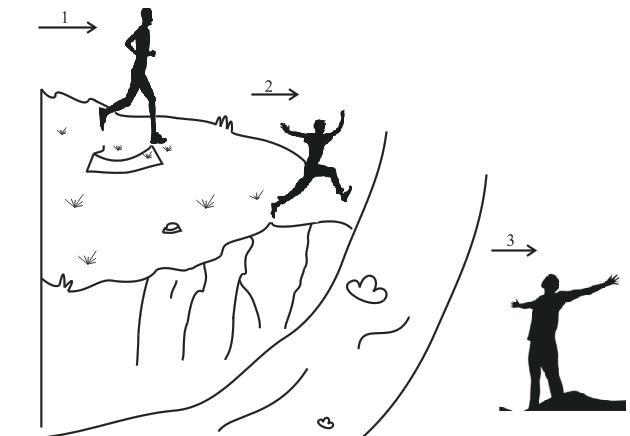
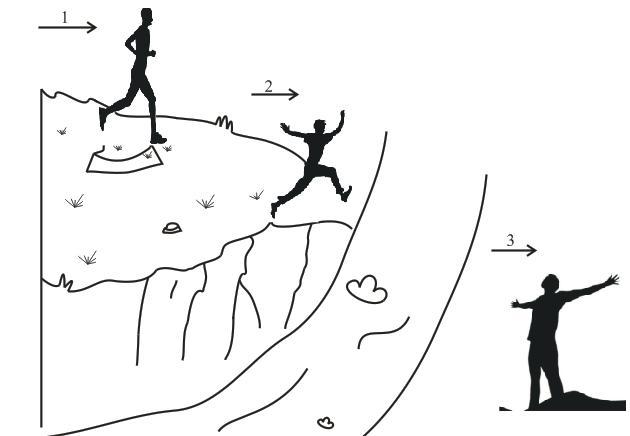
In 1780, in what is now referred to as "Brady's Leap," Captain Sam Brady of the U.S. Continental Army escaped certain death from

his enemies by running over the edge of the cliff above Ohio's Cuyahoga River in (Figure 1) , which is confined at that spot to a gorge. He landed safely on the far side of the river. It was reported that he leapt 22 ft (≈ 6.7 m) across while falling 20 ft (≈ 6.1 m).
What is the minimum speed with which he’d need to run off the edge of the cliff to make it safely to the far side of the river?

Express your answer to two significant figures and include the appropriate units.

Physics
2 answers:
zysi [14]2 years ago
7 0

The minimum speed with which Captain Brady had to run off the edge of the cliff to make it safely to the far side of the river is around 6 meters per second.

<h3>Further explanation</h3>

This is a free fall 2-dimensional type of problem, therefor we can write equations for both dimensions which model the fall of captain Brady. Let's call <em>x </em>the distance travelled by the captain on the horizontal direction and <em>y </em>the distance travelled on the vertical direction.

Lets suppose that Brady jumped with a complete horizontal velocity from a point which we will call the origin (meaning zero horizontal and vertical displacement), and let's call <em>ta</em> the time it took for captain Brady to reach the river (meaning the time he spent on the air). The equations of motion for the captain will be:

x= V \cdot t

y= - \frac{g \cdot t^2}{2}

We know that at time <em>ta</em> the captain would have traveled 6.7 m on the horizontal direction, and 6.1 m in the vertical direction. Therefor we can write that:

6.7= V \cdot ta

-6.1= - \frac{g \cdot {ta}^2}{2}

Which gives us a system of 2 equations and 2 unknowns (<em>V</em> and <em>ta</em>). From the second equation we can solve for <em>ta</em> as:

ta = \sqrt{\frac{2 \cdot 6.1}{g}} =1.12 s

And solving for <em>V</em> on the first equation, we find that:

V= \frac{6.7}{1.12} = 5.98 \frac{m}{s}

Which is almost 6 meters per second.

<h3>Learn more</h3>
  • Free fall of an arrow: brainly.com/question/1597396
  • Concept of free fall: brainly.com/question/1708231
<h3>Keywords</h3>

Free fall, projectile, gravity

melamori03 [73]2 years ago
5 0

The minimum speed with which the captain Sam Brady of the US continental army had to run off the edge of the cliff to make it safely to the far side of the river is \boxed{19.667\text{ ft/s}} or \boxed{5.998\text{ m/s}} or \boxed{6\text{ m/s}} or \boxed{599.8\text{ cm/s}}.

Further explanation:

As Captain Sam Brady jumps from the cliff, he moves in two dimension under the action of gravity.

Given:

The height of free fall of the captain Brady is 20\text{ ft} or 6.1\text{ m}.

The horizontal distance moved by the captain Brady is 22\text{ ft} or 6.7\text{ m}.

Concept:

The time required to free fall of a body can be calculated by using the expression given below.

\left( { - s}\right)=ut-\frac{1}{2}g{t^2}                                 ……. (1)

The displacement is considered negative because the captain is moving in vertically downward direction.

Here, s is the distance covered by the body in free fall, u is the initial velocity of the object, g is the acceleration due to gravity and t is the time taken in free fall of a body.  

As the Caption jumps off the cliff, he has his velocity in the horizontal direction. The velocity of the captain in vertical direction is zero.

Substitute 0 for u in the equation (1) .

s=\frac{1}{2}g{t^2}  

Rearrange the above expression for t.

\boxed{t=\sqrt {\frac{{2s}}{g}}}                                                              …… (2)  

Converting acceleration due to gravity in \text{ft}/\text{s}^2 .

\begin{aligned}g&=\left( {9.81\,{\text{m/}}{{\text{s}}^{\text{2}}}} \right)\left( {\frac{{1.0\,{\text{ft/}}{{\text{s}}^{\text{2}}}}}{{0.305\,{\text{m/}}{{\text{s}}^{\text{2}}}}}} \right) \\&=32.16\,{\text{ft/}}{{\text{s}}^{\text{2}}} \\ \end{aligned}

Substitute 20\text{ ft} for s and 32.16\,{\text{ft/}}{{\text{s}}^{\text{2}}} for g in equation (2) .

\begin{aligned}t&=\sqrt {\frac{{2\left( {20\,{\text{ft}}} \right)}}{{\left( {32.16\,{\text{ft/}}{{\text{s}}^{\text{2}}}} \right)}}} \\&=1.116\,{\text{s}} \\ \end{aligned}

Therefore, the time taken by captain to free fall a height 20\text{ ft} is 1.116\text{ s}.  

In the same time interval captain has to move 22\text{ ft} in horizontal direction. The acceleration is zero in horizontal direction. So, the velocity will be constant throughout the motion in the horizontal direction.

The distance travelled by captain in the horizontal direction is given by,

x=v\cdot t

Rearrange the above expression for v.  

\boxed{v=\dfrac{x}{t}}                                                      …… (3)  

Here, x is the distance travelled in horizontal direction, v is the velocity of the captain and t is the time.  

Substitute 22\text{ ft} for x and 1.116\text{ s} for t in equation (3) .

\begin{aligned}v&=\frac{{22\,{\text{ft}}}}{{1.116\,{\text{s}}}} \\&=19.71\,{\text{ft/s}} \\ \end{aligned}

Thus, the minimum speed with which the captain Sam Brady of the US continental army had to run off the edge of the cliff to make it safely to the far side of the river is \boxed{19.667\text{ ft/s}} or \boxed{5.998\text{ m/s}} or \boxed{6\text{ m/s}} or \boxed{599.8\text{ cm/s}}.

Learn more:

1. Energy density stored in capacitor brainly.com/question/9617400

2. Kinetic energy of the electrons brainly.com/question/9059731

3. Force applied by the car on truck brainly.com/question/2235246

Keywords:

Free fall, projectile, gravity, 1780, Brady’s, leap, Captain, Sam Brady, US, continental army, enemies, Ohio’s, Cuyahoga river, 22 ft, 6.7 m, 20 ft, 6.1 m, minimum speed, run off, edge, cliff, safely, far side, river, 19.71 ft/s, 6 m/s, 6 meter/s, 5.99 m/s, 599.8 cm/s.
You might be interested in
010) Identify the true statement. Group of answer choices The height of waves is determined by wind strength and fetch. Wave bas
AlekseyPX

Answer:

The height of the wave is determined by the wind strength and fetch.

Explanation:

The height of the wave is determined by the wind strength and fetch.

The more the strength and the more the fetch size the more will be the height of the wave.

Remember as the wave approaches the coast its wavelength decreases and the wave height increases, whereas when the wave goes away from the coast its wavelength increases and height decreases.

7 0
2 years ago
A 60-kg motor sits on four cylindrical rubber blocks. Each cylinder has a height of 3 cm and a cross-sectional area of 15 cm2. T
stealth61 [152]
<span>A.) If a sideways force of 300 N is applied to the motor, how far will it move sideways?</span>
3 0
2 years ago
Read 2 more answers
Which of the following selections completes the following nuclear reaction?
Monica [59]

Answer:

n (a neutron)

Explanation:

For a chemical element:

- The lower subscript indicates the atomic number (the number of protons)

- The upper subscript indicates the mass number (the sum of protons and neutrons in the nucleus)

In the reaction described in the problem, we see that a gamma photon hits a nucleus of Calcium-40, which has

Z = 20 (20 protons)

A = 40 (40 protons+neutrons)

Which means that the number of neutrons is n =  A - Z = 40 - 20 = 20

After the reaction, we have a nucleus of Calcium-39, which has

Z = 20 (20 protons)

A = 39 (39 protons+neutrons)

Which means that the number of neutrons is n =  A - Z = 40 - 39 = 19

So, the nucleus has lost 1 neutron, which is the particle missing in the reaction.

3 0
2 years ago
A charged paint is spread in a very thin uniform layer over the surface of a plastic sphere of diameter 13.0 cm , giving it a ch
Leokris [45]

a) Electric field inside the paint layer: zero

b) Electric field just outside the paint layer: -3.62\cdot 10^7 N/C

c) Electric field 8.00 cm outside the paint layer: -7.27\cdot 10^7 N/C

Explanation:

a)

We can find the electric field inside the paint layer by applying Gauss Law: the total flux of the electric field through a gaussian surface is equal to the charge contained within the surface divided by the vacuum permittivity, mathematically:

\int EdS = \frac{q}{\epsilon_0}

where

E is the electric field

dS is the element of surface

q is the charge within the gaussian surface

\epsilon_0 = 8.85\cdot 10^{-12}F/m is the vacuum permittivity

Here we want to find the electric field just inside the paint layer, so we take a sphere of radius r as Gaussian surface, where

R = 6.5 cm = 0.065 m is the radius of the plastic sphere (half the diameter)

By taking the sphere of radius r, we note that the net charge inside this sphere is zero, therefore

q=0

So we have

\int E dS=0

which means that the electric field inside the paint layer is zero.

b)

Now we want to find the electric field just outside the paint layer: therefore, we take a Gaussian sphere of radius

r=R=0.065 m

The area of the surface is

A=4\pi R^2

And since the electric field is perpendicular to the surface at any point, Gauss Law becomes

E\cdot 4\pi R^2 = \frac{q}{\epsilon_0}

The charge included within the sphere in this case is the charge on the paint layer, therefore

q=-17.0\mu C=-17.0\cdot 10^{-6}C

So, the electric field is:

E=\frac{q}{4\pi \epsilon_0 R^2}=\frac{-17.0\cdot 10^{-6}}{4\pi(8.85\cdot 10^{-12})(0.065)^2}=-3.62\cdot 10^7 N/C

where the negative sign means the direction of the field is inward, since the charge is negative.

c)

Here we want to calculate the electric field 8.00 cm outside the surface of the paint layer.

Therefore, we have to take a Gaussian sphere of radius:

r=8.00 cm + R = 8.00 + 6.50 = 14.5 cm = 0.145 m

Gauss theorem this time becomes

E\cdot 4\pi r^2 = \frac{q}{\epsilon_0}

And the charge included within the sphere is again the charge on the paint layer,

q=-17.0\mu C=-17.0\cdot 10^{-6}C

Therefore, the electric field is

E=\frac{q}{4\pi \epsilon_0 r^2}=\frac{-17.0\cdot 10^{-6}}{4\pi(8.85\cdot 10^{-12})(0.145)^2}=-7.27\cdot 10^7 N/C

Learn more about electric field:

brainly.com/question/8960054

brainly.com/question/4273177

#LearnwithBrainly

5 0
2 years ago
An orange of mass 3kg falls from a height 50m. When its height is H, its speed is
MArishka [77]

Answer:

(10 m/s²) (50 m) = (10 m/s²) H + ½ (4 m/s)²

Explanation:

Initially, the orange has only gravitational potential energy.

As the orange falls, it has a combination of potential energy and kinetic energy.

Energy is conserved, so initial energy = final energy:

PE₀ = PE + KE

mgH₀ = mgH + ½ mv²

gH₀ = gH + ½ v²

Plugging in values:

(10 m/s²) (50 m) = (10 m/s²) H + ½ (4 m/s)²

8 0
2 years ago
Other questions:
  • A car starts from rest and accelerates along a straight line path in one minute. It finally attains a velocity of 40 meters/seco
    6·1 answer
  • The Sun is the primary source of energy for ecosystems. The Sun emits . When an organism obtains nutrients by feeding on other o
    7·2 answers
  • Two red blood cells each have a mass of 9.05×10⁻¹⁴ kg and carry a negative charge spread uniformly over their surfaces. The repu
    9·1 answer
  • What affects the way a projectile performs when it is shot from a firearm?
    10·2 answers
  • If an irregularly shaped object (such as a wrench) is dropped from rest in a classroom and feels no air resistance, it will:
    6·1 answer
  • A car rolls down a ramp in a parking garage. The horizontal position of the car in meters over time is shown below. Graph of ver
    11·1 answer
  • An object traveling in a circular path is accelerating because its
    14·1 answer
  • Janice is unsure about her future career path. She has grown up on her family farm, but she is also interested in medicine. Jani
    9·2 answers
  • In the year 2090, and Burt is still alive! Well, he’s really just a brain connected to a “life machine.” Since Burt has no body,
    7·1 answer
  • 3. The expression 0.62 x10^3 is equivalent to...
    8·2 answers
Add answer
Login
Not registered? Fast signup
Signup
Login Signup
Ask question!
