answer.
Ask question
Login Signup
Ask question
All categories
  • English
  • Mathematics
  • Social Studies
  • Business
  • History
  • Health
  • Geography
  • Biology
  • Physics
  • Chemistry
  • Computers and Technology
  • Arts
  • World Languages
  • Spanish
  • French
  • German
  • Advanced Placement (AP)
  • SAT
  • Medicine
  • Law
  • Engineering
alisha [4.7K]
2 years ago
14

Good X is produced in a competitive market using input A. Explain what would happen to the supply of good X in each of the follo

wing situations: a. The price of input A decreases. It will not change. It will increase. It will decrease. b. An excise tax of $3 is imposed on good X. It will increase. It will not change. It will decrease. c. An ad valorem tax of 7 percent is imposed on good X. It will increase. It will decrease. It will not change. d. A technological change reduces the cost of producing additional units of good X. It will increase. It will not change. It will decrease.
Business
1 answer:
a_sh-v [17]2 years ago
3 0

Answer:

a. It will increase.

b. It will decrease

c. It will decrease

d. it will increase.

Explanation:

If the price of an input needed for production of good X decreases, the cost of production of good X reduces. It becomes cheaper to produce good X and and as a result the supply of good X would increase.

An increase in tax increases the cost of production and makes production of good X more expensive. As a result, the supply of good X would fall.

technological change that reduces the cost of producing additional units of good X, would make the production of good X less expensive. As a result, the supply of good X would increase

You might be interested in
At the end of its first year of operations, shapiro's consulting services reported net income of $27,000. they also had account
Otrada [13]
Answer: $11,200

Explanation:

Using the accounting equation:

(Total Assets) = (Total Liabilities) + (Total Capital)

So,

(Total Liabilities) = (Total Assets) - (Total Capital)    (1)

Based on equation (1), in order to compute for the total liability, we need to compute the total assets and total capital.

At the end of the first year, the following are the assets Shapiro's consulting services (together with the amount):

Cash:                              $16,000
Office Supplies:                $3,200
Equipment:                     $24,000
Accounts Receivable:       $8,000
TOTAL ASSETS            $51,200

Note that the total assets is obtained by adding the amount (or value) of the all the assets listed above.

Since the net income is an increase (or decrease if it's a net loss) of capital, we classify net income as capital. In particular, the net income of Shairo's at the end of first year adds to the capital at the start of first year. 

Moreover, the withdrawal of money by the owner also decreases the capital.  

Thus, the total capital at the end of first year is calculated as follows:

Capital (start of the year):            $15,000
Net Income (end of year):           $27,000   
Withdrawal Amount:                    ($2,000)
TOTAL CAPITAL:                       $40,000

Note: ($2,000) means -$2,000. This notation is used in accounting.

Hence using equation (1), the total liabilities at the end of first year is given by

(Total Liabilities) = (Total Assets) - (Total Capital)
                           = $51,200 - $40,000
Total Liabilities = $11,200

7 0
2 years ago
In order to generate the desired workforce skill, competencies, and behaviors that a firm needs to achieve its strategic goals,
nordsb [41]

Answer:

In order to generate the desired workforce skill, competencies, and behaviors that a firm needs to achieve its strategic goals, human resource management must first develop <u>HR policies</u>

Explanation:

Human resources (HR) policies are policies put in place as a form of guidance and protection for every worker within an organization.

When the issues that may arise among workers are sorted via HR policies, company can achieve its strategic goals effectively.

These policies include:

  1. At-will employment
  2. Anti-harassment and non-discrimination
  3. Employment classifications
  4. Leave and time off benefits
  5. Meal and break periods
  6. Timekeeping and pay
  7. Safety and health
  8. Employee conduct, attendance and punctuality
6 0
2 years ago
Read 2 more answers
Jamison Paints makes and sells paint to home improvement stores. Jamison's only plant can produce up to 12 million cans of paint
Olin [163]

Answer:

Jamison's current total cost of making and selling 10 million cans of paint is $75,000,000 and the current cost per can of paint is $7.5

Explanation:

For computing the current total cost, we need to apply the formula which is shown below:

Total cost = Fixed cost + variable cost

where,

Fixed cost = $15,000,000

And, the variable cost = Annual production × variable cost per plant

                                     = 10,000,000 × $6

                                     = $60,000,000

Now put these values to the above formula  

So, the value would equal to

= $15,000,000 + $60,000,000

= $75,000,000

Now the current cost per can of paint would be

= (Total cost) ÷ (Annual production)

= ($75,000,000) ÷ (10,000,000)

= $7.5 per can of paint

3 0
2 years ago
An artist who uses a spontaneous, less fussy approach to painting can be said to be using the ____________ technique
Scilla [17]
The technique that the artist is using could be described as the alla prima technique in which it is often used in paintings such as the oil paintings. It is a painting technique that uses wet paint to be able to give out its spontaneous and fuzzy look. The wet paints that are being applied to the portrait has many layers to show its structure or the beauty of the technique.
3 0
2 years ago
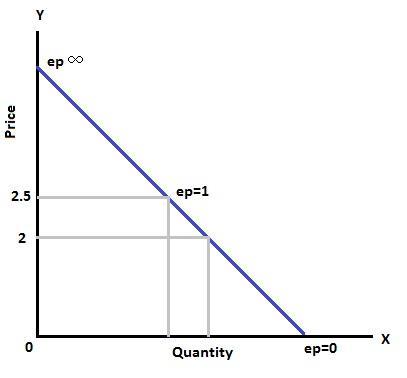
Assume that when the price of cantaloupes is $2.50 the demand for cantaloupes is unit-elastic, and that the demand curve for can
Maru [420]

Answer:

The correct answer is option A.

Explanation:

The demand for cantaloupes is unitary elastic at price level $2.50. The demand curve here is linear and downward sloping. The elasticity of demand is 1.

In this linear demand curve the lower portion will represent inelastic demand.

When the price level is reduced to $2 the demand will move to the lower portion of the curve, with fall in price and increase in demand.

So, at $2 price the demand will be inelastic, which means it will be between 0 and 1.

4 0
2 years ago
Other questions:
  • Hugh has the choice between investing in a city of heflin bond at 6.60 percent investing in a surething bond at 10.00 percent. a
    8·1 answer
  • Shelly works as a call-center employee from inside her home. The company she works for does not mind that she works from home be
    10·1 answer
  • The journal entry to issue $ 600 of direct materials and $ 40 of indirect materials to production involves​ debit(s) to the​ ___
    11·1 answer
  • At the beginning of the year, Monroe Company estimates annual overhead costs to be $2400000 and that 300000 machine hours will b
    14·1 answer
  • Jorge Cabrera paid $980 for a 15-year bond 10 years ago. The bond pays a coupon of 10 percent semiannually. Today, the bond is p
    14·1 answer
  • Thomson Co. produces and distributes semiconductors for use by computer manufacturers. Thomson issued $800,000 of 10-year, 6% bo
    12·1 answer
  • The contribution margin ratio of Kuck Corporation's only product is 75%. The company's monthly fixed expense is $456,000 and the
    5·1 answer
  • Hardy Inc. has two operating departments (1 and 2) and is considering renting a new machine to help automate the printing proces
    15·1 answer
  • Davis Florist has two employees, Anita and Jerome, and two tasks that need to be completed, floral arrangements and floral deliv
    13·1 answer
  • Abigail has an inheritance tax lien placed on all of her property. What kind of a lien is it?
    14·1 answer
Add answer
Login
Not registered? Fast signup
Signup
Login Signup
Ask question!