answer.
Ask question
Login Signup
Ask question
All categories
  • English
  • Mathematics
  • Social Studies
  • Business
  • History
  • Health
  • Geography
  • Biology
  • Physics
  • Chemistry
  • Computers and Technology
  • Arts
  • World Languages
  • Spanish
  • French
  • German
  • Advanced Placement (AP)
  • SAT
  • Medicine
  • Law
  • Engineering
Triss [41]
2 years ago
11

Question 1/5

Engineering
1 answer:
erastova [34]2 years ago
6 0
It’s between D and C
You might be interested in
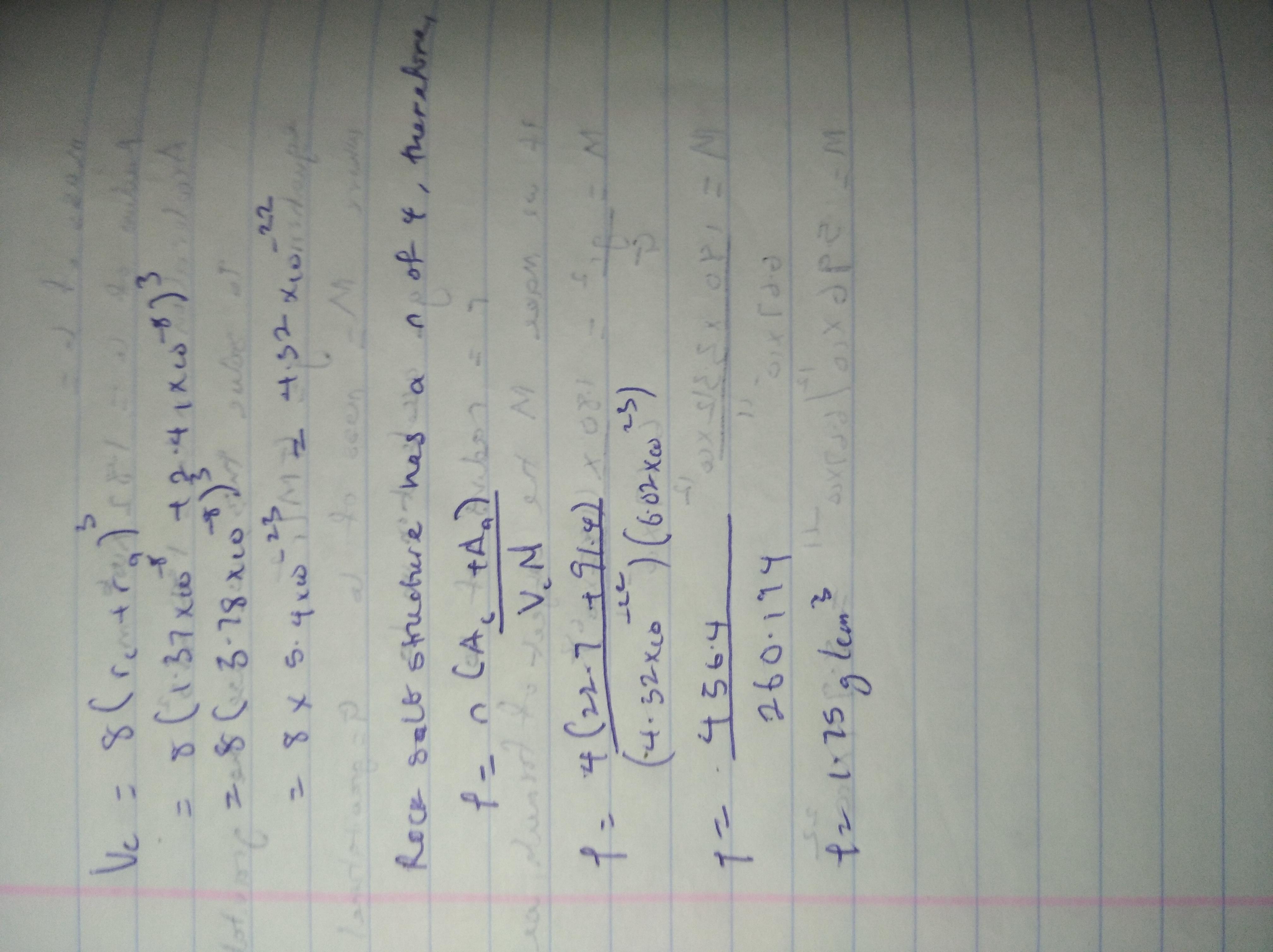
An AX ceramic compound has the rock salt crystal structure. If the radii of the A and X ions are 0.137 and 0.241 nm, respectivel
Tju [1.3M]

Answer:

c) 1.75 g/cm³

Explanation:

Given that

Radii of the A ion, r(c) = 0.137 nm

Radii of the X ion, r(a) = 0.241 nm

Atomic weight of the A ion, A(c) = 22.7 g/mol

Atomic weight of the X ion, A(a) = 91.4 g/mol

Avogadro's number, N = 6.02*10^23 per mol

Solution is attached below

3 0
2 years ago
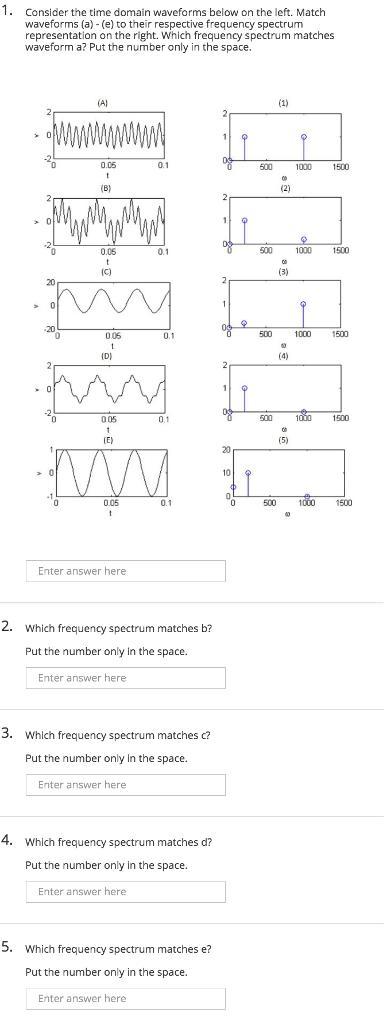
Consider the time domain waveforms below on the left. Match waveforms (a) - (e) to their respective frequency spectrum represent
lozanna [386]

Answer:

(a) ------(3). (b)------(1) (c)-----(5) (d)------(2) ------ (e) -----4

Note: Kindly find an attached copy of the diagram associated with the solution to the question below.

Sources: the diagram to this question was researched from Quizlet

Explanation:

Solution

(1) Part (a)a waveform has a high frequency components compared to another waveform. the corresponding frequency components should be high.

So for the wave form a  the corresponding frequency spectrum is (3)

(2) For part (b), waveform has three harmonics, the corresponding frequency spectrum is (1)

(3) The time domain waveform plot (c) is a sine wave but there exists a dc component.

Thus x[0] ≠0

For (c) the corresponding frequency spectrum is (5)

(4) For part (d) the corresponding frequency spectrum is (2)

(5) A sine wave is made of a single frequency only and its spectrum is a single point

For (e) the corresponding frequency spectrum is (4)

3 0
2 years ago
A mass of 12 kg saturated refrigerant-134a vapor is contained in a piston-cylinder device at 240 kPa. Now 300 kJ of heat is tran
Ket [755]

Answer:

I = 12.706 Amps

Explanation:

Given:

- The mass of saturated R-134a m = 12 kg

- The initial Conditions

      P_1 = 240 KPa

      Saturated Vapor

- The final Conditions

      P_2 = 240 KPa

      T_2 = 70° C

- The amount of Heat transferred Q_in = 300 KJ

- The voltage of current source V = 110 V

- The current supplied by the source = I

- The time duration Δt = 6 min

Find:

Determine the current supplied I.

Solution:

- Look-up enthalpies h_1 and h_2 at both states using Tables A-11 and A-13.

       P_1 = 240 KPa    

       Saturated Vapor ----------> h_1 = h_g = 247.32 KJ/kg

       P_2 = 240 KPa

       T_2 = 70° C        ----------> h_2 = 314.53 KJ/kg

- Using First Thermodynamic Law, set up an energy balance:

                           E_in - E_out = ΔE_system

                           Q_in + W_electric,in - W_out = Δ U

                           Q_in + V*I*Δt - W_out = Δ U

                           Q_in + V*I*Δt = Δ H

                           Q_in + V*I*Δt = m*( h_2 - h_1 )

- Make the current I the subject of the expression above:

                            V*I*Δt = m*( h_2 - h_1 ) - Q_in

                            I = [ m*( h_2 - h_1 ) - Q_in ] / V*Δt

- Plug in the values in the expression derived above and evaluate current of source I:

                            I = [ 12*( 314.53 - 247.32 ) - 300 ]*1000 / 110*6*60

                            I = 12.706 Amps                              

- The required source of current is I = 12.706 Amps.

4 0
2 years ago
For a bolted assembly with eight bolts, the stiffness of each bolt is kb = 1.0 MN/mm and the stiffness of the members is km = 2.
rjkz [21]

Answer:

a) 0.978

b) 0.9191

c) 1.056

d) 0.849

Explanation:

Given data :

Stiffness of each bolt = 1.0 MN/mm

Stiffness of the members = 2.6 MN/mm per bolt

Bolts are preloaded to 75% of proof strength

The bolts are M6 × 1 class 5.8 with rolled threads

Pmax =60 kN,  Pmin = 20kN

<u>a) Determine the yielding factor of safety</u>

n_{p} = \frac{S_{p}A_{t}  }{CP_{max}+ F_{i}  }  ------ ( 1 )

Sp = 380 MPa,   At = 20.1 mm^2,   C = 0.277,  Pmax = 7500 N,  Fi = 5728.5 N

Input the given values into the equation above

equation 1 becomes ( np ) = \frac{380*20.1}{0.277*7500*5728.5} = 0.978

note : values above are derived values whose solution are not basically part of the required solution hence they are not included

<u>b) Determine the overload factor of safety</u>

n_{L} =  \frac{S_{p}A_{t}-F_{i}   }{C(P_{max} )}  ------- ( 2 )

Sp =  380 MPa,   At =  20.1 mm^2, C = 0.277,  Pmax = 7500 N,  Fi = 5728.5 N

input values into equation 2 above

hence : n_{L} = 0.9191n_{L}  = 0.9191

<u>C)  Determine the factor of safety based on joint separation</u>

n_{0} = \frac{F_{i} }{P_{max}(1 - C ) }

Fi =  5728.5 N,  Pmax = 7500 N,  C = 0.277,

input values into equation above

Hence n_{0} = 1.056

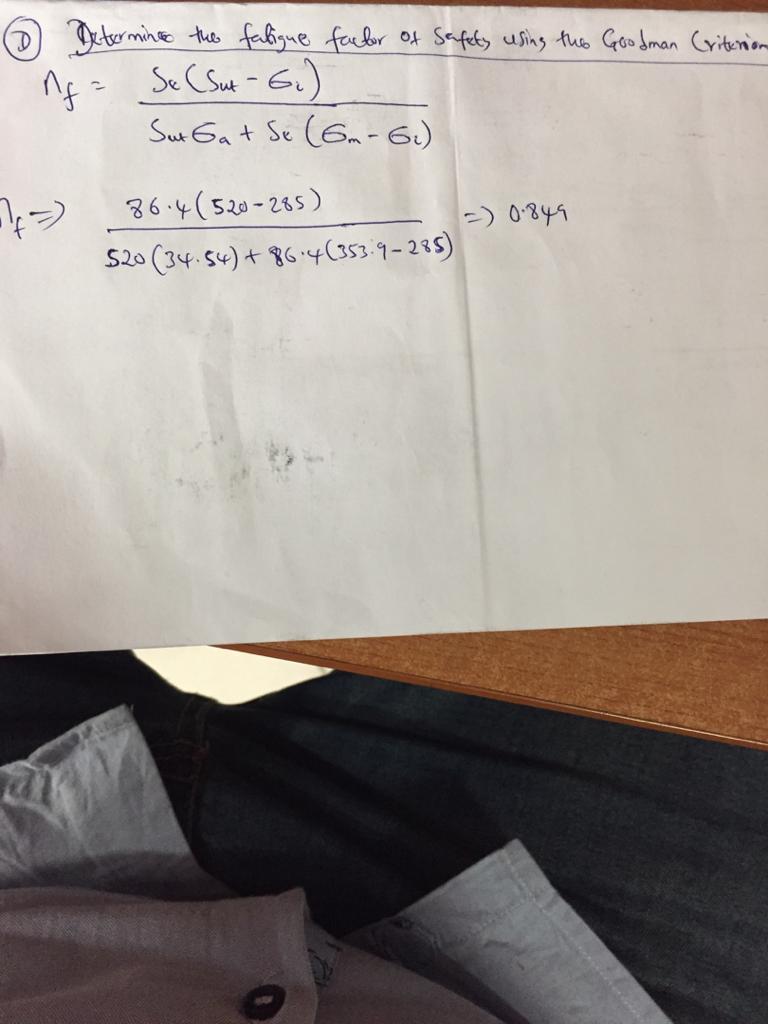
<u>D)  Determine the fatigue factor of safety using the Goodman criterion.</u>

nf = 0.849

attached below is the detailed solution .

4 0
1 year ago
Determine the angular acceleration of the uniform disk if (a) the rotational inertia of the disk is ignored and (b) the inertia
lukranit [14]

Answer:

α = 7.848 rad/s^2  ... Without disk inertia

α = 6.278 rad/s^2  .... With disk inertia

Explanation:

Given:-

- The mass of the disk, M = 5 kg

- The right hanging mass, mb = 4 kg

- The left hanging mass, ma = 6 kg

- The radius of the disk, r = 0.25 m

Find:-

Determine the angular acceleration of the uniform disk without and with considering the inertia of disk

Solution:-

- Assuming the inertia of the disk is negligible. The two masses ( A & B )  are hung over the disk in a pulley system. The disk is supported by a fixed support with hinge at the center of the disk.

- We will make a Free body diagram for each end of the rope/string ties to the masses A and B.

- The tension in the left and right string is considered to be ( T ).

- Apply newton's second law of motion for mass A and mass B.

                      ma*g - T = ma*a

                      T - mb*g = mb*a

Where,

* The tangential linear acceleration ( a ) with which the system of two masses assumed to be particles move with combined constant acceleration.

- g: The gravitational acceleration constant = 9.81 m/s^2

- Sum the two equations for both masses A and B:

                      g* ( ma - mb ) = ( ma + mb )*a

                      a =  g* ( ma - mb ) / ( ma + mb )

                      a = 9.81* ( 6 - 4 ) / ( 6 + 4 ) = 9.81 * ( 2 / 10 )

                      a = 1.962 m/s^2  

- The rope/string moves with linear acceleration of ( a ) which rotates the disk counter-clockwise in the direction of massive object A.

- The linear acceleration always acts tangent to the disk at a distance radius ( r ).

- For no slip conditions, the linear acceleration can be equated to tangential acceleration ( at ). The correlation between linear-rotational kinematics is given below :

                     a = at = 1.962 m/s^2

                     at = r*α      

Where,

           α: The angular acceleration of the object ( disk )

                    α = at / r

                    α = 1.962 / 0.25

                    α = 7.848 rad/s^2                                

- Take moments about the pivot O of the disk. Apply rotational dynamics conditions:


                Sum of moments ∑M = Iα

                 ( Ta - Tb )*r = Iα

- The moment about the pivots are due to masses A and B.


               Ta: The force in string due to mass A

               Tb: The force in string due to mass B

                I: The moment of inertia of disk = 0.5*M*r^2

                   ( ma*a - mb*a )*r = 0.5*M*r^2*α

                   α = ( ma*a - mb*a ) / ( 0.5*M*r )

                   α = ( 6*1.962 - 4*1.962 ) / ( 0.5*5*0.25 )

                   α = ( 3.924 ) / ( 0.625 )

                   α = 6.278 rad/s^2

6 0
2 years ago
Other questions:
  • Another focus of effective communication, according to Stephen Covey, is ensuring that:
    10·2 answers
  • A simple supported beam at x0 = 0 and xn = L with a uniform load w and the
    15·2 answers
  • Rewrite the following nested if-else statement as a switch statement that accomplishes exactly the same thing. Assume that num i
    6·1 answer
  • 2. Determine the surface area of a primary settling tank sized to handle a maximum hourly flow of 0.570 m3/s at an overflow rate
    13·2 answers
  • 3. Consider a 10-m-long smooth rectangular tube, with a = 50 mm and b=25 mm, that is maintained at a constant surface temperatur
    5·1 answer
  • A plate of an alloy steel has a plane-strain fracture toughness of 50 MPa√m. If it is known that the largest surface crack is 0.
    12·1 answer
  • Compute the sum with carry-wraparound (sometimes called the one's complement sum) of the following two numbers. Give answer in 8
    15·1 answer
  • an adiabatic compressor receives 1.5 meter cube per second of air at 30 degrees celsius and 101 kpa. The discharge pressure is 5
    11·1 answer
  • Toeboards are usually ___ inches high and used on landings and balconies.
    8·1 answer
  • A spherical pressure vessel is formed of 16-gauge (0.0625-in) cold-drawn AISI 1020 sheet steel. If the vessel has a diameter of
    10·1 answer
Add answer
Login
Not registered? Fast signup
Signup
Login Signup
Ask question!